Periodontics · instrument guide
Periodontists and dental hygienists work with a small set of instrument families: instruments to assess, instruments to scale and root-plane, instruments for implants, and a surgical set for flap and plastic surgery. This guide shows each one with a picture, its other names and what it is used for.
The basic hand instruments in periodontics are the mouth mirror, periodontal probe, explorer, sickle scaler, universal curette and Gracey curettes. Periodontists add ultrasonic scalers, implant-safe curettes and surgical instruments such as periodontal knives, periosteal elevators, micro scissors and micro needle holders.
The 7 groups of periodontal instruments
Periodontology textbooks group the instruments by purpose. Hand instruments cover groups 1, 2, 3, 5 and 7; the rest are power-driven or polishing tools.
| Group | Instruments | What they are for |
|---|---|---|
| 1. Periodontal probes | UNC / CP-12 / CP-15, Williams, WHO, Nabers | Measure pocket depth, attachment loss and furcations |
| 2. Explorers | Explorer 23, 3A, 11/12 ODU | Detect calculus and root irregularities by touch |
| 3. Scaling & root planing instruments | Sickle scalers, curettes, hoes, files, chisels | Remove calculus and biofilm; smooth the root |
| 4. Ultrasonic & sonic scalers | Power-driven tips | Fast debridement of calculus and biofilm |
| 5. Implant instruments | Titanium or non-metal curettes and tips | Clean implant surfaces without scratching |
| 6. Cleaning & polishing | Rubber cups, brushes, air polishing | Remove stain and biofilm after scaling |
| 7. Surgical instruments | Periodontal knives, periosteal elevators, micro scissors, needle holders, bone files | Flap surgery, gingivectomy, grafting and suturing |
5 instruments
Assessment instruments
Every periodontal visit starts by measuring. These instruments find pockets, bleeding, calculus and furcations before any treatment decision.
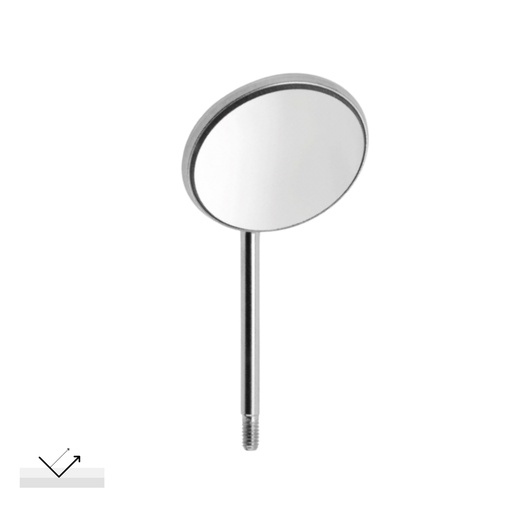 Mouth mirrorNo. 4 / No. 5 mirrorIndirect vision, light and retraction of cheek and tongue.View instrument →
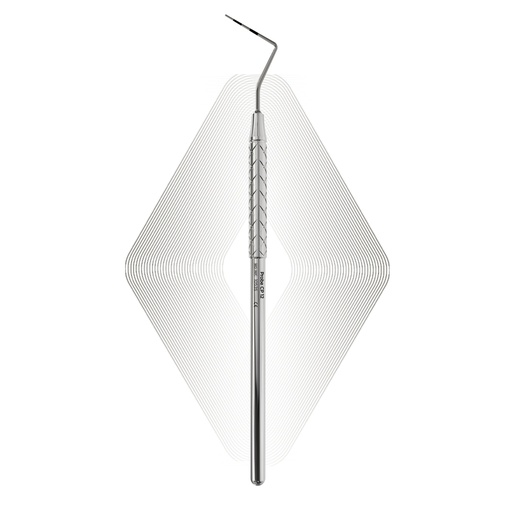 Periodontal probe (CP-12)UNC-type probe, pocket probeMeasures probing depth and clinical attachment loss in millimetres.View instrument →
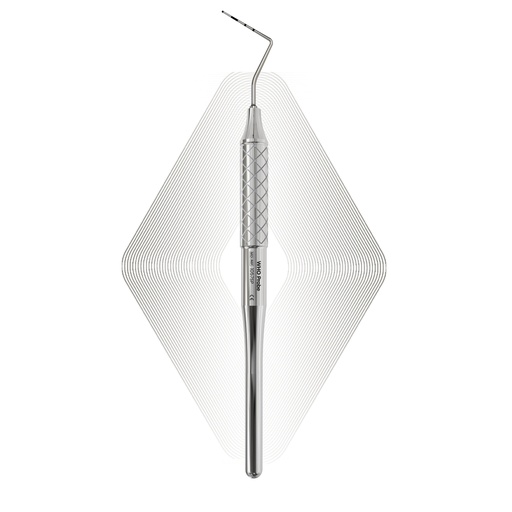 WHO probeCPITN / BPE / PSR probe0.5 mm ball end and 3.5–5.5 mm band for periodontal screening.View instrument →
 Nabers probeFurcation probeCurved probe that detects and grades furcation involvement.View instrument →
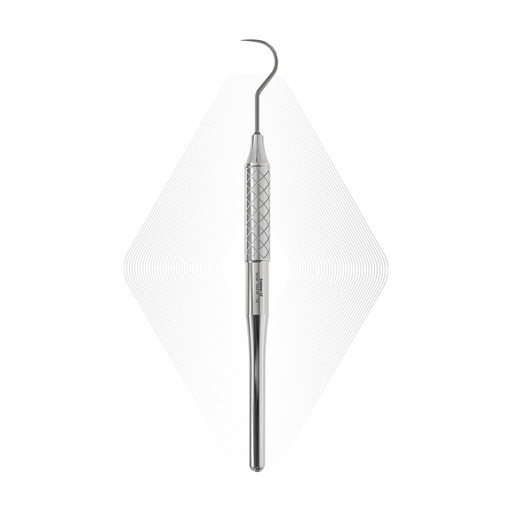 Explorer 23Shepherd's hookFeels subgingival calculus and root irregularities by touch.View instrument →
3 instruments
Scalers
Scalers remove calculus. They have a pointed or straight working end and work mainly above the gumline or just below it.
 Sickle scaler H6/H7Anterior sickleTriangular blade for supragingival calculus on anterior teeth.View instrument →
 Sickle scaler 204SDPosterior sickleContra-angled sickle for interproximal calculus on premolars and molars.View instrument →
 Hoe scalerPeriodontal hoePull stroke for heavy, ledge-type calculus on accessible surfaces.View instrument →
8 instruments
Curettes
Curettes have a rounded toe and back, so they can go below the gumline for subgingival debridement and root planing. This is the core of non-surgical periodontal therapy.
 Universal curette M23AUniversal scaler / curetteTwo cutting edges; one instrument adapts to every tooth surface.View instrument →
 Columbia 4R/4LUniversal curetteClassic universal curette for subgingival scaling in all regions.View instrument →
 Gracey 1-2Area-specific curetteAnterior teeth.View instrument →
 Gracey 5-6Area-specific curetteAnterior teeth and premolars.View instrument →
 Gracey 11-12Area-specific curettePosterior teeth, mesial surfaces.View instrument →
 Gracey 13-14Area-specific curettePosterior teeth, distal surfaces.View instrument →
 Mini Gracey 11-12Mini-five curetteShorter blade for deep, narrow pockets and furcations.View instrument →
 Langer 1-2Gracey-shank universalGracey shank with a universal blade for lower posterior teeth.View instrument →
1 instrument
Implant maintenance
Implant surfaces scratch easily. Periodontists and hygienists use titanium or non-metal working ends around implants.

8 instruments
Periodontal surgery instruments
These are the instruments that set a periodontist's tray apart: flap surgery, gingivectomy, grafting and suturing.
 Kirkland knifeGingivectomy knifeKidney-shaped blade for gingivectomy and gingival contouring.View instrument →
 Tunneling knifeTunnel elevatorUndermines soft tissue for tunnel techniques in recession coverage.View instrument →
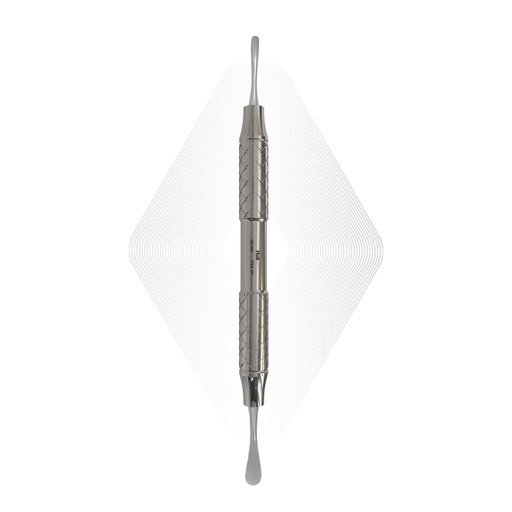 Periosteal elevator (Molt)Molt 9 / NordbergLifts the mucoperiosteal flap from the bone.View instrument →
 Surgical tweezer 1:2Tissue forcepsHolds the flap without slipping.View instrument →
 Goldman-Fox scissorsPeriodontal scissorsTrims tissue tags and flap margins.View instrument →
 La Grange scissorsGum scissors, double-curvedDouble-curved blades for trimming gingival tissue.View instrument →
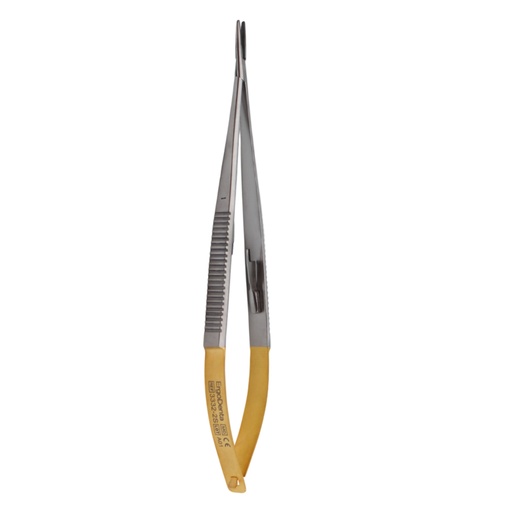 Castroviejo micro needle holderMicro needle holderHolds fine sutures (6-0 and finer) in microsurgery.View instrument →
 Bone fileHoward bone fileSmooths bone margins during osseous surgery.View instrument →
What are the basic hand instruments used in periodontics?
A basic periodontal set covers assessment, calculus removal and root planing in every region of the mouth. Most clinics and dental schools start with these six:
| Instrument | Why it is in the basic set |
|---|---|
| Mouth mirror | Vision, light and retraction on every surface |
| Periodontal probe | Charting pocket depth and bleeding (a WHO probe for screening) |
| Explorer | Checking for residual calculus after scaling |
| Sickle scaler | Supragingival and interproximal calculus |
| Universal curette | One instrument for sub- and supragingival work in every region |
| Gracey curettes | Area-specific root planing, typically 5-6, 11-12 and 13-14 (plus 1-2 or 7-8) |
Which Gracey curette goes where?
Gracey curettes are area-specific: each pair is designed for particular teeth and surfaces. Odd and even numbers are mirror images of each other.
| Gracey | Area of use |
|---|---|
| 1-2, 3-4 | Anterior teeth |
| 5-6 | Anterior teeth and premolars |
| 7-8, 9-10 | Posterior teeth, buccal and lingual surfaces |
| 11-12 | Posterior teeth, mesial surfaces |
| 13-14 | Posterior teeth, distal surfaces |
Quick rule: probes measure, explorers feel, scalers work above the gumline, curettes work below it. More detail in our Gracey numbering guide, universal vs Gracey curette and periodontal probes guide.
Periodontist vs hygienist: what is different?
Hygienists and periodontists share the same assessment and scaling instruments. The difference is in the surgical tray. Periodontists treat deep residual pockets, bone defects and recession surgically, so they add periodontal knives, tunneling knives, periosteal elevators, micro scissors, micro needle holders and fine sutures, and often work under loupes or a microscope.
Instrument choice also follows the diagnosis. How far the disease has progressed decides whether scaling and root planing is enough or surgery is needed. Read more in Types of periodontitis: stages, grades and can it be cured?
Build your periodontal set
Every ErgoDenta perio pattern comes on several handles: ErgoX®, ErgoX® Plus, ErgoLite and ErgoSteel. Or start with a ready-made kit.
Questions
Frequently asked questions
What instruments do periodontists use?
Periodontists use assessment instruments (mouth mirror, periodontal probes, Nabers furcation probe, explorer), scalers and curettes for non-surgical therapy (sickle scalers, universal and Gracey curettes, ultrasonic scalers), implant-safe curettes, and a surgical set: periodontal knives, periosteal elevators, tissue forceps, micro scissors, micro needle holders and bone files.
What are the instruments used in periodontology?
Periodontal instruments are usually grouped into seven types: periodontal probes, explorers, scaling and root planing instruments (sickles, curettes, hoes, files, chisels), ultrasonic and sonic scalers, implant instruments, cleaning and polishing instruments, and surgical instruments.
What are the basic hand instruments used in periodontics?
The basic set is a mouth mirror, a periodontal probe, an explorer, a sickle scaler, a universal curette and a few Gracey curettes, typically 5-6, 11-12 and 13-14. Together they cover assessment, calculus removal and root planing in every region.
What is the difference between a scaler and a curette?
A scaler has a pointed tip and a triangular cross-section and is used mainly for calculus above the gumline. A curette has a rounded toe and back, so it can go below the gumline and adapt to the root surface without injuring the soft tissue.
How many Gracey curettes do I need?
Most clinicians work with three or four: Gracey 5-6 for anteriors and premolars, 11-12 for posterior mesial surfaces, 13-14 for posterior distal surfaces, and optionally 1-2 or 7-8. Mini Graceys are added for deep, narrow pockets.