Universal Curette vs Gracey Curette — when to reach for which
Two periodontal workhorses, two very different jobs. The 90° universal handles routine prophy and light subgingival work; the 70° area-specific Gracey takes over for deep pockets and definitive root planing. Here's how to tell them apart at the chair.
Both Universal and Gracey curettes have been part of periodontal therapy for decades, but they're built for different clinical situations. The geometry tells the story — once you can read the blade, the choice at the chair becomes obvious. This guide walks through the engineering, the clinical decision points, and the full ErgoDenta range of both.
The headline difference — 90° vs 70°
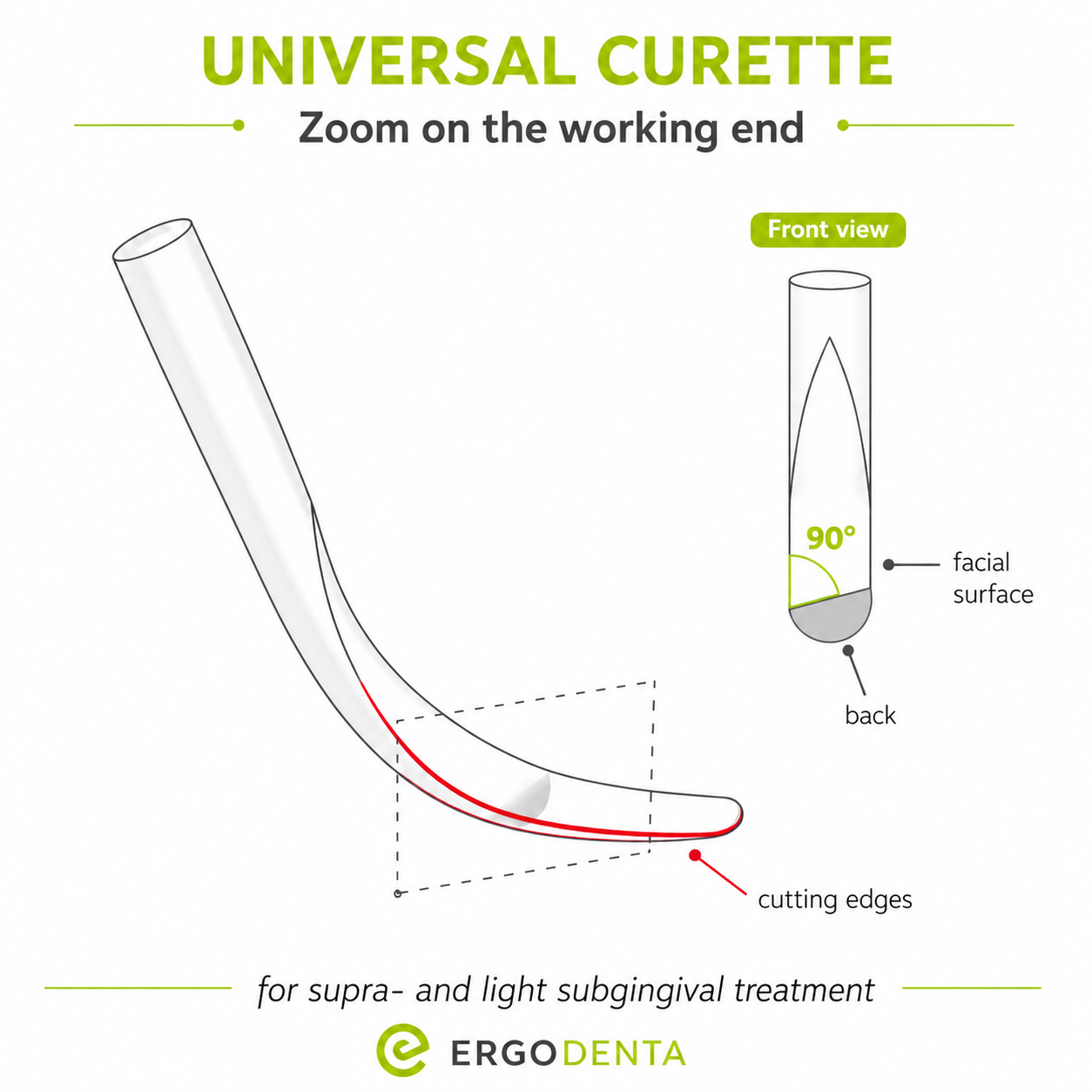
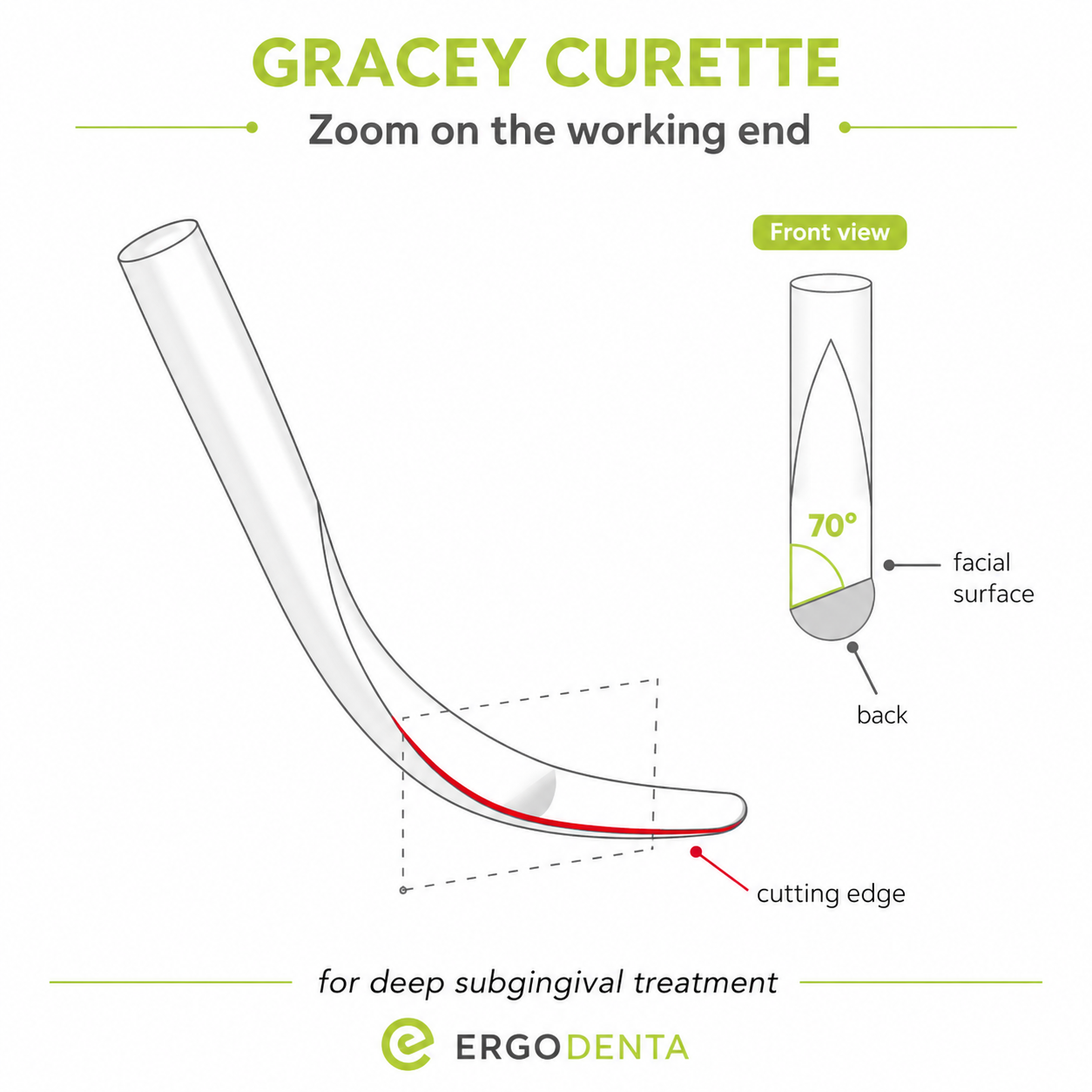
The simplest way to tell a Universal from a Gracey is to look at the working end straight on. A Universal curette presents a blade face that sits perpendicular to the lower shank — a clean 90° angle. A Gracey curette tilts the blade face forward by twenty degrees, giving an offset 70° angle. That single geometric choice cascades into everything else: how the blade adapts, how deep it can safely go, and which edge does the cutting.
One edge or two — and why it matters
Look at the side view of each blade and the second difference becomes visible. The Universal has both upper and lower edges sharpened — both make contact with the tooth at usable angles, so a single instrument adapts to many surfaces in the same area. Flip the curette over and the other edge does the work.
The Gracey has only the lower edge sharpened. The upper edge sits at an unfavourable angle to the tooth and is left blunt by design. This is not an oversight — it's what makes the Gracey safe for subgingival use. The blunt upper edge can rest against the soft tissue wall of the periodontal pocket without lacerating, while the sharp lower edge does the calculus removal against the root.
This is also why Gracey curettes come in pairs (1/2, 3/4, 5/6 and so on). Each pair is mirrored — one end for the right side, one for the left — because a single sharpened edge needs a matching opposite end to cover the full mouth.
Chapter 3Side-by-side comparison
| Feature | Universal Curette | Gracey Curette |
|---|---|---|
| Blade-to-shank angle | 90° (perpendicular) | 70° (offset) |
| Cutting edges | Two — both sides sharpened | One — lower edge only |
| Adaptability | Multiple surfaces with one instrument | Area-specific — one instrument per surface |
| Tissue safety in deep pockets | Limited — both sharp edges in tissue | High — blunt upper edge sits against tissue |
| Best clinical use | Supragingival & light subgingival scaling, recall prophylaxis | Definitive root planing, moderate-to-deep periodontal pockets |
| Examples in our range | Columbia 13-14, Columbia 2L-2R, Barnhart 1-2/5-6, Langer 1-2/3-4/5-6, McCall 17-18, Goldman-Fox 3, Duplex | Gracey 1/2, 3/4, 5/6, 7/8, 9/10, 11/12, 13/14, 15/16, 17/18 — plus Mini and Rigid variants |
| Number of products at ErgoDenta | 37 universal curettes | 95 Gracey curettes (Standard, Mini, Rigid, Titanium) |
The decision rule — at the chair, in seconds
How to choose, every time
For most appointments the choice rule is simple. Match the instrument to the depth and intent of the procedure.
→ Reach for a Universal
- Routine recall prophylaxis
- Supragingival scaling
- Light subgingival deposits, shallow pockets (≤ 4 mm)
- Quick coverage of multiple surfaces with one instrument
- Student / hygienist training (one instrument, simpler adaptation)
→ Reach for a Gracey
- Moderate-to-deep periodontal pockets (≥ 5 mm)
- Definitive root planing
- Furcation involvement
- Maintenance therapy on previously treated periodontal patients
- Where the upper edge of a Universal would risk soft-tissue trauma
The Universal range at ErgoDenta
ErgoDenta carries 37 universal curettes across the most clinically relevant designs — Columbia, Barnhart, Langer, McCall, Goldman-Fox, and the multi-purpose Duplex. Most are available in both standard ErgoDenta steel and the cryogenically treated ErgoRazor® variant for up to 3× longer edge retention. Mini variants of Duplex, Langer and McCall cover narrow access and recall therapy.
Columbia 2L-2R · REF 2201R-XP · ErgoRazor® range
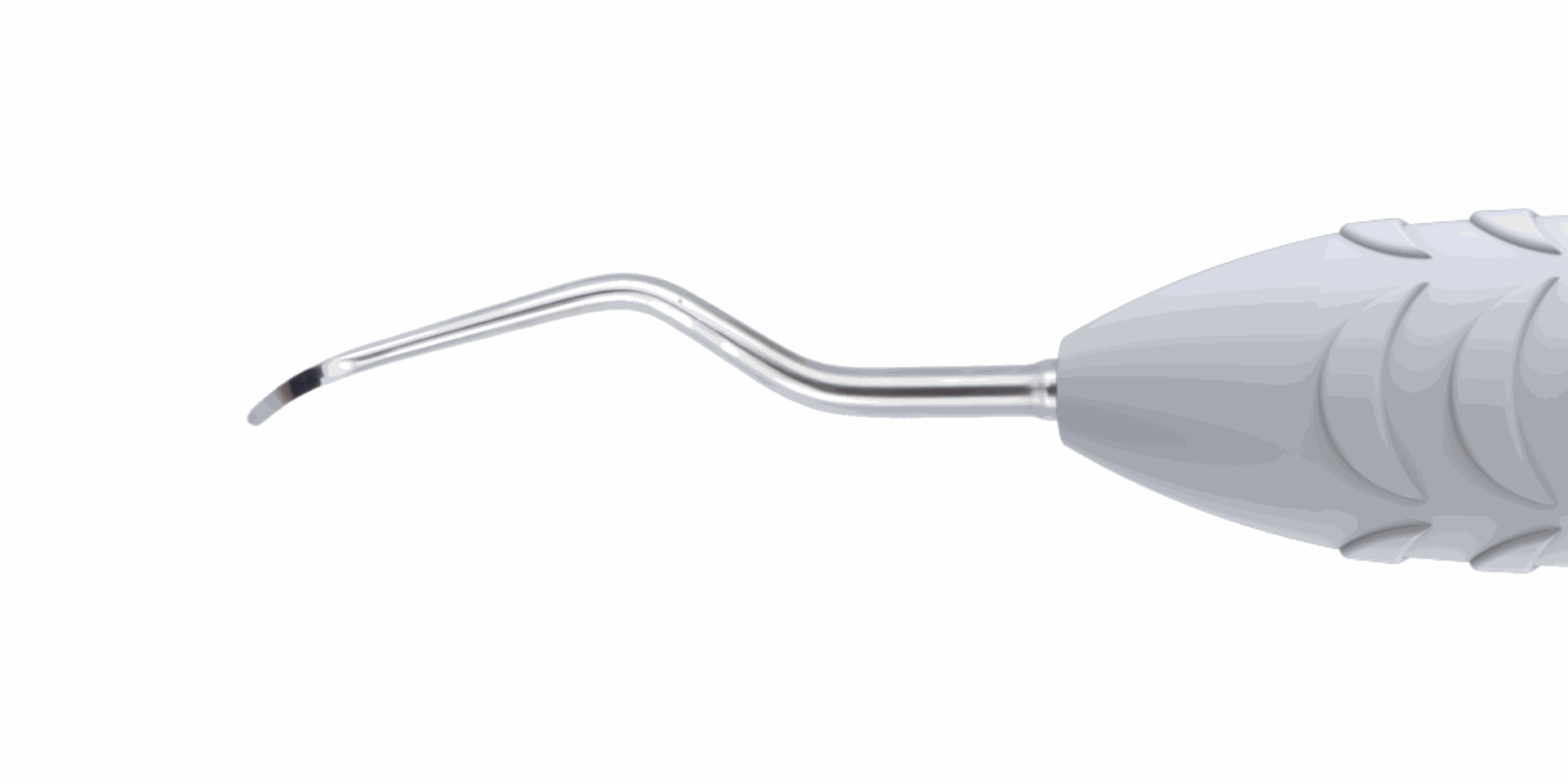
Working-end close-up. The 90° blade-to-shank angle and the rounded toe are visible — both edges of the blade sit at usable cutting angles to the tooth.






Browse all 37 Universal curettes →
Chapter 6The Gracey range at ErgoDenta
ErgoDenta carries 95 Gracey curettes — the most comprehensive Gracey range from a Nordic-designed brand. Standard, Mini Five for narrow pockets, and Rigid for tenacious calculus. All available across handle lines (ErgoX®, ErgoX® Plus, ErgoSteel Standard, ErgoSteel Plus, ErgoLite X) and layered with the ErgoRazor® sharpness system or the ErgoTip® modular tip system.





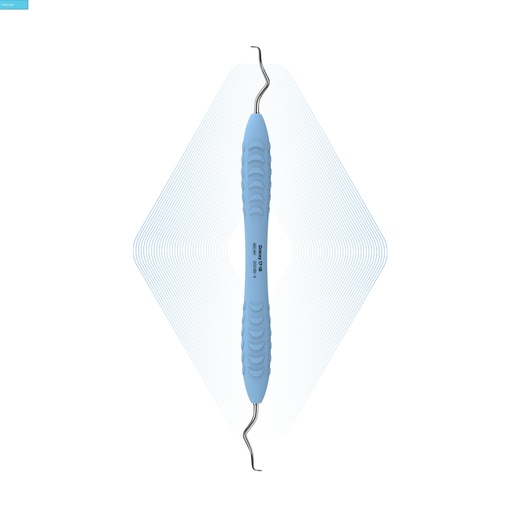
Browse all 95 Gracey curettes → · Read the complete Gracey numbering guide →
Chapter 7One curette geometry isn't 'better' than the other
Universal curettes aren't an inferior version of Graceys, and Graceys aren't a fancier upgrade. They are two different tools designed for two different jobs. Asking which is 'better' is like asking whether a hand mirror is better than a periodontal probe — they answer different questions in the operatory.
Most well-equipped practices stock both. A balanced periodontal kit typically holds two universals (one anterior, one posterior) for routine prophy, plus four to six Graceys covering the area-specific surfaces (1/2 for anterior, 7/8 for posterior buccal/lingual, 11/12 for mesial, 13/14 for distal). From there, additional Graceys (5/6, 9/10, 15/16, 17/18) and the Mini variants get added as periodontal caseload grows.
Chapter 8Beyond geometry — sharpness systems & handles
Both Universal and Gracey families share the same ErgoDenta sharpness systems and handles, so the clinical choice (which geometry) is independent of the comfort and longevity choice (which steel and which grip).
Whichever geometry you choose, a sharp edge decides the outcome — here's how to know when a curette needs sharpening.
- ErgoRazor® sharpness system — cryogenically treated 440C steel, HRC 60+, up to 3× longer edge retention. Available across both Universal and Gracey ranges.
- ErgoTip® modular system — replaceable working tips on a host handle, no sharpening required.
- Handles — ErgoX® (silicone, 11.5 mm), ErgoX® Plus (silicone, 13.65 mm), ErgoSteel Standard (9.5 mm), ErgoSteel Plus (10 mm), ErgoLite X (lightweight resin over steel).
Read more in our complete Gracey curette guide for the full handle and system breakdown.
Build your periodontal kit with ErgoDenta
132 curettes between Universal and Gracey families — from a Danish dental instrument company, every option from budget-friendly to premium with the same ErgoDenta build quality.
Browse all curettes →Frequently asked questions
What is the difference between a universal curette and a Gracey curette?
A universal curette has a 90° blade angle to the lower shank with both edges sharpened, so a single instrument can adapt to multiple tooth surfaces — ideal for routine prophylaxis and light subgingival work. A Gracey curette has a 70° offset blade with only the lower edge sharpened, designed area-specific for deep subgingival scaling and root planing where blade adaptation and tissue safety matter most.
When should I use a universal curette versus a Gracey curette?
Reach for a universal curette (Columbia, Barnhart, Langer, McCall, Goldman-Fox) for routine recall scaling, supragingival calculus, and light subgingival work where pocket depths are shallow. Switch to a Gracey when you're treating moderate-to-deep periodontal pockets, area-specific surfaces, or doing definitive root planing — the offset blade adapts safely deep into the pocket without trauma.
Why are there two cutting edges on a universal curette but only one on a Gracey?
Universal curettes have a 90° blade-to-shank angle, so both edges meet the tooth at usable angles — both can cut. Gracey curettes have a 70° offset, which puts only the lower edge in proper contact with the tooth surface. The upper edge sits at an unfavourable angle and is not sharpened — only the lower edge does the work.
What does 'area-specific' mean for Gracey curettes?
Each Gracey number (1/2, 3/4, 5/6 ... 17/18) is engineered for a specific tooth surface in a specific region of the mouth. The shank curvature and blade orientation are tuned to one job — for example, Gracey 11/12 is for posterior mesial surfaces and Gracey 13/14 for posterior distal. A universal curette tries to do many jobs with one geometry; a Gracey does one job perfectly.
Can a Gracey curette replace a universal curette in routine prophylaxis?
It can, but it's inefficient. For supragingival and light subgingival scaling on multiple surfaces, you'd need to swap between several Gracey numbers where one universal would do the work. Most practices stock universal curettes for routine prophy and Graceys for periodontal therapy — together they cover the full clinical need without compromise.
How is the blade angle measured on a periodontal curette?
The angle is measured between the face of the blade (the working surface) and the lower shank, when viewed from the front (cross-section). A universal curette is set at 90° — the blade face is perpendicular to the shank. A Gracey is set at 70° — the blade face tilts away from the shank by 20°, creating the characteristic offset that allows safe pocket entry.
Are there universal versions of Mini and Rigid blades like Graceys have?
Yes. ErgoDenta offers Mini Universal curettes (e.g. Mini Duplex, Mini Langer, Mini McCall) for narrow access and recall therapy, alongside the standard universal range. Rigid versions are more commonly seen in the Gracey family because the rigid shank is most useful when applying lateral pressure on tenacious interproximal calculus — but Mini variants are widely available across both families.
Which curette geometry is better for peri-implant maintenance?
Neither stainless-steel design is appropriate for direct work on implant surfaces — both will scratch the implant. For peri-implant maintenance, use the titanium-tipped versions (identifiable by their blue colour). ErgoDenta offers both titanium Mini Gracey and titanium Universal Columbia curettes, where the softer working end cleans abutments and implant collars without damaging the implant surface.
Do universal curettes wear down faster than Graceys?
Wear rate depends on the steel and treatment, not the geometry. A standard 440-grade universal will dull at the same pace as a standard Gracey. ErgoRazor® variants — available across both families — use cryogenically treated 440C steel that holds its edge up to 3× longer than untreated curettes, regardless of whether it's Universal or Gracey geometry.
What's a good starter set — Universal-only, Gracey-only, or both?
For most general dental practices, a balanced starter is two universals (Columbia 13-14 + Columbia 2L-2R or Barnhart 1-2/5-6) for routine prophylaxis, plus four Graceys (1/2, 7/8, 11/12, 13/14) covering anterior, buccal/lingual, mesial, and distal surfaces. From there, build out additional Graceys (5/6, 9/10, 15/16, 17/18) and Mini variants as the periodontal caseload grows.