
A sharp curette does the work; a dull one makes you work harder and leaves calculus behind. Here is how to tell — in seconds, chairside — when yours needs sharpening.
A scaling curette removes calculus with a fine cutting edge. With use that edge slowly rounds over and stops cutting — but the change is gradual, so it is easy to keep using a curette long after it has gone dull. Working with a blunt edge means more strokes, more pressure, burnished (not removed) calculus, slower appointments and more hand fatigue. The good news: two quick tests tell you exactly where your edge stands. (Not sure when to reach for a curette vs a sickle? See sickle scalers vs. curettes.)
The two quick chairside tests
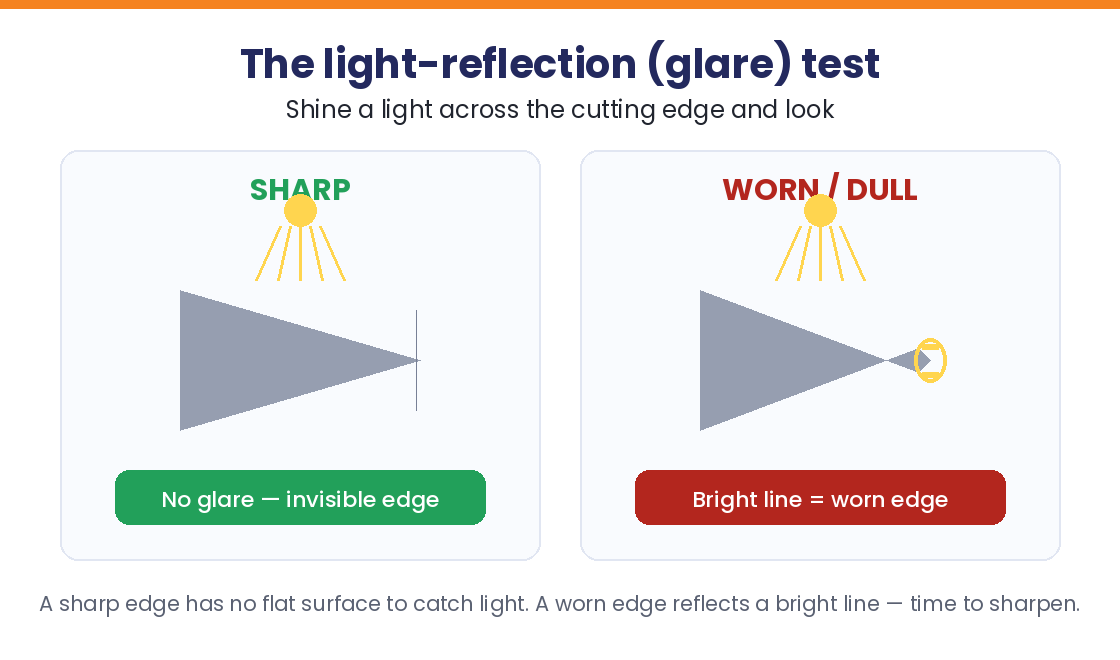
1. The light-reflection (glare) test
Hold the curette under the operating light and look along the cutting edge. A sharp edge is a fine line with no flat surface, so it reflects no light — it almost disappears. A dull edge has rounded over into a tiny flat that catches the light as a bright line. If you can see that shiny line, it needs sharpening.
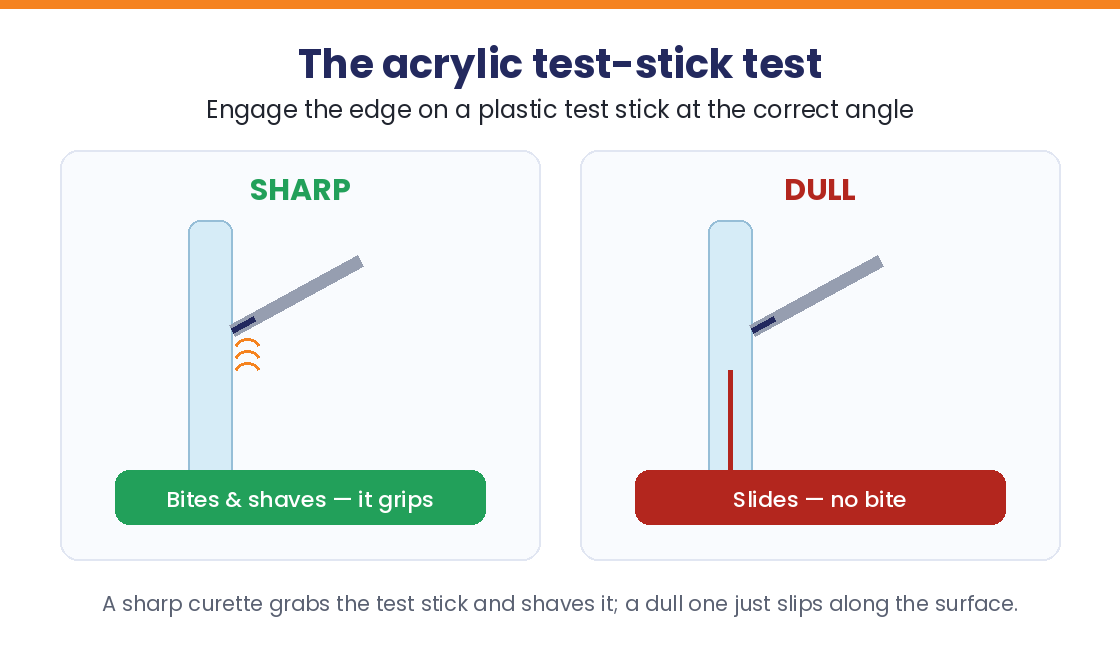
2. The acrylic test-stick test
Engage the cutting edge on a plastic test stick at the correct working angle and draw it upward. A sharp edge bites and shaves the plastic — you feel it grip. A dull edge just slides down the surface with no bite.
Three more signs to watch for
You are burnishing, not removing. If calculus feels smoother after your stroke but is still there, the edge is polishing it instead of shearing it off — a classic dull-edge sign.
More strokes, more pressure. Needing extra force or repeated passes over the same spot means the edge has stopped doing the work for you.
A rounded, shiny toe or edge. Under magnification a worn edge looks rounded and reflective rather than crisp; the lateral surface may look polished.
When sharpening isn't enough
Sharpening removes a little metal each time, so eventually a curette is worn out: once the blade is sharpened down to about half its original width, the toe is over-rounded, or it won't hold an edge, it's time to replace it (our Gracey numbering guide helps you re-order the exact tip). A finer, harder edge holds longer between sharpenings — ErgoDenta Graceys come across Gracey Curettes in ErgoLite, ErgoTip and ErgoRazor lines so you can match edge life to your caseload.
One caution: implant-safe titanium curettes must be sharpened with a matching (non-steel) technique and aren't tested with a metal stick the same way — see our implant-safe titanium instruments guide.