Build a dependable instrument system—not just a long shopping list
Opening a dental clinic involves hundreds of purchasing decisions. The instruments are easier to plan when you start with the procedures you will perform, the number of operatories running at the same time and the time needed to clean, package and sterilise each set.
This guide gives you a practical starting point for general dentistry. It covers essential hand instruments, example quantities per operatory, procedure-based kits and a staged buying plan. Use it to prepare your first order, compare suppliers or structure a clinic-opening quotation.
How many instruments does a new clinic need?
The most common planning mistake is buying one set for each operatory. That works only until a set is waiting for reprocessing, an instrument is damaged, or two similar procedures overlap.
For frequently used diagnostic and restorative instruments, a practical starting range is often four to eight of each core item per active operatory. Procedure-specific instruments can usually start lower, provided that complete sets can circulate through the day without creating delays.
The correct multiplier depends on your cycle time and appointment schedule. A busy hygiene room may need more diagnostic and periodontal sets than a surgery room used only a few times each week. Before finalising quantities, map one normal clinical day and follow each cassette from treatment room to reprocessing and back.
Cleaning must always precede sterilisation, and reusable instruments must be reprocessed according to their instructions for use. The CDC’s dental sterilisation guidance is a useful general reference; your local requirements remain decisive.
New dental clinic instrument checklist
Use this table as a procurement framework. The ranges are for one active general-dentistry operatory and should be multiplied only after considering shared instruments, reprocessing capacity and the procedures assigned to that room.
| Clinical area | Core instruments | Example starting quantity | Buying priority |
|---|---|---|---|
| Examination & diagnostics | Mirror handles and heads, explorers, periodontal probes, college tweezers | 4–8 of each core item | Opening day |
| Restorative dentistry | Composite instruments, excavators, burnishers, carvers, spatulas, matrix retainers, articulating-paper forceps | 3–4 complete working sets; 2 of lower-frequency items | Opening day |
| Periodontics & hygiene | Sickle scalers, universal curettes, core Gracey curettes, probes and sharpening accessories | 3–4 scaling sets; 2 core Gracey sets | Opening day |
| Endodontics & isolation | Endodontic explorers, pluggers, spreaders, locking tweezers, rubber dam punch, clamp forceps, frame and clamps | 2–3 endodontic sets; 2 isolation setups | First 30 days |
| Oral surgery & extraction | Extraction forceps, elevators or luxators, periosteal elevators, curettes, retractors, needle holders, tissue forceps and scissors | 1–2 complete core sets; 2–3 suturing sets | According to services |
| Prosthodontics | Cord packers, crown instruments, wax carvers, spatulas, measuring and placement instruments | 2–3 routine sets; specialised items as needed | First 90 days |
| Reprocessing | Procedure cassettes, instrument trays, organisers and approved cleaning accessories | Enough for the full daily rotation plus reserve | Before opening |
What to include in each clinical area
Examination and diagnostics
Every patient journey starts here, so diagnostic instruments deserve the highest duplication level.
- Mirror handles with replaceable mirror heads
- Explorers suitable for your diagnostic routine
- Periodontal probes with clear markings
- College tweezers or dressing pliers
Start with: 4–8 complete diagnostic sets per active operatory.
Restorative dentistry
Build a standard tray for the procedures performed most often, then add material-specific instruments.
- Composite placement and contouring instruments
- Spoon excavators, carvers and burnishers
- Cement and mixing spatulas
- Matrix retainers and placement instruments
- Articulating-paper forceps
Start with: 3–4 complete restorative sets and duplicates of high-use items.
Periodontics and hygiene
A focused core selection is usually more useful than buying every curette pattern on day one.
- Sickle scalers for supragingival deposits
- Universal curettes for broad routine use
- A core Gracey set for area-specific instrumentation
- Periodontal probes and appropriate sharpening tools
Start with: 3–4 scaling sets plus 2 core Gracey sets per hygiene room.
Endodontics and rubber dam
Isolation equipment should be organised as a complete setup, not scattered individual items.
- Endodontic explorers and locking tweezers
- Pluggers and spreaders in the sizes you use
- Rubber dam punch, clamp forceps and frame
- A practical clamp selection for anterior and posterior teeth
Start with: 2–3 endodontic sets and 2 complete isolation setups.
Extraction and oral surgery
Match the range to the procedures you genuinely intend to provide during the first months.
- Core upper and lower extraction forceps
- Straight and angled elevators or luxators
- Periosteal elevators, retractors and surgical curettes
- Needle holders, tissue forceps and surgical scissors
Start with: 1–2 core extraction sets and 2–3 suturing sets.
Prosthodontics
Prioritise the instruments needed for preparations, impressions, temporaries and cementation.
- Gingival cord packers in useful tip sizes
- Crown removal and placement instruments
- Wax carvers and laboratory spatulas
- Measuring, contouring and finishing instruments
Start with: 2–3 routine sets; add specialist instruments as demand becomes clear.
Use procedure kits to simplify setup and reprocessing
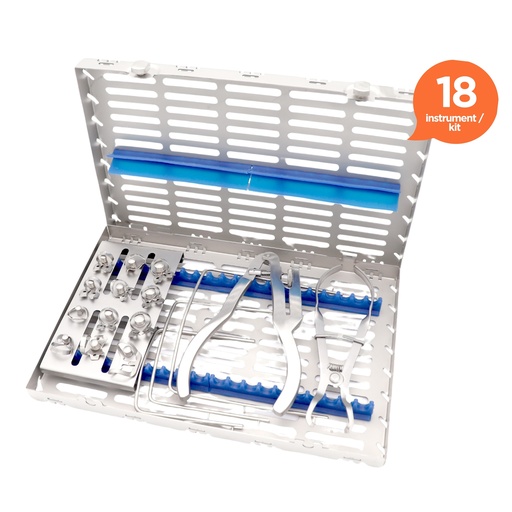
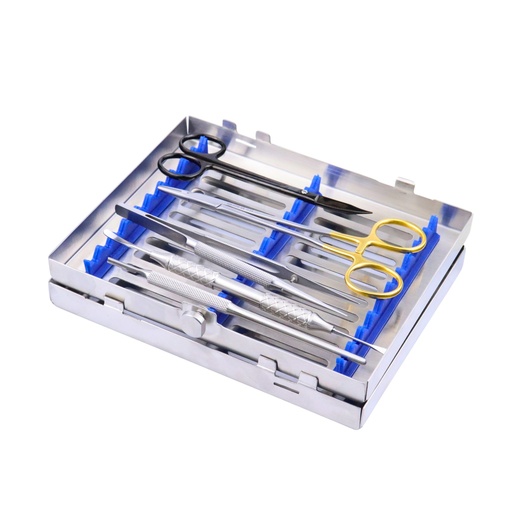
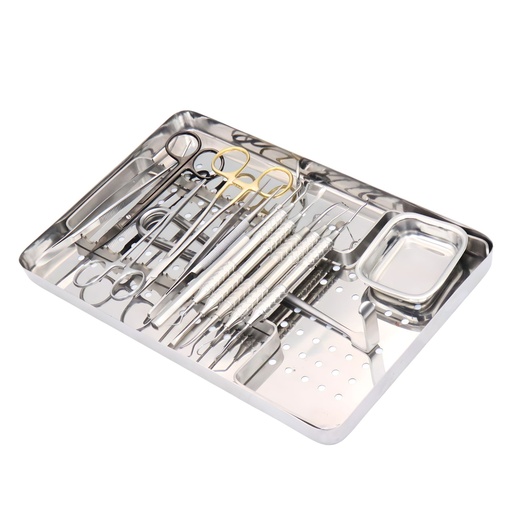
Standardised kits reduce the number of decisions made during room preparation. Each tray contains the same core instruments, follows the same route through reprocessing and is easy to replenish when an instrument needs replacement.
These ErgoDenta kits use current product photography from our catalogue. Their role here is illustrative: combine ready-made kits with individual instruments to match your clinic’s exact workflow.



A staged buying plan for a new clinic
A phased purchase protects the opening-day workflow while preventing capital from being tied up in specialist instruments before demand is known.
Before opening
Complete diagnostic, restorative and hygiene rotations; emergency extraction and suturing instruments; enough cassettes and trays for the planned reprocessing cycle.
First 30 days
Strengthen the areas that create bottlenecks. Add rubber dam, endodontic and prosthetic sets according to actual appointment patterns.
First 90 days
Add specialised periodontal, surgical, implant, orthodontic or paediatric instruments only where the service mix justifies them.
Three questions to ask before adding any instrument
- 1
Which procedure requires it?
Connect every line item to a specific tray or treatment workflow. - 2
How often will that procedure occur?
High-frequency instruments need rotation capacity; occasional instruments usually need fewer duplicates. - 3
What happens while it is being reprocessed?
If the next patient cannot be treated without it, another complete set is needed.
Choose instruments that are easy to standardise
A new clinic is an opportunity to create one consistent system. Standardisation makes training, tray assembly, replacement and stock control easier.
Handle and grip
Compare diameter, weight, balance and surface texture. A handle that feels controlled in the intended procedure is more important than choosing one design for every task.
Working-end selection
Buy the patterns and sizes your clinicians will actually use. A focused, clearly documented range is easier to manage than a broad collection with overlapping functions.
Identification
Consistent reference numbers, names and colour coding help the team return instruments to the correct cassette and reorder the right item.
Replacement availability
Confirm that individual instruments can be reordered. A kit is easier to maintain when one damaged item can be replaced without buying the whole set again.
Supplier checklist for clinics, dealers and distributors
Price matters, but a clinic-opening order also depends on documentation, product continuity and a catalogue structure that remains usable after installation.
| Check | Why it matters | What to request |
|---|---|---|
| Regulatory documentation | Supports market access and clinic records | Applicable declarations, labelling information and manufacturer details |
| Traceable references | Prevents ordering errors | A stable SKU for every instrument and variant |
| Product continuity | Keeps standardised trays serviceable | Lead times, replacement availability and substitution policy |
| Reprocessing information | Supports correct handling of reusable devices | Current instructions for use and care guidance |
| Scalable pricing | Allows phased purchasing | Clinic-opening, group-practice or distributor quotation |
| Catalogue data | Simplifies ERP and e-commerce setup | Names, SKUs, images, specifications and category files |
Send us your procedure list or opening order.
ErgoDenta can help structure the instruments into clear categories, kits and reorderable references.