“Clear image, ultra-thin profile” — a microscopic endodontist on ErgoDenta’s 0.7 mm endo mirrors
MUDr. Vladislav Růžička spends about 60 % of his clinical time behind an operating microscope, mostly on complicated retreatments referred by colleagues in Prague. He recently sent us a few lines about the Microscopic HD UltraThin mouth mirrors he keeps on his tray — and why he keeps several of them.
TL;DR
Four things make an endo mirror versatile according to Dr. Růžička: a clear image, an ergonomic handle, a wide choice of shapes and sizes and an ultra-thin 0.7 mm head. ErgoDenta’s Microscopic HD series delivers all four in five head shapes — and is priced so that you can keep more than one on the tray and actually use them.
The review — Czech original and English translation
Jasný obraz, ergonomická rukojeť, která příjemně sedí v ruce, široký výběr tvarů a velikostí a ultratenký profil zrcátek (0,7 mm) dávají zrcátkům ErgoDenta velkou univerzálnost a umožňují dobrou orientaci i manipulaci v operačním poli – ať už při mikrochirurgické endodoncii, nebo třeba při sanaci obtížně přístupných kazů.
A k tomu velmi příjemná cena. Díky ní jich můžete mít na stole rovnou několik a nemusíte se bát je skutečně používat. 🙂

A clear image, an ergonomic handle that sits comfortably in the hand, a wide choice of shapes and sizes and the ultra-thin profile of the mirror heads (0.7 mm) make ErgoDenta mirrors extremely versatile and allow good orientation and handling in the operating field – whether in microsurgical endodontics or, say, when treating hard-to-reach caries.
And on top of that, a very pleasant price. Thanks to it you can have several of them on the tray at once, and you don’t have to be afraid to actually use them. 🙂
The full review, with the mirrors he uses, is also on its own page: Dr. Růžička on ErgoDenta UltraThin endo mirrors.
Why 0.7 mm matters under the microscope
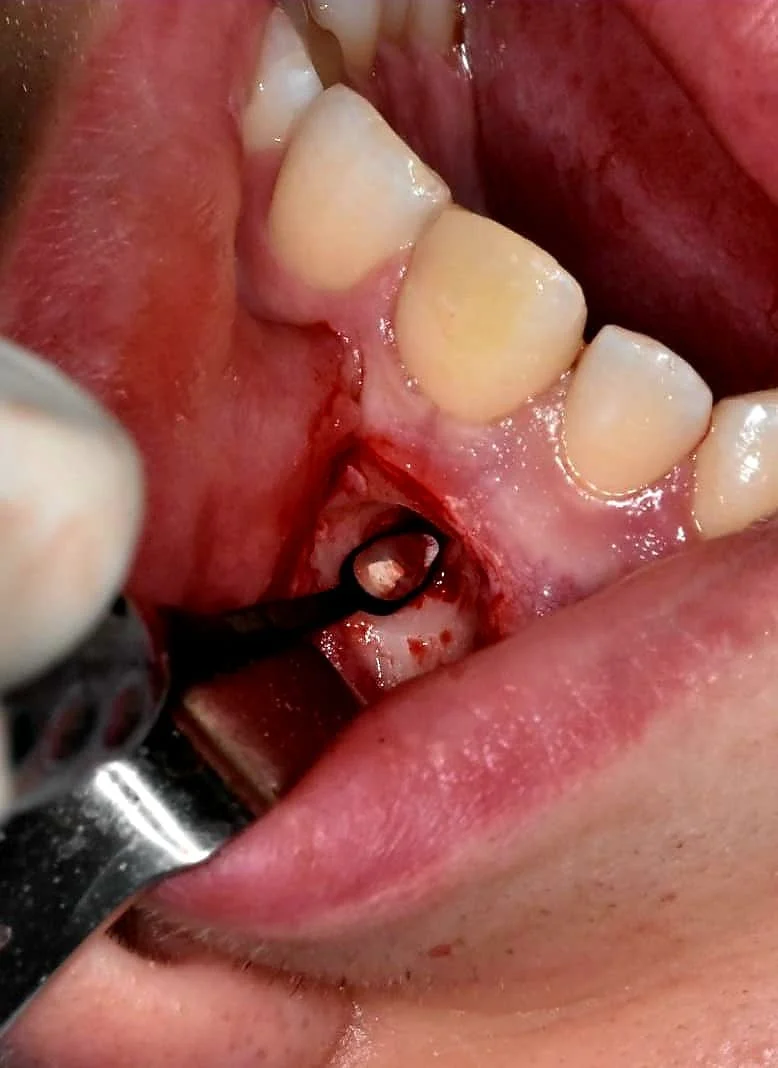
In microsurgical endodontics the mirror is never alone in the access cavity. It has to share the space with the light beam, the file or ultrasonic tip and, in retreatments, with the fragment you are trying to bypass. A conventional mirror head is around 1.5 mm thick; the UltraThin head is 0.7 mm. That saved millimetre is exactly what decides whether you can see the orifice and still keep the instrument on it — the “good orientation and handling in the operating field” Dr. Růžička describes.
Three details behind the clear image. A front-surface mirror avoids the double image of glass-backed mirrors; a 36-layer anti-glare coating tames the reflections a microscope light throws back; and the black matte finish of head and handle keeps stray glare out of the eyepiece. Together they give the “jasný obraz” — clear image — that opens his review.
The same properties pay off outside endodontics. His example is the restoration of hard-to-reach caries: a thin, non-glare mirror that reaches distal and lingual surfaces makes the difference between working by feel and working by sight.
Five shapes — which mirror for which situation
“A wide choice of shapes and sizes” is the third point in the review. The UltraThin series comes in five heads; every card below links to the product page.
| Head | Article | Best for |
|---|---|---|
| Ø 3 mm round | 7091U | The smallest head — for canal orifices and micro-access under the microscope |
| Ø 5 mm round | 7092U | Everyday endo mirror for single-rooted and premolar cases |
| 2 × 7 mm oval | 7093U | Slim oval for narrow interproximal and lingual access |
| 3 × 9 mm oval, angled | 7094U | Angled oval head for distal molars and awkward angles |
| Ø 7 mm round | 7095U | Widest field of view for orientation in the whole operating field |
A practical set for microscope work is three mirrors on the tray at once: one round for orientation (Ø 5 mm), one slim oval for isthmuses and interproximal access (2 × 7 mm) and one angled oval for the distal molar (3 × 9 mm). Which brings us to his last point — “thanks to the price you can have several of them on the tray at once, and you don’t have to be afraid to actually use them.”
UltraThin 0.7 mm vs Regular 1.5 mm
| UltraThin (709xU) | Regular (709xR) | |
|---|---|---|
| Head thickness | 0.7 mm | 1.5 mm |
| Coating | 36-layer anti-glare, front-surface | 36-layer anti-glare, front-surface |
| Handle | ErgoLite, black | ErgoLite, black |
| Shapes | Ø 3, Ø 5, 2 × 7, 3 × 9 angled, Ø 7 | Ø 3, Ø 5, 2 × 7, 3 × 9 angled |
| Choose it for | Microsurgical endo, retreatments, limited access, hard-to-reach caries | General use where extra rigidity and durability are preferred |
Both series live in the HD Micro Mirrors category, next to the wider Black Endo range. For a broader comparison of mirror types, read Mouth Mirrors Compared and Precision Vision for Endodontics.
About Dr. Růžička
MUDr. Vladislav Růžička runs a private practice at Anděl in Prague 5 with a strong focus on microscopic endodontics. With 20 years in clinical practice and close to 15 of them behind an operating microscope, he treats around 450 patients a year — most of them complicated retreatments referred by colleagues — and removes roughly 200 separated instrument fragments annually. He also lectures and runs hands-on endodontic workshops.
Frequently asked questions
Why does mirror thickness matter in endodontics?
What does the 36-layer anti-glare coating do?
Which mirror shape should I start with?
UltraThin 0.7 mm or Regular 1.5 mm?
Which handle do the mirrors come with?
Are the mirrors autoclavable?
See the difference 0.7 mm makes
Five UltraThin heads, one ergonomic handle, anti-glare coated — CE-marked and shipped from Denmark.