Instrument Guide · Diagnostics
Mouth Mirrors Compared — Plain, Front-Surface, HD and Microscopic
A mouth mirror is the most-used instrument in dentistry — every patient, every procedure, dozens of times per visit. So why are there four different kinds? Because the choice of plain, front-surface, HD or microscopic matters for image quality, working comfort, and the precision of every restoration you place.

The four mirror types — at a glance
| Type | Reflective surface | Image quality | Best for |
|---|---|---|---|
| Plain | Behind glass (rear-surface) | Standard, ghost image | Routine exams, training, low-cost replacement |
| Front-Surface | On top of glass (front) | Sharp, no ghosting | Restorative, endodontic, anywhere precision matters |
| HD | Front-surface + premium coating | Brightest, color-accurate | Indirect work, photography, magnification under loupes |
| Microscopic (UltraThin 0.7mm) | Front-surface, ultra-thin profile | Sharp, ultra-low profile | Endodontics under microscope, restricted access |
Plain vs front-surface — why the "ghost image" matters
A plain mirror has its reflective coating behind the glass. Light has to pass through the glass twice — once on the way in, once on the way out — and reflects off both the front of the glass AND the silvered back. The result: a faint secondary "ghost image" that's offset by 1–2 mm from the primary one. Acceptable for a routine exam, but enough to throw off precision work.
A front-surface mirror puts the reflective coating directly on top of the glass. No ghost. Crisp, sharp, single-image reflection — exactly what you need when placing a Class II box, working under a loupe, or doing endodontic visualization.
HD mouth mirrors — when sharpness matters
HD mouth mirrors are front-surface mirrors with a premium reflective coating that increases brightness by ~40% and preserves color fidelity. If you do indirect restorations, intra-oral photography, or zoom work under loupes, the difference is immediately visible. Available in 4 handle colors for tray colour-coding:
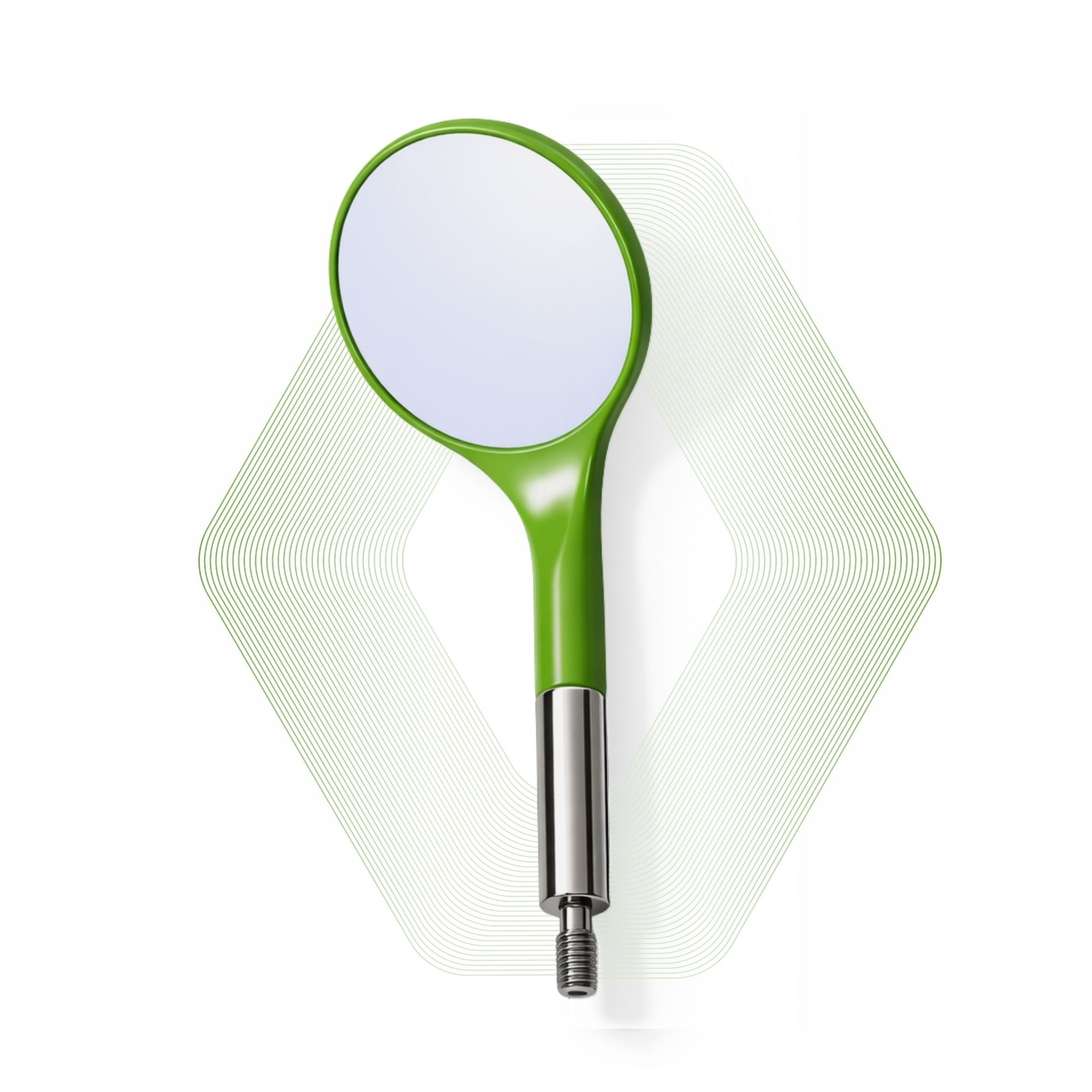
- 1514HK — HD Mouth Mirror No.4, Black
- 1514HB — HD Mouth Mirror No.4, Blue
- 1514HG — HD Mouth Mirror No.4, Green
- 1514HP — HD Mouth Mirror No.4, Pink
Microscopic mirrors — endo's secret weapon
Microscopic HD mirrors have an UltraThin 0.7 mm profile that fits where standard mirrors can't — into pulp chambers, around shoulders, under the operating microscope. The black-coated rim reduces glare under coaxial illumination. Five sizes available for different access scenarios:
- 7091U — Microscopic HD Mirror (small endodontic)
- 7092U — Microscopic HD Mirror
- 7093U — Microscopic HD Mirror
- 7094U — Microscopic HD Mirror
- 7095U — Microscopic HD Mirror
Mirror sizes — what does No. 4 mean?
Mirror sizes are standardised:
| Size | Diameter | Best for |
|---|---|---|
| No. 2 | 18 mm | Pediatric, narrow arches |
| No. 3 | 20 mm | Adult anterior, average mouth |
| No. 4 | 22 mm | Most common — adult posterior, indirect work |
| No. 5 | 24 mm | Wide arches, cheek/tongue retraction |
Pair the mirror to the right handle
Every ErgoDenta mirror head fits all standard SS-socket dental handles. Combine an HD mirror head with one of our ergonomic handle ranges:
- ErgoX & ErgoX Plus Mirror Handles — 15 colors, two grip sizes
- ErgoLite Mirror Handles — lightweight, color-coded
Mirror types compared
| Type | Reflection surface | Ghost image | Sharpness | Best use | Cost ratio |
|---|---|---|---|---|---|
| Plain (back-surface) | Behind glass | Yes (visible) | Reduced | Budget option, training | 1× |
| Front-surface (rhodium) | On front of glass | No | Maximum | Diagnostic exams, restorative | 1.5–2× |
| Magnifying (concave) | Front-surface, concave | No | 1.5× magnified | Detail work, caries detection | 2–3× |
| Mini front-surface | Front, smaller diameter | No | Maximum | Paediatric, posterior molars, tight access | 1.5× |
Why front-surface mirrors changed dentistry
A standard "plain" mirror is silvered on the BACK of the glass. When light enters, it reflects partly off the front of the glass (creating a faint "ghost" image) and the bulk reflects off the silvered back. The ghost image overlays the real image, creating a subtle double-vision effect. For routine inspection it's fine. For caries detection, fissure analysis, or precise restoration finishing, the ghost is enough to slow your diagnostic eye.
Front-surface mirrors have the reflective coating applied directly to the FRONT of the glass — no second reflection, no ghost. The image is sharper, contrast is higher, fissure shadows are clearer. Most modern dentistry textbooks recommend front-surface as the default.
The downside: the reflective coating is exposed and scratches more easily than a plain mirror's protected back-coating. Solution: cone-socket handles let you replace the mirror head every 6–12 months without buying a new handle.
Rhodium vs. aluminium coating
Front-surface mirrors are usually rhodium- or aluminium-coated. Rhodium is more reflective, more durable, and resists tarnishing in autoclaves. Aluminium is cheaper but tarnishes faster. For practices using regular sterilization cycles, rhodium pays back within a year.
Magnifying mirrors — when they earn their place
Concave (magnifying) mirrors are useful for detail work — caries detection in deep fissures, marginal gap inspection on indirect restorations. The 1.5× magnification is enough to spot what regular mirrors miss without needing loupes.
Caveat: the magnification only works at a specific focal distance (~5–8mm). Move closer or further and the image distorts.
The cone-socket workflow advantage
Most practices replace the entire mirror when the head scratches — but the handle is still perfect. Cone-socket systems split the two: a one-time handle purchase ([contact for pricing]), then [contact for pricing] mirror heads as consumables. Over 5 years a typical hygienist saves [contact for pricing], plus stays with their preferred handle weight and ergonomics.
Frequently asked questions
What's the difference between plain and front-surface mouth mirrors?
A plain mirror has its reflective coating behind the glass and produces a slight ghost image (light bounces off both the glass surface and the silvered back). A front-surface mirror has the reflective coating directly on top of the glass — sharper image, no ghosting, but the coating is more delicate.
Are HD mouth mirrors worth the extra cost?
Yes if you do indirect restorations, intra-oral photography, or work under loupes/microscope. HD mirrors are roughly 40% brighter than standard front-surface mirrors and preserve color accurately. For routine exams a standard front-surface or even plain mirror is fine.
What size mouth mirror should I use?
No. 4 (22 mm) is the most common adult-posterior size. No. 3 (20 mm) is better for anteriors and average mouths. No. 2 (18 mm) is pediatric. No. 5 (24 mm) is for cheek/tongue retraction in wide arches.
How do I clean and sterilise a front-surface mirror?
Hand-wipe the front surface with a soft microfibre after each use, never with abrasive gauze. Autoclave per manufacturer protocol (usually 134 °C, 5 min). The reflective coating on front-surface mirrors is more delicate than plain — replace at first sign of pitting or scratching.
Do microscopic mirrors fit standard handles?
Yes — ErgoDenta microscopic HD mirrors use the standard SS-socket and fit any standard dental mirror handle, including the ErgoX, ErgoLite, and ErgoSteel ranges.