
Condensation determines whether an amalgam (or increasingly, a bulk-fill composite) restoration lives or dies: under-condensed fills mean voids, corrosion and marginal leakage. The condenser — also called a plugger or packer — is the instrument that does that work, and choosing the wrong size wastes both effort and margin quality.
TL;DR
Amalgam condensers compact freshly placed restorative material with overlapping vertical strokes. Start small (1.0–1.5 mm) to reach line angles, finish large (2.0–2.5 mm) for the bulk. Smooth round faces for amalgam; drop-shaped and offset patterns reach where straight shanks cannot.
Condenser sizes and when to use them
| Working end | Size | Use |
|---|---|---|
| Small round | 1.0–1.5 mm | First increments — proximal boxes, line angles, retention grooves |
| Large round | 2.0–2.5 mm | Bulk condensation of occlusal mass |
| Drop-shaped | 1.3–1.8 mm | Follows rounded internal anatomy; doubles as pre-carve burnisher |
| Offset / back-action | various | Distal boxes of second molars where straight shanks cannot condense vertically |
Technique that actually condenses
- Increment depth max 2 mm — deeper increments spring back instead of packing.
- Condense with firm vertical pressure (~4–7 kg for amalgam) in overlapping strokes covering every point of the increment, then step the next stroke half a face over.
- Work from cavity walls to centre; finish each increment with lateral strokes against the walls for margin adaptation.
- The face should be smaller than the cavity — a condenser that bridges the walls only polishes the surface.
ErgoDenta condensers


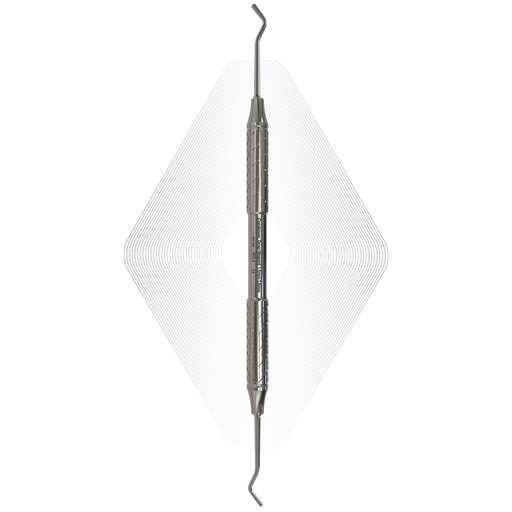
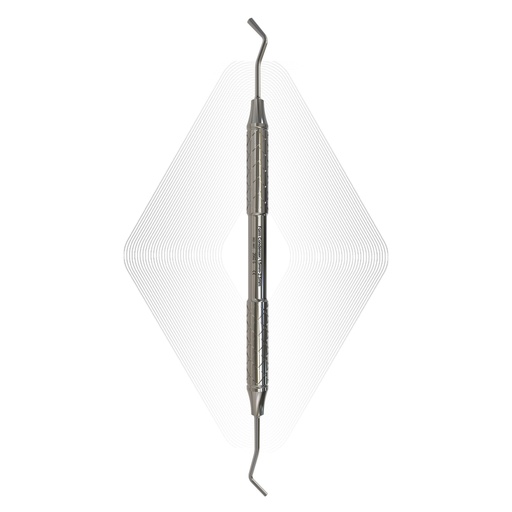
All patterns are available on ergonomic silicone handles — condensation is a force job, and a 9 mm cushioned grip beats a 6 mm steel handle over a full day of dentistry. See also the ErgoSlip drop-shaped condenser with a non-stick working end for composite.
Frequently asked questions
Is a condenser the same as a plugger?
In restorative dentistry yes — condenser, plugger and packer are used interchangeably. Endodontic pluggers are a different, canal-sized instrument.
Serrated or smooth face?
Smooth for spherical amalgam alloys and composite; serrated faces grip admixed alloys but can trap material and are harder to clean.
Can I condense composite with an amalgam condenser?
Yes, if the face is polished or non-stick coated — otherwise composite drags. Purpose-made non-stick composite condensers avoid the pull-back that creates voids.
Why do my proximal boxes fail first?
Almost always under-condensation of the first increment. Use the smallest condenser that fits the box, and condense before placing the next increment, not after.
Related reading
Build your dental instrument range with ErgoDenta
3,300+ instruments with Danish-inspired ergonomic design. One supplier. Full documentation. Ready to ship from Denmark.