
Why dental instruments rust — corrosion, staining and how to care for your instruments
A spot of orange on a freshly-sterilised instrument is one of the most common — and most misunderstood — problems in the practice. The good news: surgical stainless steel rarely fails on its own. Almost always, corrosion and staining are a reaction to water, debris or the load around it. Here is what actually causes it, how to tell staining from real damage, and a care routine that keeps a set working for years.
TL;DR
Most instrument 'rust' comes from chloride, dried debris, or poor autoclave water — not a faulty instrument. Learn to tell staining (cosmetic) from rust and pitting (transferable and permanent), then follow a simple routine: clean immediately, ultrasonic, rinse in distilled water, dry, lubricate, and sterilise in cassettes with quality water. Titanium-coated and silicone-handled instruments make care easier.
Why instruments corrode
Surgical stainless steel resists corrosion because of a thin, self-healing passive oxide layer. Corrosion starts when something breaks that layer faster than it can repair: chlorides from tap water, saline or some disinfectants; dried blood and debris that trap moisture against the surface; galvanic contact between dissimilar metals in a wet load; and autoclave water that is not distilled or de-mineralised, leaving brown mineral deposits. None of these mean the steel is bad — they mean the environment is aggressive.
The single biggest cause is time and water. Debris left to dry before reprocessing, and a rinse or autoclave fed with hard tap water, account for most of the staining practices see. Fix those two and the majority of 'rust' disappears.
Staining vs rust vs pitting — know the difference
Not every mark is equal, and the response differs:
| What you see | What it is | What to do |
|---|---|---|
| Blue / brown film | Staining — water minerals or heat tint, cosmetic | Clean and passivate; review water quality |
| Orange deposit | Rust — iron-oxide corrosion, often transferred | Isolate the source; clean; retire if pitted |
| Small cavities / dull spots | Pitting — passive layer destroyed, permanent | Retire the instrument |
The important idea is that a single corroding instrument can seed rust across a whole load. Finding and removing the source matters more than polishing the symptoms.
A care routine that works
None of this is complicated; it is consistency that protects a set:
- Clean immediately — remove debris before it dries; pre-soak if there will be a delay.
- Ultrasonic clean with the correct solution — it removes what would otherwise bake on.
- Rinse in distilled or de-mineralised water — the step that prevents most staining.
- Dry fully, and lubricate hinged instruments before sterilising.
- Sterilise in a well-maintained autoclave with quality water, and don't overload.
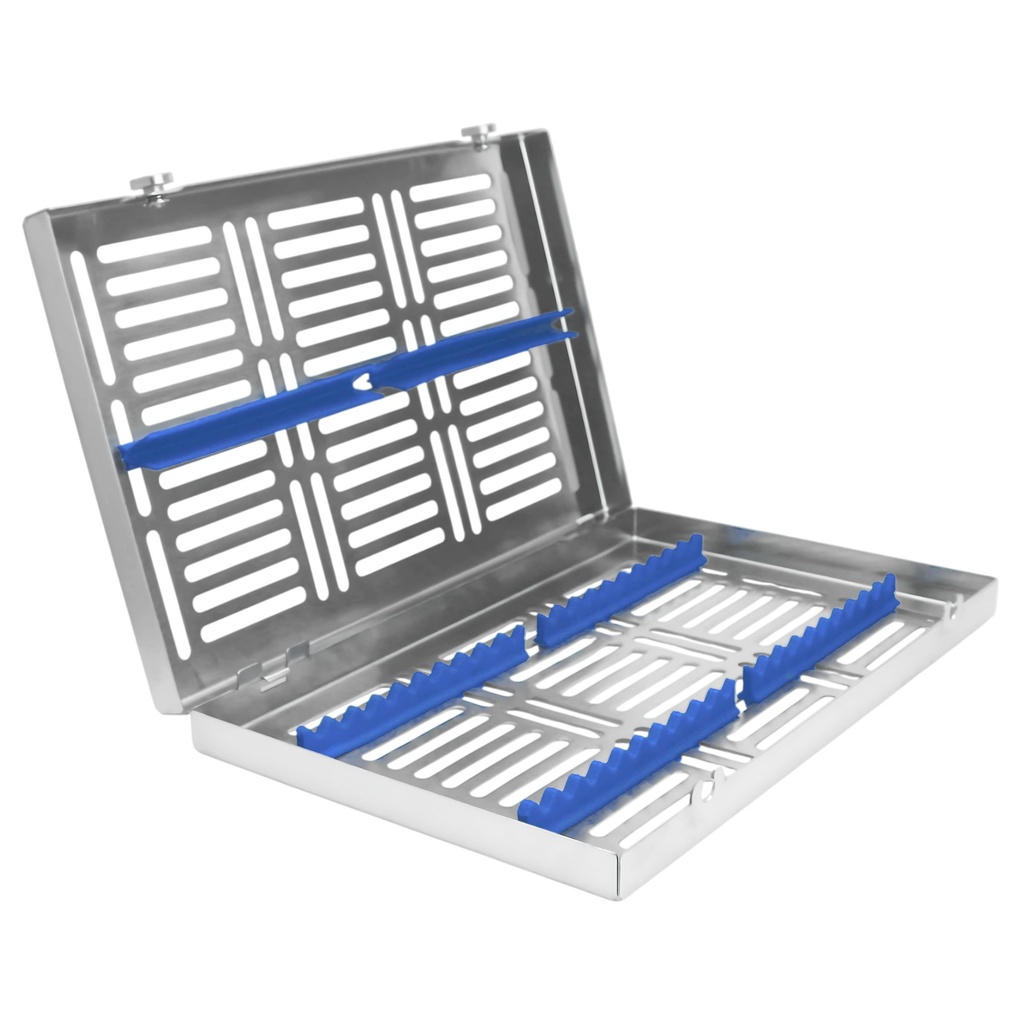
- Use cassettes to protect cutting edges, keep sets together and avoid metal-on-metal in the load.
Materials that make care easier
Instrument choice reduces how hard the routine has to work. Titanium-coated (blue) instruments add a hard, corrosion- and scratch-resistant surface. Silicone-handled instruments such as ErgoLite are fully autoclavable and avoid the crevices where moisture collects on some jointed handles. And cassettes — see how to choose them — are the simplest upgrade to protect edges through every cycle.
Frequently asked questions
Why do dental instruments rust in the autoclave?
What is the difference between staining, rust and pitting?
How do you prevent dental instruments from corroding?
Does an ultrasonic bath damage instruments?
Are titanium-coated (blue) and silicone-handled instruments more corrosion-resistant?
Can rusted dental instruments be saved?
Instruments built to last, and to clean
Titanium-coated and silicone-handled instruments, and colour-coded cassettes that protect every set through the autoclave. CE-marked, shipped from Denmark.