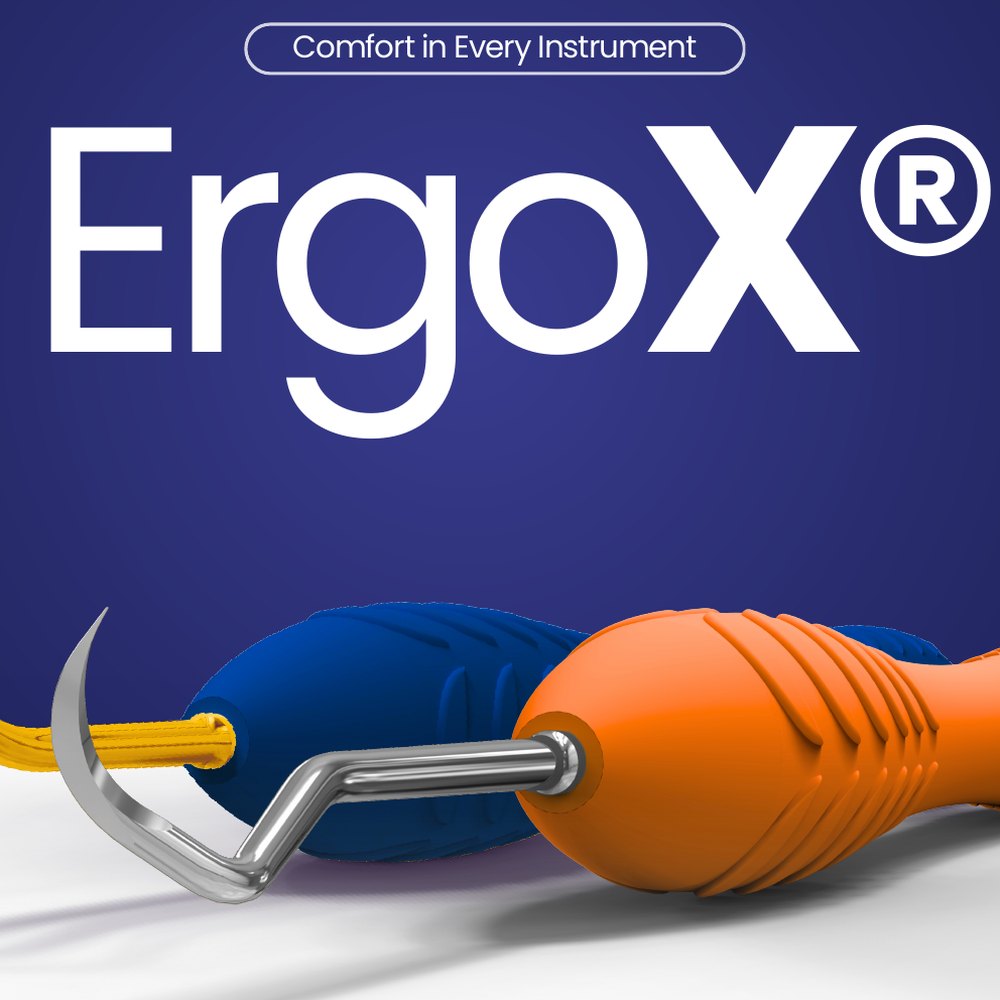
Implant surfaces demand a different kind of care. Standard stainless steel instruments — no matter how sharp — are harder than titanium implant surfaces. Over time, they can leave micro-scratches that roughen the surface and create ideal conditions for bacterial colonisation.
The solution? Instruments with pure titanium working ends. At ErgoDenta, we carry the complete Blue Titanium range — a full lineup of curettes, sickle scalers, and universal instruments, all designed to clean effectively without compromising implant integrity. Browse the full collection in our Periodontics shop.
ErgoDenta was founded with one clear purpose — to make daily clinical work easier with instruments designed for comfort, control, and reliability. from a Danish dental instrument company, every instrument is developed with attention to grip, balance, finish, and handling, so clinicians can work with greater comfort throughout the day. With over 2,700 ergonomic instruments, 30+ distribution partners across 25+ countries, and fast dispatch directly from Denmark with no middlemen, ErgoDenta has quickly grown into a trusted partner for dental professionals worldwide. Our products follow international regulatory requirements including Danish, UK, EU-MDR, and FDA standards.
New for 2026
The complete Blue Titanium lineup is featured in our latest catalog — curettes, scalers, and universals, all in one place. View the 2026 Catalogs →
Why Titanium Working Ends?
Four reasons clinicians reach for the Blue Titanium range.
Implant-safe
Titanium tips are softer than implant surfaces, so they clean without scratching or roughening — preserving the surface finish.
Biocompatible
Pure titanium reduces bacterial adhesion risk when in contact with implant and soft tissue surfaces.
Lightweight & flexible
Comfortable in hand, gentle on tissue — with the strength needed for reliable daily performance.
Hand-sharpened edge
Each tip is individually hand-sharpened by skilled artisans — ready to perform straight from the packaging.
The Blue Titanium Range
The range covers three instrument families, each with titanium working ends and ergonomic handles. Whether you need area-specific precision or all-purpose versatility, there is a titanium option for the job.
Mini Gracey Curettes
Area-specific curettes with a shorter, more compact blade — designed for tight pockets and furcation areas around implants. The mini design gives better access to posterior regions where space is limited.
Models: 1-2 · 5-6 · 7-8 · 11-12 · 13-14
Refs: 2101TB-SP through 2105TB-SP
Sickle Scalers
Designed for supragingival scaling around implants and restorations. The titanium tips remove calculus effectively above the gumline while protecting the underlying implant surface from damage.
Models: H6-H7 · 204S · 204SD
Refs: 2153TB-SP, 2156TB-SP, 2157TB-SP
Universal Curettes
Versatile instruments that work on all tooth surfaces and implant areas. Ideal when you need a single instrument for both supra- and subgingival work without switching between area-specific curettes.
Models: Columbia 4L-4R · Langer 1-2
Refs: 2202TB-SP, 2206TB-SP
When to Reach for Titanium
These instruments are most valuable when implant surface integrity is a priority:
"Whether you're scaling supragingivally with a sickle scaler or debriding a deep pocket with a mini Gracey — the titanium tip ensures you're never compromising the implant surface."
Looking for more periodontal instruments? We carry a full range of probes, kits, and accessories — all part of The Nordic Selection™.
Get Yours Through ErgoDenta
ErgoDenta develops ergonomic dental instruments designed for comfort, control, and everyday clinical use. With fast dispatch from Denmark, a direct supply model with no middlemen, and EU-based distribution across 25+ countries, every order is backed by consistent quality and reliable delivery.
Shop Titanium Instruments
Browse our Blue Titanium range — curettes, scalers, and universal instruments for implant-safe maintenance.










Frequently Asked Questions
Common questions about the Blue Titanium range — curettes, scalers, and universal instruments.
Why choose titanium instruments over stainless steel?
Titanium working ends are softer than stainless steel, which means they will not scratch or gouge implant surfaces during debridement. They are also lightweight, reducing hand fatigue over long procedures, and naturally biocompatible — an important consideration when working in the sulcus around osseointegrated implants.
What is the difference between Mini Gracey curettes, sickle scalers, and universal curettes?
Mini Gracey curettes have a shorter, area-specific blade designed for subgingival scaling in deep or narrow pockets — ideal for implant maintenance. Sickle scalers feature a pointed tip and triangular cross-section for removing supragingival calculus, particularly in interproximal areas. Universal curettes (Columbia, Langer) have two cutting edges and can be adapted to both mesial and distal surfaces without switching instruments, making them versatile for general periodontal debridement.
Can I use these titanium instruments on natural teeth as well?
Yes. While titanium instruments are essential for implant work, they perform equally well on natural tooth surfaces. They are especially valued for patients with mixed dentition — natural teeth alongside implants — because you can treat the entire mouth without switching instrument sets.
What does "hand-sharpened" mean, and why does it matter?
Each instrument in the Blue Titanium range is hand-sharpened at the factory, ensuring a precise cutting edge right out of the packaging. A properly sharpened blade requires less lateral pressure, improving tactile sensitivity and reducing tissue trauma — both of which are critical during peri-implant therapy.
Which Mini Gracey curettes do I need for implant maintenance?
For comprehensive implant maintenance, most clinicians start with the 1-2 (anterior facial/lingual), 11-12 (mesial of posteriors), and 13-14 (distal of posteriors). The 5-6 and 7-8 add coverage for premolars and buccal/lingual of molars. All five are available individually so you can build the set that suits your caseload.
Which sickle scaler model should I choose?
The H6-H7 is a classic Jacquette-style scaler suited for anterior interproximal areas. The 204S is the standard posterior sickle with a wider blade for heavier supragingival deposits. The 204SD is a modified design with a thinner, more tapered blade — ideal for tighter posterior embrasures and lighter deposits. If you regularly treat implant patients with supragingival build-up, having at least one sickle scaler in titanium is recommended.
Are these instruments autoclavable?
Yes. All Blue Titanium instruments are fully autoclavable at standard sterilisation cycles (134 °C / 273 °F). Titanium is highly resistant to corrosion and maintains its structural integrity through repeated sterilisation cycles.
How do I care for and resharpen titanium instruments?
Titanium instruments can be resharpened using a fine ceramic or Arkansas stone, following the same angles as stainless steel instruments. Use light pressure — titanium is softer and removes material quickly. Avoid diamond-coated stones, which can be too aggressive. Regular sharpening preserves cutting efficiency and extends the instrument's working life.
What handle do the Blue Titanium instruments use?
All instruments in the range feature a satin-finish stainless steel handle with a comfortable diameter for balanced grip and reduced hand fatigue. The titanium working end is securely attached to this handle, combining the benefits of both materials.
Do you ship across the Nordics and EU?
Yes. ErgoDenta ships to Denmark, Sweden, Norway, Finland, and across the EU. Visit our contact page or browse the full Periodontics shop to place your order.
Explore ErgoDenta Instruments
Premium ergonomic dental instruments crafted in Europe. Browse the catalogue or get in touch for custom requirements and private-label orders.
Frequently asked questions
How do I become an ErgoDenta distributor?
Send us a one-paragraph enquiry with your country, dealer profile, and current portfolio. We reply within one business day. Exclusive territories are available in selected markets.
What does the ErgoDenta range cover?
2,700+ ergonomic dental hand instruments across diagnostics, restoration, periodontics, extraction, surgery, sterilisation and ergonomic handle systems.
Where is ErgoDenta already sold?
Across 30+ distributors in 25+ countries — see our distributor network page for the full list.