
Search any periodontal screening protocol — BPE in the UK and Denmark, PSR in the US, CPI in WHO surveys — and one instrument sits at the centre of all of them: the WHO probe. It is the only probe designed to stop you from probing too hard, and the only one you can read at a glance.
TL;DR
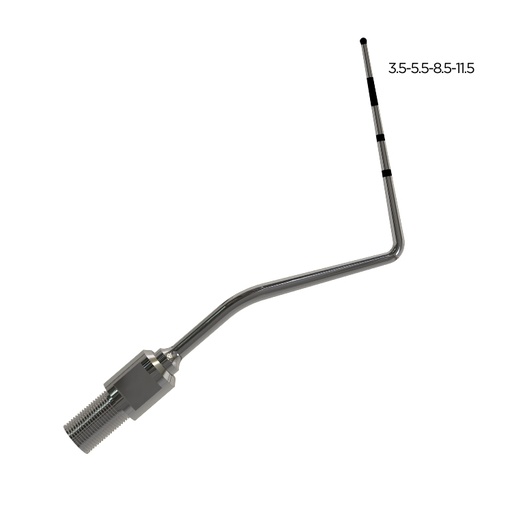
The WHO probe (also called CPITN or BPE probe) has a 0.5 mm ball end and a black band from 3.5 to 5.5 mm. Ball within the band = score 3; band disappears = score 4. Use it for screening (BPE/PSR/CPI); switch to a UNC-15 for full charting.
Anatomy of the WHO probe
| Feature | Specification | Why it matters |
|---|---|---|
| Ball end | 0.5 mm sphere | Prevents penetration of the junctional epithelium; detects subgingival calculus without scratching root surface |
| Colour band | 3.5–5.5 mm (black) | The BPE scoring zone — read the score without counting millimetres |
| Second band (some patterns) | 8.5–11.5 mm | Deep pocket reference on the "C" (clinical) variant |
| Working force | 20–25 g | About the weight of a coin — more force overestimates depth |
How to read the markings — BPE scores
| What you see | BPE score | Meaning |
|---|---|---|
| Band fully visible, no bleeding | 0 | Healthy |
| Band fully visible, bleeding on probing | 1 | Gingivitis |
| Band visible, calculus or defective margins | 2 | Plaque-retentive factors |
| Band partially within pocket (4–5.5 mm) | 3 | Moderate pocketing — full chart the sextant |
| Band disappears (pocket ≥ 5.5 mm) | 4 | Deep pocketing — full periodontal assessment |
Walk the probe around all teeth in each sextant and record only the highest score per sextant. A furcation involvement adds a "*" to the score — switch to a curved Naber's furcation probe to grade it.
WHO vs CPITN vs BPE probe — same instrument?
Essentially yes. CPITN (Community Periodontal Index of Treatment Needs) is the WHO survey protocol the probe was designed for; BPE and PSR are its chairside descendants. The probe pattern is identical: ball end plus 3.5–5.5 mm band. The "WHO C" variant adds 8.5 and 11.5 mm marks for clinical use.
ErgoDenta WHO probes
Available on every handle system — pick by grip preference:
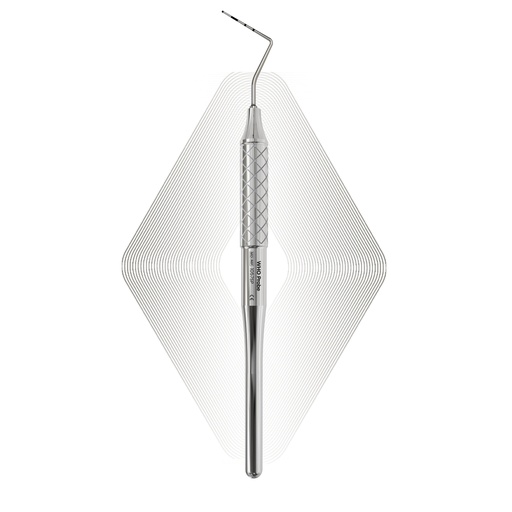

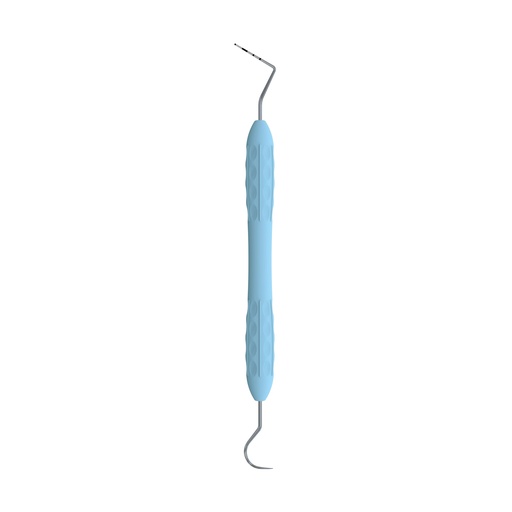
The double-ended Explorer 23 + WHO probe combines screening and caries detection in one instrument — a favourite for exam trays.
Frequently asked questions
Can I do BPE with a UNC-15 instead?
You can, but the WHO ball end is safer on inflamed tissue and the colour band gives you the score instantly. Use the UNC-15 for the full 6-point chart when a sextant scores 3 or 4.
What force should I use?
20–25 grams. Practise on a fingernail: the probe should blanch the nail bed without discomfort.
When do I need the Naber's probe instead?
Whenever a molar furcation is exposed or suspected — the WHO probe's straight shank cannot follow the furcation entrance.
How often should WHO probes be replaced?
When the band fades or the ball end wears — typically 12–18 months of regular sterilization cycles.
Related reading
- Periodontal Probes Guide — UNC-15, Williams, WHO, Naber's
- Universal vs Gracey Curette
- Shop Periodontal Probes
Build your dental instrument range with ErgoDenta
3,300+ instruments with Danish-inspired ergonomic design. One supplier. Full documentation. Ready to ship from Denmark.