
A composite filling is only as good as the instrument that places it. The ErgoLite filling range gives you a full set of lightweight, colour-coded placement instruments — comfortable in the hand, all appointment long.
Placing a modern composite restoration is a sequence of small, precise steps: you carry the material into the cavity, condense it so there are no voids, shape it to the right anatomy, then smooth and finish the surface. Each of those steps wants a slightly different instrument end — and that is exactly what the ErgoLite filling range covers.
ErgoDenta's ErgoLite filling instruments are the restorative tools of the ErgoLite line: composite spatulas, plastic (filling) instruments, condensers, burnishers and a cord packer. Every one sits on the same ultralight, colour-coded ErgoLite resin handle. Two things make that handle matter in daily work. First, it is far lighter than a solid-steel instrument and warm to the touch, so your hand stays relaxed through long restorative appointments. Second, the colours let you set up and recognise instruments at a glance — useful when you are building a tidy composite tray or working with an assistant. You still get a precision stainless working tip; only the handle changes. Browse the full restorative range under Restoration.
Below we walk through the range by what each tool actually does, point out the best-sellers, and finish with simple FAQs and tips.



Placement, condensing & shaping
These are the workhorses of the composite build-up — they carry material to the cavity, press it firmly into place and shape the final anatomy. Here is what each one is for:
Composite spatula — a flat, smooth blade for picking up composite and laying it into the cavity, then smoothing the surface. This is the instrument most clinicians reach for first.
Plastic (filling) instruments — anterior & posterior — shaped ends that place material and carve anatomy. The anterior version is finer for front-tooth contours and incisal edges; the posterior version has ends suited to building cusps and occlusal grooves on back teeth.
Mini spatula — a slimmer blade that reaches tight interproximal and anterior spaces where a full-size spatula is too bulky.
Form condenser — a rounded end (1.5–2.5 mm) to press each composite increment firmly into the cavity floor and walls, removing voids before curing.

A smooth, flat blade that carries and smooths composite cleanly into the cavity — the everyday placement instrument.
When to use: Bulk placement and smoothing of composite on most restorations.
Shop restorative range →

Burnishing, packing & pluggers
Once the material is placed, these tools condense it, smooth the surface and help with the steps around the restoration:
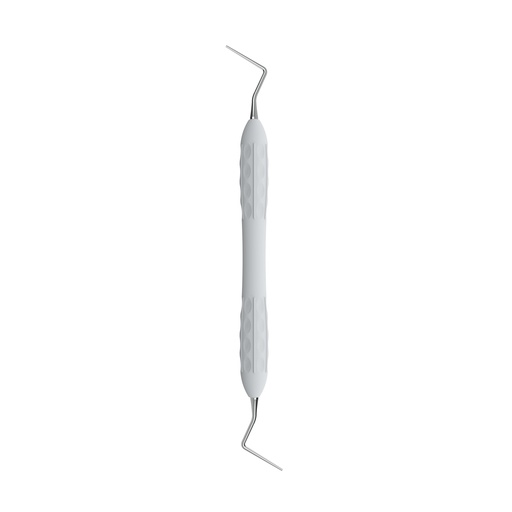
Burnisher & plugger — a double-ended favourite: use the plugger end to condense composite into the cavity and the burnisher end to smooth and adapt the surface and margins before curing. One instrument covers two jobs.
Ball burnisher (1.75–2.25 mm) — a rounded tip for polishing the surface, adapting matrix bands and removing small marginal excess.
Cord packer — gently tucks gingival retraction cord into the sulcus so the margin is exposed and dry before you take an impression or place a sub-gingival restoration.
Endo plugger — included in the ErgoLite range for vertically compacting material in the pulp chamber; handy where restorative and endodontic work overlap.

A double-ended burnisher and plugger — condense with one end, burnish and adapt the surface with the other.
When to use: Condensing increments and burnishing the composite surface; adapting margins.
Shop restorative range →
How to build your ErgoLite composite kit
If you are starting a kit, a simple, well-covered set is: a composite spatula (placement and smoothing), an anterior and a posterior plastic instrument (anatomy front and back), a condenser or the burnisher & plugger (condensing and finishing), and a cord packer if you do crown-and-bridge or sub-gingival work. Add a mini spatula for tight anterior cases. From there you can grow the set to taste.
Why ErgoLite for fillings?
The working tips are precision stainless steel — the same quality you'd expect — but the handle is the difference. Three practical reasons clinicians choose ErgoLite for restorative work:
Lighter, less fatigue. Composite appointments involve a lot of small, controlled movements. A lighter handle means your hand and forearm stay relaxed, which helps both comfort and precision late in the day.
Colour-coded organisation. Each handle colour lets you build a tidy composite tray and pick the right instrument instantly — and assign colours per operator or procedure across the practice.
Clean and reusable. Every ErgoLite filling instrument is reusable and fully autoclavable, and the smooth, polished tips release composite well. If you want a fully non-stick coated tip, ErgoDenta also offers the ErgoSlip line.
Frequently asked questions
- Why ErgoLite Instruments Are Not Just Another Handle
- Find Your Perfect ErgoHandle
- Composite Filling Instruments — Pluggers, Spatulas, Anteriors & Posteriors
- Composite Placement Instruments — Burnishers, Condensers, Plastics & Carvers
- Dental Excavators by ErgoDenta — Types, Sizes & Handle Options
- What Are the Basic Dental Instruments? A Simple Guide