Instrument Guide · Restorative
Composite Filling Instruments — Pluggers, Spatulas, Anteriors and Posteriors
A direct composite restoration moves through five tactile phases: place, condense, contour, sculpt, finish. Each phase calls for a different instrument tip — and reaching for the wrong one wastes minutes and compromises the final anatomy. Here's a practical clinician's guide to the composite kit.
The five phases of placing a composite
- Place — incremental delivery of composite into the cavity
- Condense — eliminate voids, push material into line angles
- Contour — establish proximal contact, marginal ridge, occlusal anatomy
- Sculpt — refine cusp morphology, fissures, secondary anatomy
- Finish — final smoothing, marginal blending, polish prep
Instruments by phase
| Phase | Instrument | Why |
|---|---|---|
| Place | Filling Twister, Cord Packer | Threaded or angled tip carries composite from well to cavity without sticking |
| Condense | Plugger, Condenser | Flat or domed tip pushes increment into line angles, eliminates voids |
| Contour | Filling Anterior, Contour Spatula | Curved blades shape proximal box, marginal ridge, contact area |
| Sculpt | Filling Posterior, Filling Sculptor | Working tip mimics cusp slopes and fissure pattern |
| Finish | Filling Trimmer, Filling Former | Refine margins, create smooth contour, prep for polishing |
Anterior vs posterior composite instruments
Anterior instruments have slimmer, more delicate working tips suited to the convex labial anatomy of incisors and canines, the precise marginal ridges, and the complex inter-proximal contour of Class III/IV restorations.
Posterior instruments have wider, sturdier working tips designed for cusp anatomy, occlusal sculpting, and the larger material volumes typical of Class I/II restorations on molars.
The role of color and coating
Composite instruments come in three finishes:
- Stainless steel — classic, sharp, but composite tends to stick.
- Gold-coated (TiN) — non-stick surface, easier release of viscous composite, less drag.
- Black-coated (DLC) — high contrast against tooth structure, premium non-stick performance, ideal for dark-light composites.
The ErgoDenta composite range
- 9119 — Cord Packer 2.0 mm (ErgoLite X)
- 2532 XP — Filling Twister (ErgoX Plus)
- Filling Anterior — multiple finishes
- Filling Posterior — multiple finishes
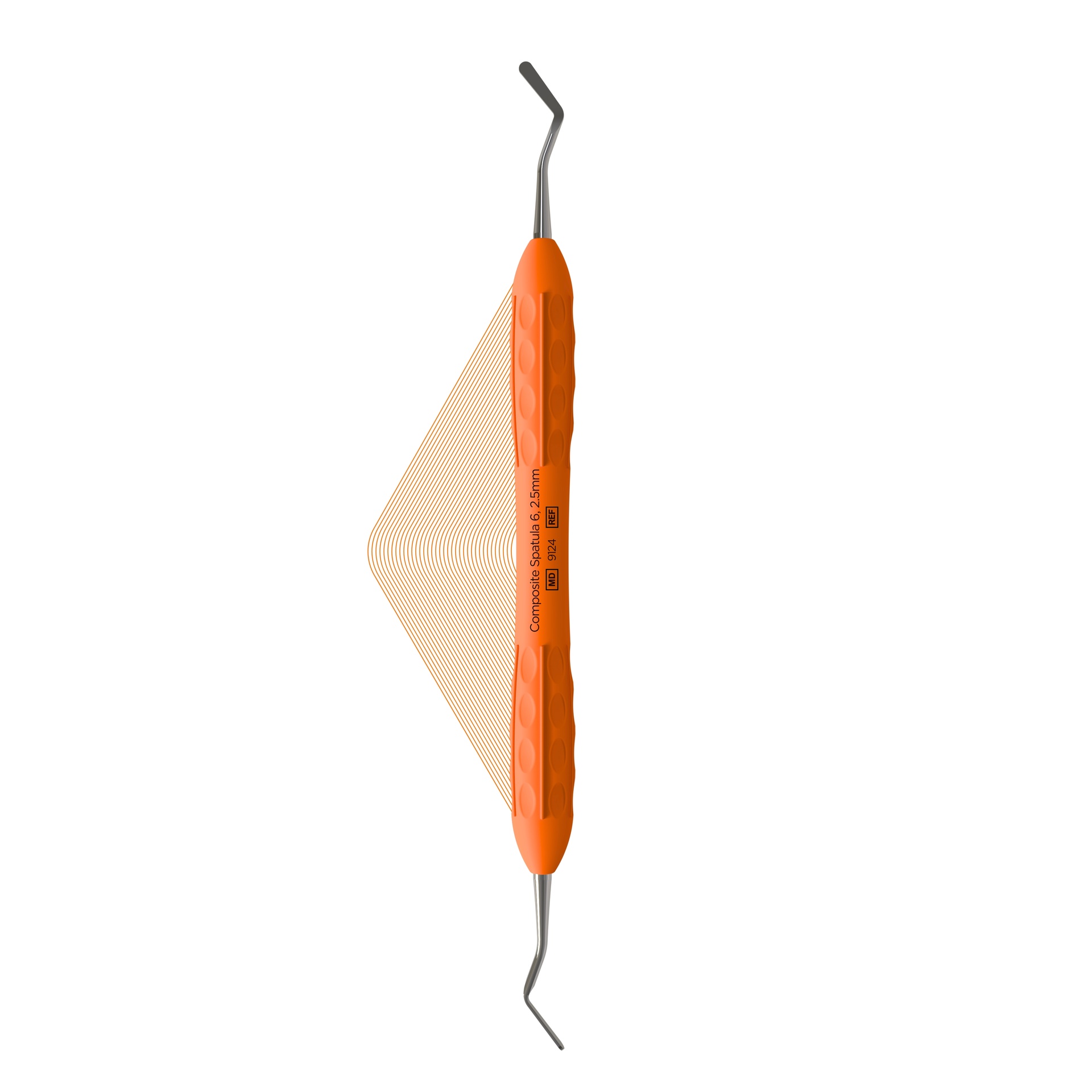
- Composite Spatula 6 — ErgoLite, ErgoSlip, ErgoX variants
Frequently asked questions
What composite instruments do I need to start a basic kit?
A starter composite kit needs four tips: a Filling Twister or Cord Packer (for placement), a Plugger or Condenser (for adaptation), a Filling Anterior (for shaping anteriors / Class III/IV), and a Filling Posterior (for occlusal anatomy on molars). A Composite Spatula 6 covers most general work.
Why does composite stick to my filling instrument?
Composite stick is mostly a function of surface chemistry and temperature. Dipping the tip in resin, alcohol, or a non-stick coating helps. Permanent solutions: gold (TiN) or black (DLC) coated instruments release composite far more reliably than bare stainless steel.
What's the difference between a plugger and a condenser?
A plugger has a flat or slightly domed tip used to compact composite vertically into the cavity. A condenser has a similar function but the tip is shaped to push material into specific anatomical features (line angles, internal corners).
How often should composite instruments be sharpened?
Composite instruments don't have cutting edges in the traditional sense, but the trimmer/former tips do dull and lose definition. Replace when working tips show visible wear — typically every 18–24 months in heavy use. Coated instruments (gold/black) lose their non-stick performance once the coating wears, even if the tip shape is intact.
Are gold-coated composite instruments worth the cost?
Yes for clinicians who place a high volume of composite. The non-stick coating saves seconds-per-restoration on material release, and the visual contrast helps track exactly where the tip is in the cavity. Over the life of the instrument, the time saved often justifies the premium.