Ask most clinicians what causes hand and wrist fatigue by the end of a list and the answer is rarely the procedure — it's the instruments. The working ends are often identical between brands; what changes your day is handle weight, balance, grip diameter and surface friction. "Ergonomic" is the difference between a tool you forget about and one you feel in your thumb at 4pm.
This guide explains what actually makes a dental instrument ergonomic, how the leading ergonomic ranges compare, and how to choose the best instruments for your hands and your speciality — from diagnostics and periodontics to endodontics and surgery.
TL;DR
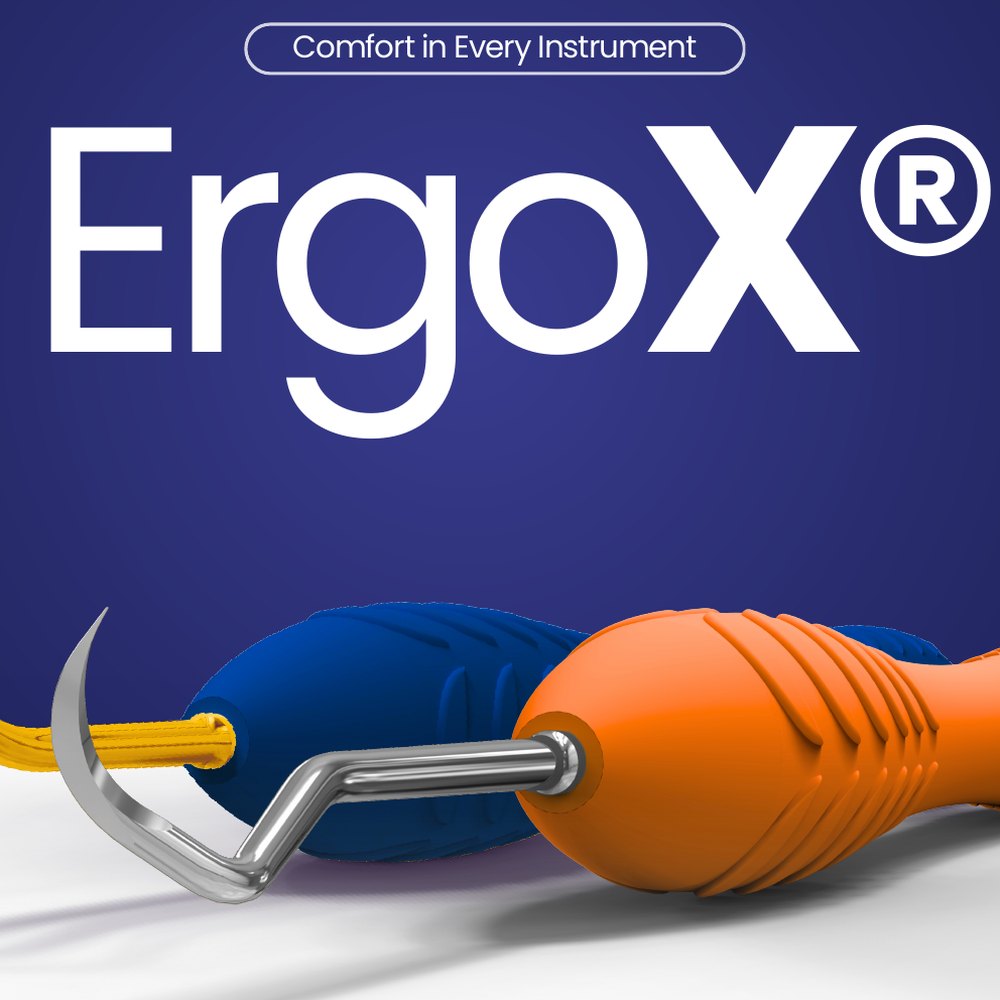
The best ergonomic dental instruments are light, well balanced and grippy so you pinch less and feel more. Silicone-handled ranges (ErgoLite, ErgoX) are lightest and best for high-volume hygiene; hollow or solid steel (ErgoSteel) gives more feedback for surgery; the ErgoTip cone-socket system lets one handle carry many working ends; and the ErgoRazor edge stays sharp up to 3× longer. Match the handle to your hands and speciality, not the other way around.
What makes a dental instrument “ergonomic”?
Four measurable things decide how an instrument feels over a full day:
- Weight — a lighter handle needs less muscle to control, which directly lowers fatigue. This is why silicone-resin handles outperform heavy solid steel for repetitive scaling.
- Balance point — weight centred near the fingers (not the working end) means the instrument does what you intend with less correction.
- Grip diameter & surface — a wider, high-friction grip lets you hold securely with a relaxed pinch. A thin, slippery handle forces a tight grip and accelerates fatigue and slips.
- Tactile feedback — you still need to feel calculus, canal walls and margins. The best ergonomic handles cut weight without deadening that feedback.
The short version: the best ergonomic instrument is the lightest one that still gives you the grip and feedback your procedure needs. There is no single “best” — there is a best for you.
The ErgoDenta ergonomic ranges, compared
ErgoDenta is built specifically around ergonomics — Danish-inspired handles engineered to reduce hand load. Here is how the ranges differ and who each suits:
ErgoLite & ErgoX →
Feather-light silicone handles with a high-friction grip. The lowest-fatigue option — ideal for hygienists and high-volume scaling.
ErgoTip system →
Cone-socket handles that take interchangeable screw-in tips. One handle, many instruments — less to buy, sharpen and store.
ErgoRazor edge →
Premium cutting edge that holds its sharpness up to 3× longer, on scalers and curettes — fewer sharpenings, more consistent cutting.
ErgoSlip & ErgoSteel →
Non-stick composite instruments and hollow/solid steel handles for restorative and surgical work where feedback and durability matter most.
| Range | Handle feel | Best for |
|---|---|---|
| ErgoLite / ErgoX | Lightest, silicone, high grip | Hygiene, high-volume scaling, hand-fatigue sufferers |
| ErgoX Plus | Light silicone, slightly more body & feedback | Clinicians who want low weight with more tactile control |
| ErgoSteel | Hollow/solid steel, most feedback | Surgery and detail-precision work |
| ErgoTip | Cone-socket, customisable | Practices standardising on interchangeable tips |
Best ergonomic instruments by speciality
Whatever your field, the ergonomic principles are the same — here is where to start in each range:
- Ergonomic mirrors & diagnostics — lightweight cone-socket mirror handles and front-surface mirrors for distortion-free vision. Browse mouth mirrors and mirror handles.
- Ergonomic perio & hygiene — light-handled scalers and curettes that cut fatigue across a full list. See our Top 7 hygienist instruments, the full periodontics range, plus hoe scalers and periodontal probes (including the Nabers furcation probe).
- Ergonomic endodontic instruments — balanced endo spreaders and pluggers and explorers for fine canal work. Browse all endodontics.
- Ergonomic restorative instruments — light condensers (amalgam & composite), spoon excavators and matrix bands & Tofflemire retainers. Browse all restoration.
- Ergonomic surgical instruments — balanced extraction forceps, elevators and needle holders. Browse surgery and extraction.
How to choose the best ergonomic instruments for you
- Start with your hands. Smaller hands and fatigue sufferers do best on the lightest silicone handles; if you rely on feedback for surgery, a steel handle may suit you better.
- Match the handle to the workload. High-volume hygiene rewards the lightest grip; occasional detailed work rewards feedback.
- Standardise where you can. A cone-socket system lets one familiar handle carry many working ends — consistent feel, lower cost.
- Don't forget edge retention. An ergonomic handle on a blunt blade still makes you work harder; a long-lasting edge keeps the ergonomics honest.
Frequently asked questions
What makes a dental instrument ergonomic?
Which is the best ergonomic dental instrument brand?
What is the best ergonomic mouth mirror?
Are ergonomic dental instruments worth the cost?
What are the best ergonomic instruments for endodontics?
Can I keep one handle and just change the working tip?
Equip your practice with ergonomic instruments
Danish-inspired, ergonomic by default. 3,300+ instruments, one supplier, full documentation, shipped from Denmark.