A hygiene tray doesn't need to be big — it needs to be right. Across thousands of ErgoDenta orders, the same handful of instruments come up again and again because they cover the full appointment: see the field, diagnose, remove deposits above and below the gumline, and finish without fatigue.
Below are the seven best-selling hygienist instruments in the ErgoDenta range, ranked by sales. For each one you'll find what it does, why hygienists choose it, and what it's best for — plus a side-by-side comparison and answers to the questions we get asked most.
The 7 at a glance
1. Sickle Scaler H6-H7 – supragingival calculus. 2. Front-Surface Mouth Mirror No. 4 – distortion-free vision. 3. ErgoX Plus Mirror Handle – premium ergonomics. 4. Gracey 11-12 – subgingival, site-specific. 5. Micro Sickle 01-02 – fine anterior deposits. 6. Explorer 23 + WHO Probe – detect & measure. 7. Universal Curette Columbia 2L-2R – all-surface scaling.
← Swipe to browse all seven →
1Sickle Scaler H6-H7
The single best-selling hygiene instrument in the ErgoDenta range. The H6-H7 is a double-ended sickle with a sharp, triangular cross-section made to flick supragingival calculus off enamel cleanly.
Why hygienists pick it
The pointed tip reaches interproximal deposits that ultrasonics leave behind, and the contra-angled ends cover both the front and back of the mouth with one instrument. In ErgoRazor steel the edge holds up to 3× longer than a standard scaler, so you sharpen less and finish faster.
Best for: Routine prophy, removing hard supragingival tartar, fast full-mouth debridement.
View Sickle Scaler H6-H7 → Browse all Sickle Scalers →2Front-Surface Mouth Mirror No. 4
Nothing happens chairside until you can see clearly. The No. 4 front-surface mirror carries its reflective coating on the front of the glass, so the image is single, crisp and free of the ghosting you get from ordinary rear-surface mirrors.
Why hygienists pick it
With no glass layer between you and the reflection, a front-surface mirror gives a brighter, true-to-life view — the difference is obvious on fine work like crown margins and canal orifices. It threads onto any cone-socket handle, so you choose the weight and colour you like.
Best for: Indirect vision where image clarity matters, retracting soft tissue, reflecting light into the working field.
View Front-Surface Mouth Mirror No. 4 → Browse all Mouth Mirrors →3ErgoX Plus Mirror Handle
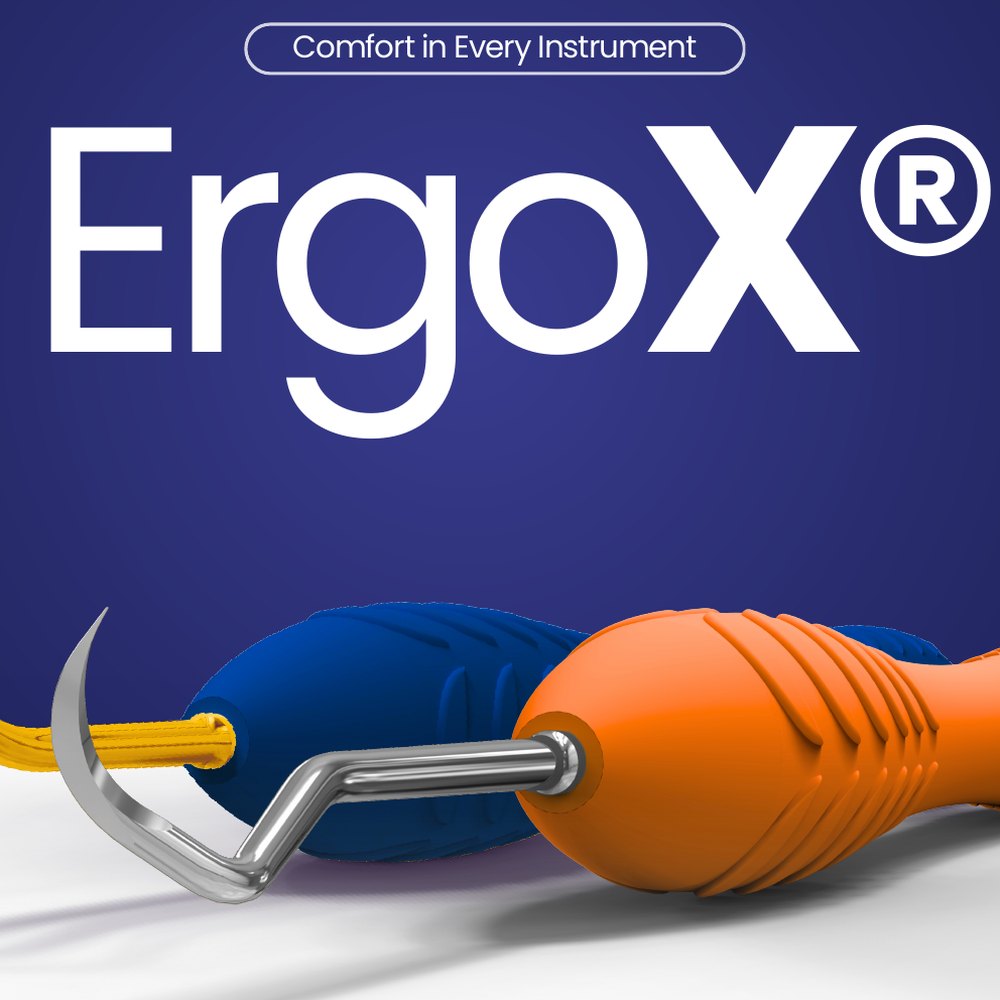
The handle is where an 8-hour day is won or lost. The ErgoX Plus is ErgoDenta's premium silicone cone-socket handle — light, grippy and built to carry any screw-in mirror head or ErgoTip working end.
Why hygienists pick it
Its wider, high-friction silicone grip cuts the pinch force needed to control the instrument, which is exactly what reduces hand and wrist fatigue over a full list. The cone socket means a worn mirror or tip is swapped in seconds while you keep the handle you like — and the ErgoX Plus body gives a little more substance and feedback than the ultra-light ErgoLite.
Best for: Hygienists on high-volume days, anyone managing hand fatigue, practices standardising on interchangeable cone-socket tips.
View ErgoX Plus Mirror Handle → Browse all Mirror Handles →4Gracey Curette 11-12
The Gracey 11-12 is the area-specific curette every perio tray needs. Its offset blade and long, complex shank follow the mesial root surfaces of premolars and molars below the gumline.
Why hygienists pick it
A single working cutting edge and rounded toe let it adapt to the root and slip under the tissue without trauma — far gentler than a universal curette for deep deposits. The 11-12 is the most-used Gracey number, which is why it outsells the rest of the set.
Best for: Subgingival debridement and root planing on the mesial of posterior teeth; periodontal maintenance.
View Gracey Curette 11-12 → Browse all Gracey Curettes →5Micro Sickle Scaler 01-02
A miniaturised sickle with a slim blade for the places a full-size scaler can't reach — tight lower-anterior contacts and fine, tenacious deposits.
Why hygienists pick it
The reduced blade lets you work crowded incisors and developmental grooves without blanching the tissue, while the ErgoRazor edge keeps its bite through hard calculus. A favourite for finishing after the bulk deposit is gone.
Best for: Lower anterior crowding, interproximal finishing, light calculus on delicate areas.
View Micro Sickle Scaler 01-02 → Browse all Sickle Scalers →6Explorer 23 + WHO Probe 11.5mm
One double-ended instrument that does two diagnostic jobs. A No. 23 shepherd's-hook explorer for caries and calculus on one end, a ball-ended WHO 11.5 mm probe for BPE pocket screening on the other.
Why hygienists pick it
Combining detection and periodontal screening on one shaft means fewer instruments on the tray and fewer swaps during an exam. The WHO ball tip is atraumatic and the 11.5 mm markings give instant BPE codes.
Best for: New-patient exams, BPE/periodontal screening, charting and caries detection in a single pass.
View Explorer 23 + WHO Probe 11.5mm → Browse all Explorers →7Universal Curette Columbia 2L-2R
The all-rounder. Unlike a Gracey, the Columbia universal has two cutting edges per blade and a blade angled at 90°, so a single instrument adapts to every tooth surface in every quadrant.
Why hygienists pick it
It is the most economical way to cover supra- and subgingival scaling when you don't want a full area-specific set — ideal as a back-up, for general practice, or for student kits. ErgoRazor steel keeps both edges sharp longer.
Best for: General-practice scaling, mixed deposits, a do-everything curette for a lean tray.
View Universal Curette Columbia 2L-2R → Browse all Universal Curettes →Compare the seven side by side
| Instrument | Primary role | Working area | Browse category |
|---|---|---|---|
| Sickle Scaler H6-H7 ErgoRazor® · H6-H7 | Supragingival scaling | Above the gumline — anterior & posterior | Sickle Scalers |
| Front-Surface Mouth Mirror No. 4 ErgoDenta · 1504F | Distortion-free vision & retraction | Whole mouth | Mouth Mirrors |
| ErgoX Plus Mirror Handle ErgoX® Plus · 1401 XP | Premium ergonomic handle | Carries mirror & screw-in tips | Mirror Handles |
| Gracey Curette 11-12 ErgoRazor® · 11-12 | Subgingival, site-specific | Mesial surfaces of posterior teeth | Gracey Curettes |
| Micro Sickle Scaler 01-02 ErgoRazor® · 01-02 | Fine & anterior deposits | Tight anterior contacts | Sickle Scalers |
| Explorer 23 + WHO Probe 11.5mm ErgoDenta · 9106 | Diagnosis: detect + measure | Caries detection & pocket screening | Explorers |
| Universal Curette Columbia 2L-2R ErgoRazor® · 2L-2R | Versatile all-surface scaling | All surfaces, all quadrants | Universal Curettes |
How the seven work together
Run through a typical appointment and the logic of the set becomes clear. You start with the mirror and ergonomic handle for vision and comfort, then an explorer/probe to detect deposits and screen pockets. The sickle scaler clears the bulk of supragingival calculus, the Gracey 11-12 takes care of subgingival deposits on posterior teeth, the universal curette handles everything else, and the micro sickle finishes the tight anterior contacts. Seven instruments, one complete hygiene workflow — all part of the wider Periodontics and Diagnostics ranges.
Tip: standardising on a cone-socket handle (like the ErgoX Plus) lets one handle carry your mirror today and a screw-in ErgoTip working end tomorrow — fewer instruments to buy, sharpen and store.
Why these are the ones to buy
Two things separate the ErgoDenta versions from a generic tray. First, the ErgoRazor steel used on the scalers and curettes is engineered to hold its edge up to three times longer than a standard instrument — less sharpening, more consistent cutting, longer service life. Second, the ErgoX Plus and ErgoLite silicone handles are exceptionally light with a high-friction grip, which is what reduces the pinch force and hand fatigue that build up over a full day of scaling.
All of it is from a Danish dental instrument company, fully autoclavable, and available from a single supplier with complete documentation — so a hygiene tray can be reordered and replaced without juggling brands.
Frequently asked questions
What instruments does a dental hygienist need?
What is the difference between a sickle scaler and a curette?
Gracey vs universal curette — which should a hygienist choose?
Why is the Gracey 11-12 the most popular number?
What does ErgoRazor mean and is it worth it?
Are these instruments autoclavable?
Can I replace just the mirror or working tip instead of the whole instrument?
Build your hygiene tray with ErgoDenta
Danish-inspired scalers, curettes, probes and mirrors. One supplier, full documentation, ready to ship from Denmark.