Which suture goes with which needle holder? What does 4/0 actually mean, and why should a 3/0 needle never go anywhere near a Castroviejo? This complete guide covers dental suture sizes, needle anatomy, materials, suturing techniques and procedure-by-procedure recommendations — plus the full ErgoDenta needle holder range, every model matched to its correct suture sizes.
In this guide
- Suture sizes explained (2/0 – 8/0)
- Matching needle holder to suture — the golden rule
- Which suture for which procedure
- Needle anatomy & how to hold it
- Suture materials compared
- The four suturing techniques
- The complete ErgoDenta needle holder range (all 28 models)
- Care & maintenance
- FAQ — 16 questions answered
Suture sizes explained: what 3/0, 4/0 and 6/0 mean
Suture diameter is described by the USP scale. The more zeros (written 4-0, 4/0 or 0000), the finer the thread: a 3/0 suture is thicker and stronger than a 6/0. Finer sutures cause less tissue trauma, hold less plaque and leave smaller marks — but they need finer needles, and finer needle holders, to place well.
| Suture size | Approx. diameter | Typical use in the mouth | Needle holder |
| 2/0 – 3/0 | 0.25 – 0.35 mm | Heavy flaps, tissue under tension, bone-related closures | Mayo-Hegar |
| 3/0 – 4/0 | 0.15 – 0.25 mm | Routine extractions, flap closure, general oral surgery | Mathieu, Lichtenberg, Crile-Wood |
| 5/0 – 6/0 | 0.07 – 0.1 mm | Periodontal & implant surgery, esthetic zone, papilla management | Crile Ryde / Fine Swedish, Castroviejo |
| 7/0 – 8/0 | 0.03 – 0.05 mm | Microsurgery: connective tissue grafts, root coverage, delicate mucosa | Castroviejo Micro |
Two useful rules of thumb: use the finest suture that will hold the tissue without tearing, and when in doubt in the posterior mouth, go one size stronger — patients chew on their sutures.
Match the needle holder to the suture — the golden rule
The single most important rule of instrument selection: match the jaw of the needle holder to the size of the needle. A heavy needle in a micro needle holder crushes the fine tungsten carbide (TC) insert pattern and never seats securely; a fine 7/0 needle in a heavy holder gets bent, rotated or dropped mid-pass. Every ErgoDenta needle holder lists its recommended suture range on its product page — and you'll find a quick-reference Suture Guide tab on each one.
| Needle holder | Suture sizes | Grip | Best for |
| Mayo-Hegar | 2/0 – 4/0 | Ring, ratchet | Heavy sutures, tissue under tension |
| Mathieu & Mathieu Olsen | 3/0 – 5/0 | Palm, auto-release ratchet | Fast routine suturing, extractions |
| Lichtenberg | 3/0 – 5/0 | Ring, ratchet | Classic dental pattern, long reach |
| Crile-Wood | 3/0 – 6/0 | Ring, ratchet | The versatile all-rounder |
| Crile Ryde & Fine Swedish | 4/0 – 6/0 | Ring, ratchet, fine jaws | Periodontal & implant suturing |
| Castroviejo Micro | 5/0 – 8/0 | Pencil, spring lock | Microsurgery, grafts, esthetic zone |
Which suture for which procedure
| Procedure | Suture | Recommended needle holder |
| Routine extraction | 3/0 – 4/0, resorbable (PGA / chromic gut) | Mathieu or Lichtenberg |
| Wisdom tooth / surgical extraction | 3/0 – 4/0, resorbable or silk | Mayo-Hegar or Crile-Wood (18 cm for reach) |
| Implant surgery | 4/0 – 5/0, PTFE or nylon | Crile Ryde / Fine Swedish |
| Periodontal flap / bone graft | 4/0 – 6/0, PTFE or PGA | Crile-Wood or Fine Swedish |
| Connective tissue graft / root coverage | 6/0 – 7/0, nylon or PTFE | Castroviejo Micro |
| Esthetic zone / papilla | 6/0 – 8/0, nylon monofilament | Castroviejo Micro / Barraquer |
| Frenectomy | 4/0 – 5/0, resorbable | Crile Ryde or Mathieu |
| Apicoectomy / microsurgical endo | 5/0 – 6/0, monofilament | Castroviejo Micro |
| Biopsy / soft-tissue lesion | 4/0 – 5/0, resorbable or nylon | Crile-Wood |
Needle anatomy & how to hold it
A suture needle has three parts: the point, the body (the curve your holder grips), and the swage where the thread is attached. Most oral surgery uses a 3/8-circle reverse-cutting needle — the cutting edge sits on the outer curve, so it cannot tear inward through the flap margin. Typical lengths: 16–19 mm for general closure, 12–13 mm for periodontal and microsurgical work.
- Grip at two-thirds from the tip. Never at the point (dulls it) and never on the swage (bends it, weakens the thread attachment).
- Perpendicular to the tips. The needle should sit at 90° across the jaws, not angled.
- Lock on the first or second ratchet click. Full-force clamping deforms fine needles and wears the TC pattern.
- If the needle rotates in the jaws, the holder is too large for the needle — or the TC inserts are worn. Move down a size or inspect the jaws.
Suture materials at a glance
| Material | Type | Handling | Notes for oral use |
| Polyglycolic acid (PGA) | Resorbable, braided | Excellent knot security | Predictable resorption over weeks — standard for flaps when no removal visit is planned |
| Chromic gut | Resorbable, natural | Soft, ties easily | Fast resorption (~7–10 days); lower tensile strength |
| Nylon / polyamide | Non-resorbable, monofilament | Springy, needs extra throws | Minimal plaque adhesion; removal at ~7–14 days; favourite for the esthetic zone |
| PTFE | Non-resorbable, monofilament | Ultra-soft, no memory | Zero bacterial wicking — first choice around implants and grafts |
| Silk | Non-resorbable, braided | The easiest to tie | Economical, comfortable, but wicks bacteria — remove within ~7 days |
| Polypropylene | Non-resorbable, monofilament | Very low friction | Inert and strong; slides well for continuous techniques |
Rule of thumb: braided ties easier, monofilament heals cleaner. In plaque-heavy environments (posterior mouth, implant sites) prefer monofilament; where knot security under moisture matters most, braided PGA earns its keep.
The four suturing techniques every clinician uses
- Simple interrupted — one stitch, one knot. The universal default: secure, and if one fails the rest hold. Use for extractions and most flaps.
- Horizontal / vertical mattress — everts wound edges and resists tension. Ideal over sockets and grafts where edges tend to invert.
- Continuous (running) — fast closure of long incisions, e.g. multi-implant flaps. One knot at each end; a low-friction monofilament slides best.
- Sling suture — wraps around a tooth to position a flap around its neck without engaging the opposite papilla. The periodontal workhorse; a fine-jaw holder like the Fine Swedish makes the tight passes easier.
Whichever technique: enter the tissue at 90°, follow the needle's curve with rotation (not push), pass from the movable flap to the fixed tissue, keep 2–3 mm from the wound edge, and place knots to the side of the incision line. Approximate — don't strangulate: blanching edges will necrose or tear.
The complete ErgoDenta needle holder range
All 28 models, grouped by pattern — every one with tungsten carbide options, fully autoclavable, and marked with its recommended suture sizes on the product page. Click any instrument for details and pricing.
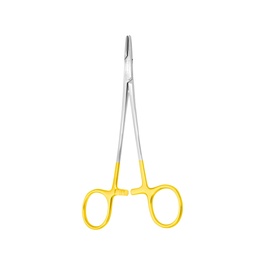
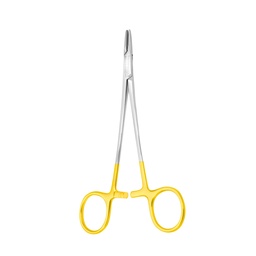
Mayo-Hegar — 2/0 – 4/0
The heavy-duty workhorse. Broad serrated jaws for larger needles and sutures under tension. Choose 13 cm for anterior access, 16 cm for general use.
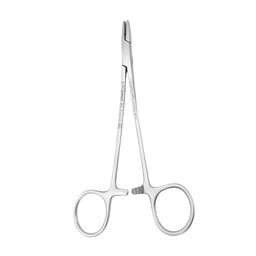
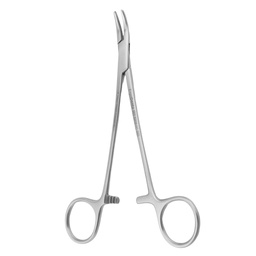
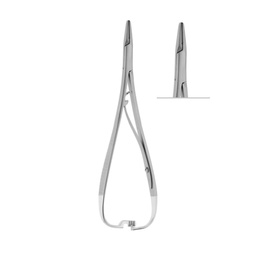
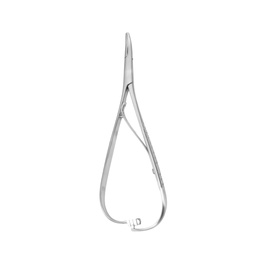
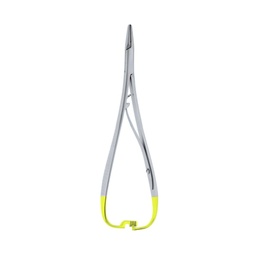
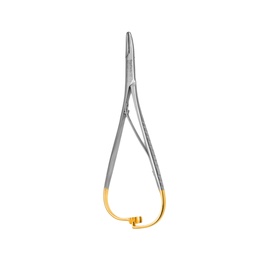
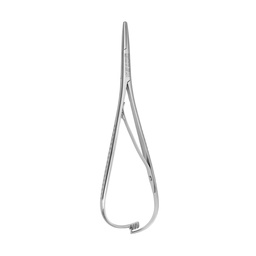
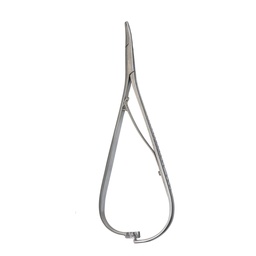
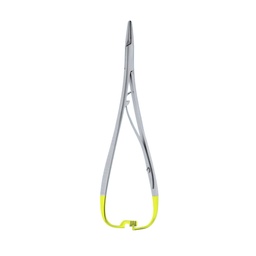
Mathieu & Mathieu Olsen — 3/0 – 5/0
Palm-grip ratchet holders — squeeze to lock, squeeze again to release, without changing your grip. The fastest pattern for routine extraction and flap closure. Olsen variant adds scissor rings for a hybrid grip.
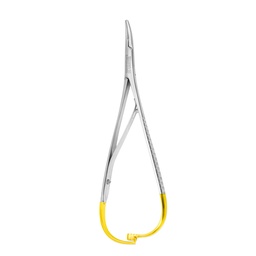
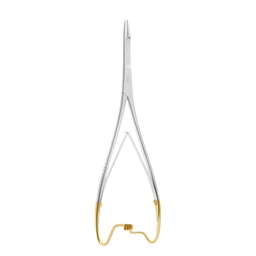
Lichtenberg — 3/0 – 5/0
The classic dental needle holder — ring handles, secure ratchet lock and 17 cm of reach for posterior sites.
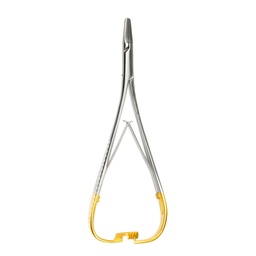
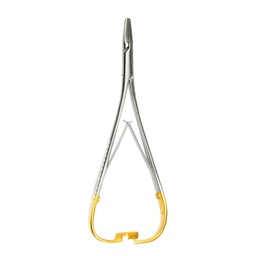
Crile-Wood — 3/0 – 6/0
The versatile all-rounder. Slimmer, longer jaws than Mayo-Hegar span both routine 3/0 closure and finer 6/0 periodontal work — if you own one needle holder, make it this.
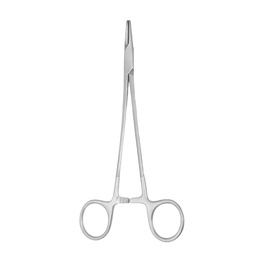
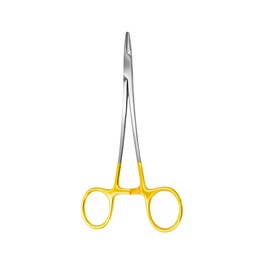
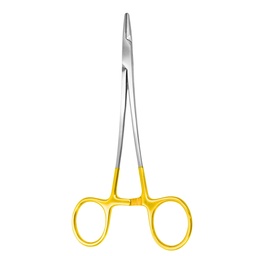
Crile Ryde & Fine Swedish — 4/0 – 6/0
Fine-jaw ring-handle holders that bridge the gap between standard and micro — ideal for periodontal and implant suturing with 4/0–6/0 without switching to a pencil grip.
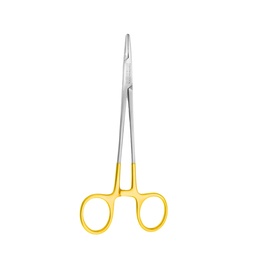
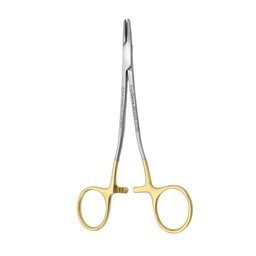
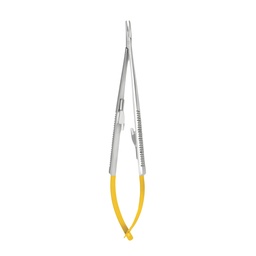
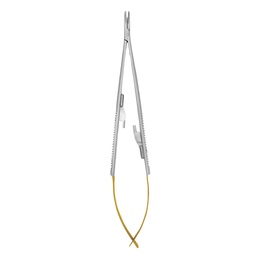
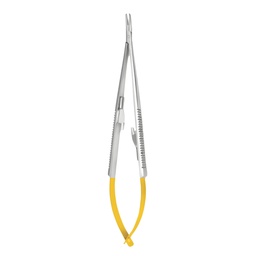
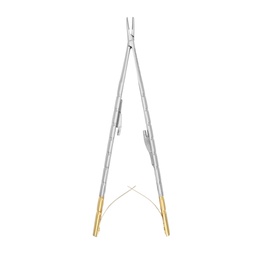
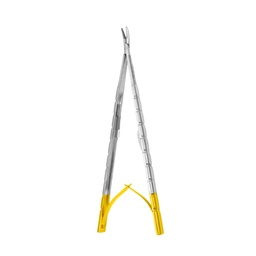
Castroviejo Micro — 5/0 – 8/0
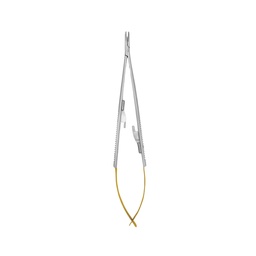
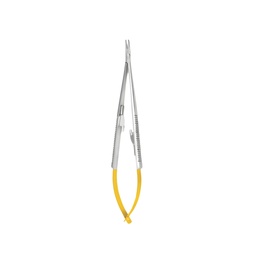
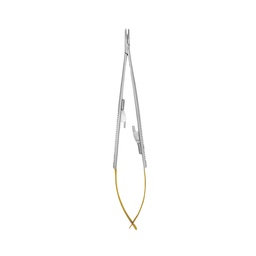
Pencil-grip microsurgical holders with spring action and a gentle lock. The round handle rotates between the fingers for wrist-free needle arcs — the standard for grafts, root coverage and esthetic-zone suturing. Barraquer variant has an extra-delicate jaw.
Care of your needle holders
Needle holders are hinged instruments: rinse immediately after use, clean in a washer-disinfector, lubricate the box lock with medical-grade lubricant, and autoclave at 134 °C (pre-vacuum). Inspect TC inserts regularly — wear shows as a shiny, flattened cross-hatch, and a worn insert lets fine needles rotate. Full step-by-step instructions are on the Reprocessing tab of every product page and at ergodenta.dk/care.
Frequently asked questions
What suture size should I use after a tooth extraction?
3/0 or 4/0 is standard for extraction sites and flap closure — strong enough to hold tissue under tension, forgiving to tie. Pair with a Mathieu, Lichtenberg, Mayo-Hegar or Crile-Wood needle holder.
What is the best suture for wisdom tooth extraction?
Most surgeons close third-molar flaps with 3/0 or 4/0 resorbable suture (PGA or chromic gut) so no removal visit is needed, using an 18 cm Crile-Wood or Mayo-Hegar for posterior reach. Silk is an economical alternative if the patient will return for removal.
What does 4/0 (4-0) mean in sutures?
It is the USP size: four zeros (0000). More zeros = finer thread. A 4/0 suture (~0.2 mm) is thicker than a 6/0 (~0.08 mm) and thinner than a 3/0 (~0.3 mm).
Which needle holder do I need for 5/0 and 6/0 sutures?
A fine-jaw holder: Crile-Wood, Crile Ryde or Fine Swedish handle 5/0–6/0 well; for the most delicate work a Castroviejo micro needle holder gives the best control with its pencil grip and spring action.
Can I use a Castroviejo needle holder with 3/0 sutures?
No. Castroviejo micro needle holders are designed for 5/0–8/0. The heavy needle of a 3/0 suture damages the fine tungsten carbide inserts and will not seat securely. Use a Mayo-Hegar, Mathieu or Crile-Wood instead.
What does TC mean on a needle holder?
Tungsten carbide — jaw inserts made of a metal far harder than stainless steel. TC jaws grip needles more securely, resist wear for years, and are replaceable. TC instruments are traditionally marked with gold-coloured rings or handles.
Mathieu vs. Castroviejo — what is the difference?
A Mathieu is a palm-grip ratchet holder for fast routine suturing with 3/0–5/0 — squeeze to lock, squeeze again to release. A Castroviejo is a pencil-grip microsurgical holder with a spring lock for 5/0–8/0, giving fingertip precision for grafts and esthetic-zone work.
Mayo-Hegar vs. Crile-Wood — which should I buy?
Mayo-Hegar has broader jaws for heavy needles (2/0–4/0) and maximum grip strength. Crile-Wood is slimmer and longer-jawed, spanning 3/0–6/0 — the more versatile choice if you buy only one. Many clinics keep both: Mayo-Hegar for surgical extractions, Crile-Wood for everything else.
What is a needle holder and how is it different from a hemostat?
A needle holder has short, wide jaws with a cross-hatched (often TC) gripping surface and a ratchet lock, built to hold a curved needle rigidly. A hemostat has longer, thinner jaws with transverse serrations for clamping vessels — its jaws are too weak to hold a needle securely and are damaged by trying.
Straight or curved needle holder — which do I need?
Straight is the everyday default and easiest to control. A curved pattern (Mathieu, Castroviejo or Mayo-Hegar curved) improves the line of sight and access in posterior or interproximal areas, letting the hand stay out of the visual field.
What length needle holder is best for dental use?
13–15 cm suits anterior work and small hands; 16–18 cm adds reach for posterior and third-molar sites. Micro work is usually 14–16 cm Castroviejo. If most of your suturing is molar-region, choose the longer pattern.
How do I hold a needle holder correctly?
Ring-handle holders: thumb and ring finger in the rings, index finger extended along the shank for control. Mathieu: in the palm, squeezing with all fingers. Castroviejo: like a pen, rotating the round handle between thumb and fingers. Grip the needle two-thirds back from the tip, locked on the first or second click.
Why does the needle rotate or slip in my needle holder?
Three common causes: the holder is too heavy for the needle size, the needle is gripped at the wrong point, or the TC inserts are worn flat. Check the suture-size range of your holder, reposition the needle perpendicular across the jaw tips, and inspect the insert pattern.
How long should sutures stay in the mouth?
Non-resorbable sutures are typically removed after 7–14 days depending on the site and healing. Resorbable materials break down on their own — chromic gut in roughly 7–10 days, PGA over several weeks. Always follow the clinician's protocol for the specific case.
What sutures are used around dental implants?
PTFE monofilament 4/0–5/0 is the modern first choice: it does not wick bacteria, stays soft, and removes cleanly at review. Nylon is a good alternative. Pair with a fine-jaw holder such as the Crile Ryde or Fine Swedish.
Are ErgoDenta needle holders autoclavable?
Yes — all ErgoDenta needle holders are fully autoclavable at 134 °C (pre-vacuum). They are supplied non-sterile and must be reprocessed before first use. See the Reprocessing tab on each product page.
Explore the full needle holder range
Every model lists its recommended suture sizes — from Mayo-Hegar to Castroviejo Micro. Danish-inspired ergonomic design, TC jaws, fully autoclavable.
Shop Needle Holders →