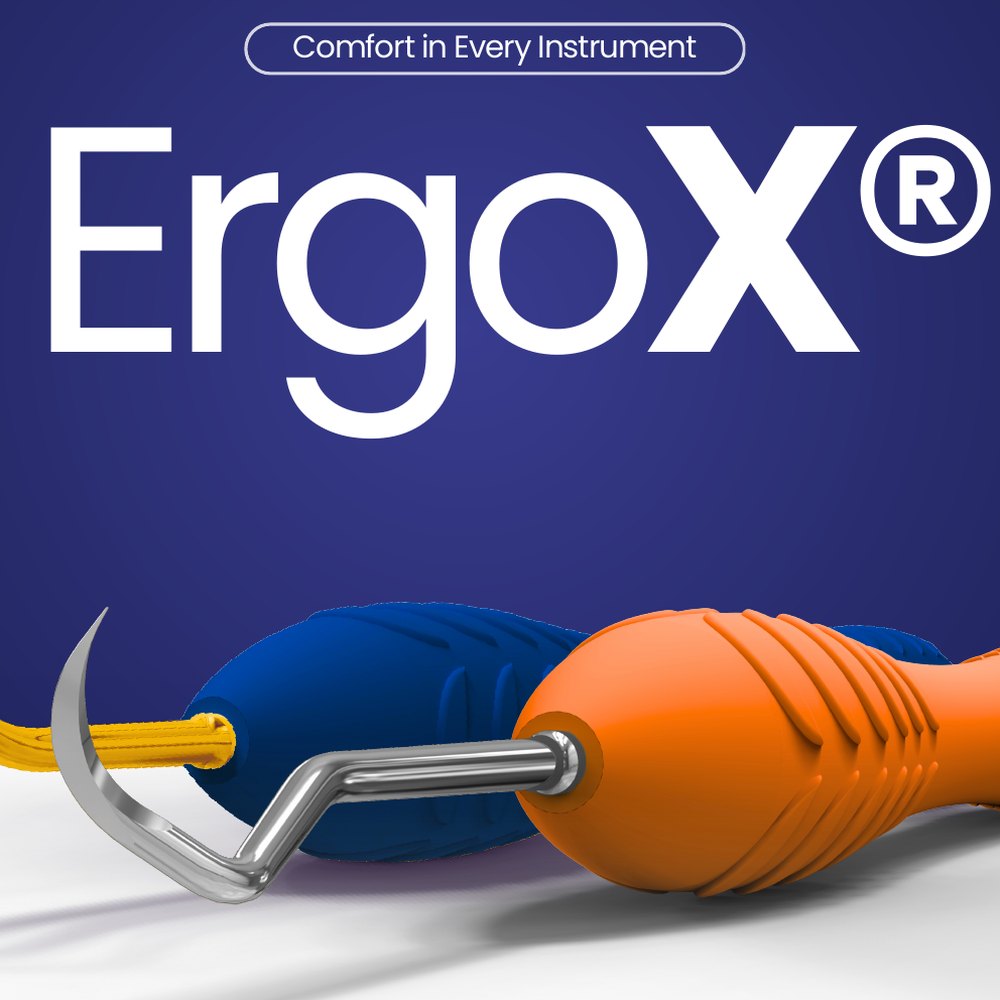
Good surgical access is half the procedure. A retractor that holds soft tissue and bone out of the way — without slipping, without crushing the flap, without blocking your light — lets you operate cleanly and finish faster. Here are the dental retractors that matter and when to reach for each.
Retractors hold back cheeks, lips, tongue, flaps and bone so the surgical field stays open and visible. In oral and maxillofacial surgery a handful of designs cover almost every case. This guide explains the main surgical retractors ErgoDenta makes and the job each one is built for.
The main dental retractors
Langenbeck retractor
The workhorse flap retractor. A right-angled blade on a handle holds a mucoperiosteal flap or cheek away from the bone during ostectomy, implant placement and cyst removal. ErgoDenta offers two blade sizes (29 × 10 mm and 42 × 11 mm) so you can match the depth and width of the field.
Farabeuf retractor
A double-ended, hand-held flat retractor supplied as a pair, used to retract soft tissue and small flaps in more superficial work. Its smooth, broad blades distribute pressure and protect the flap edge.
Cawood-Minnesota cheek retractor
A curved cheek-and-flap retractor that gives wide exposure of the buccal field — a favourite for third-molar surgery and implant work. ErgoDenta also makes a Minnesota-style tongue holder for controlling the tongue during floor-of-mouth procedures.
Bowdler Henry (rake) retractor
A pronged, angled retractor designed for apical (periapical) surgery — it holds the flap and cheek away during apicoectomy so the root end is accessible. For deeper apical access ErgoDenta also makes toothed apicoectomy retractors angled at 45° and 90°.




How to choose a retractor
- Raising and holding a flap over bone: Langenbeck — pick the blade size to match the field.
- Wide buccal exposure (third molars, implants): Cawood-Minnesota cheek retractor.
- Apical / periapical surgery: Bowdler Henry, or a toothed apicoectomy retractor for deeper access.
- Superficial soft-tissue retraction: Farabeuf pair.
- Tongue control: Minnesota tongue holder.
Choose a blade that is wide enough to hold the whole flap (so the edge doesn't dig in) and an angle that keeps your hand and the retractor out of your line of sight and light.
Looking after surgical retractors
Retractors are simple, robust instruments, but the working edge and any teeth/prongs should be inspected for bending and burrs. Clean, lubricate hinged tongue holders, and autoclave per your reprocessing protocol. Danish-inspired ErgoDenta retractors are made from surgical stainless steel for repeated sterilisation.