
Color-coded dental instrument kits — operatory workflow guide
Coloured rings, coloured tape, coloured cassettes — a few seconds of colour-coding saves minutes per procedure across the operatory. Here's how to build a system that pays for itself in the first week.
In a busy operatory, the slowest moments aren't the clinical steps — they're the in-between moments: identifying the right tray, finding the right instrument, confirming sterilisation status. Colour-coding turns those moments into instant visual recognition. ErgoDenta's organising range covers the full workflow: 16 colour-coded rings, 9 ErgoTape colours, 22 ErgoTrays, and 35 sterilisation cassettes.



Why colour-code instruments at all?
Three operational gains, repeated dozens of times per day:
- Faster setup — the assistant identifies "blue tray = restorative" at a glance and pulls it from the cassette stack without reading labels.
- Faster turnover — instruments returning from sterilisation get sorted by colour back into the correct trays without the assistant having to identify each piece individually.
- Lower error rate — instruments that escape from one cassette into another are spotted immediately. A red ring on a perio cassette obviously doesn't belong if your perio code is green.
Most practices that adopt colour-coding report 10–20 minutes per chair saved per day — the system pays for itself in the first week.
Chapter 2The four building blocks
- Color-coded rings — silicone rings (Large 25/box, Small 50/box) that snap onto the handle of any hand instrument. The colour identifies the procedure (perio = green) or the operator (Dr. Smith = blue).
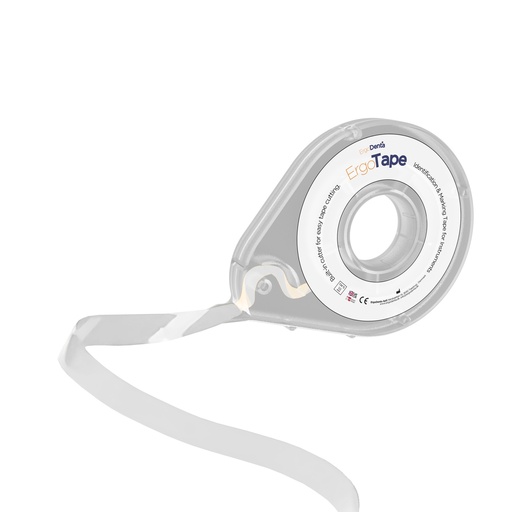
- ErgoTape — colour-marking tape (10 m × 5 mm, 8 colours) that wraps around any instrument, handpiece or cassette for additional identification. Available in black, blue, dark/light yellow, pink, purple, red, white.
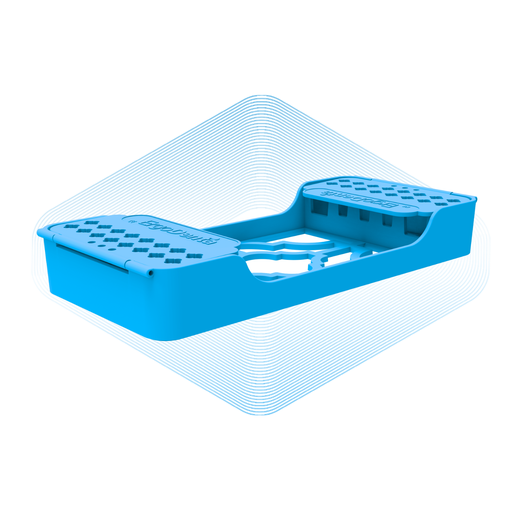
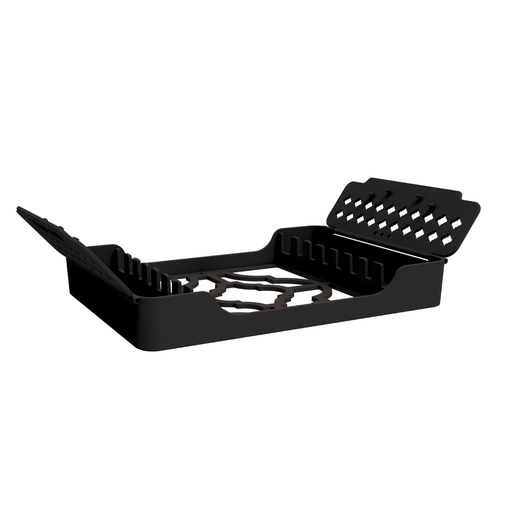
- ErgoTrays — colour-coded plastic instrument trays in two sizes (180×86 and 180×136 mm) and 8 colours. The tray itself signals the procedure type before any instruments are loaded.
- Sterilisation cassettes — perforated stainless or coloured cassettes that hold the instrument set during reprocessing and storage. Colour-band stickers or coloured cassette frames complete the system.
A practical colour scheme
There's no single right way to assign colours, but a workable starter scheme groups by procedure type:
- Blue — Restorative (composite, amalgam)
- Green — Periodontal (curettes, scalers, probes)
- Red — Surgical (extractions, sutures, hemostats)
- Yellow — Endodontic (files, pluggers, spreaders)
- Pink — Pediatric / orthodontic
- White — Diagnostic / examination
- Black — Doctor's personal kit
- Purple — Hygiene / prophy
Whatever scheme you pick, write it down, laminate it, post it in the sterilisation room. Consistency is the entire benefit.
Chapter 4Operator colour-coding (multi-doctor practices)
In multi-doctor or multi-hygienist practices, a second colour layer identifies the operator. ErgoTape on the cassette frame or a coloured ring on the doctor's preferred mirror handle signals "Dr. Smith" or "Hygienist Anna". This solves the daily problem of doctors borrowing each other's preferred instruments and never returning them.
The Color-Coded Rings range covers 8 colours in two sizes — enough for 4 procedure codes layered with 4 operator codes in most practices.
Chapter 5Sterilisation status tracking
The third colour layer is sterilisation status. Use coloured indicator tape or coloured cassette frames to mark:
- Used / contaminated — sitting in the dirty zone awaiting reprocessing.
- Cleaned / sterilised this week — ready for use, dated.
- Long-term storage — pre-sterilised, sealed, awaiting deployment.
Most practices use two-colour rotation (e.g., red for current week, blue for previous week) so the assistant can immediately see which cassettes are within their use-by window.
At a glanceThe four colour-coding building blocks
| Element | Sizes | Colours | Best for |
|---|---|---|---|
| Color-coded rings (Large) | 25 pcs/box | 8 colours | Mark hand instruments by procedure or operator |
| Color-coded rings (Small) | 50 pcs/box | 8 colours | Probes, explorers, fine instruments |
| ErgoTape | 10 m × 5 mm | 8 colours | Wrap cassettes, handpieces, custom marking |
| ErgoTrays | 180×86 / 180×136 mm | 8 colours | Procedure-type tray identification |
| Sterilisation cassettes | Various | Various with frames | Hold instrument sets through reprocessing |
Build your operatory colour-coding system
16 colour-coded rings + 9 ErgoTape colours + 22 ErgoTrays + 35 sterilisation cassettes — the full ErgoDenta organising range.
Browse all organising products →Frequently asked questions
Are colour-coded rings autoclavable?
Yes — ErgoDenta colour-coded rings are made from medical-grade silicone that withstands standard 134°C autoclave cycles indefinitely. They retain colour and elasticity through hundreds of cycles. Replace only when visibly degraded or torn.
Do colour-coded rings interfere with the use of dental instruments?
No — the rings are designed to sit at the proximal end of the handle (away from the working end). They don't change the grip, balance or autoclavability of the instrument. Many operators find that the rings actually improve grip stability.
How should I assign colours to procedures?
There's no universal standard — pick a scheme that works for your practice and stick to it. A common starter scheme: blue (restorative), green (perio), red (surgical), yellow (endo), white (diagnostic), pink (pedo), black (doctor's personal). Write it down, laminate it, post it in the sterilisation room.
Can I use colour-coding to track sterilisation status?
Yes — many practices use a two-colour rotation on cassette frames: red for current week, blue for previous week. The assistant immediately sees which cassettes are within their reprocessing window. ErgoTape (10m × 5mm) is ideal for this layer because it can be added or removed quickly.
What's the difference between Large and Small colour-coded rings?
Large rings (25 pcs/box, ~3-4 mm internal diameter) fit standard hand instrument handles. Small rings (50 pcs/box, ~2 mm internal diameter) fit thinner instruments — fine probes, explorers, microsurgical tools. Most operatories stock both sizes.
How many colours do I need to start?
Four colours cover most setups: blue (restorative), green (periodontal), red (surgical), yellow (endodontic). Add white (diagnostic) and black (doctor's personal) as the system matures. The 8-colour assorted ErgoTape pack is a good way to test multiple colours before committing to large purchases.
Should every instrument have a colour ring?
No — only instruments where misidentification or misplacement causes friction. Universal instruments (mirrors, basic probes) often go unmarked; specialty instruments (perio curettes, endo files, surgical hemostats) benefit most from colour-coding.
Can ErgoTape be removed and reused?
ErgoTape is designed for permanent or semi-permanent marking — it bonds to the surface during the first autoclave cycle and is difficult to remove cleanly afterward. For temporary or rotational marking (sterilisation status tracking), the silicone rings are easier to swap.
How do colour-coded ErgoTrays differ from sterilisation cassettes?
ErgoTrays are the procedure-type setup tray that the assistant brings to the chair — coloured plastic, designed for daily use and easy cleaning. Sterilisation cassettes are perforated metal frames designed to hold the instrument set during the autoclave cycle. The two work together: the ErgoTray colour signals procedure type at the chair; the cassette colour can signal sterilisation status.
Will a colour-coding system slow down the sterilisation team?
Initially yes — the team needs 1–2 weeks to memorise the scheme and develop sorting habits. After that, the system actually speeds up sterilisation because instruments get sorted by colour back into correct cassettes without anyone having to read labels or identify each piece individually.