
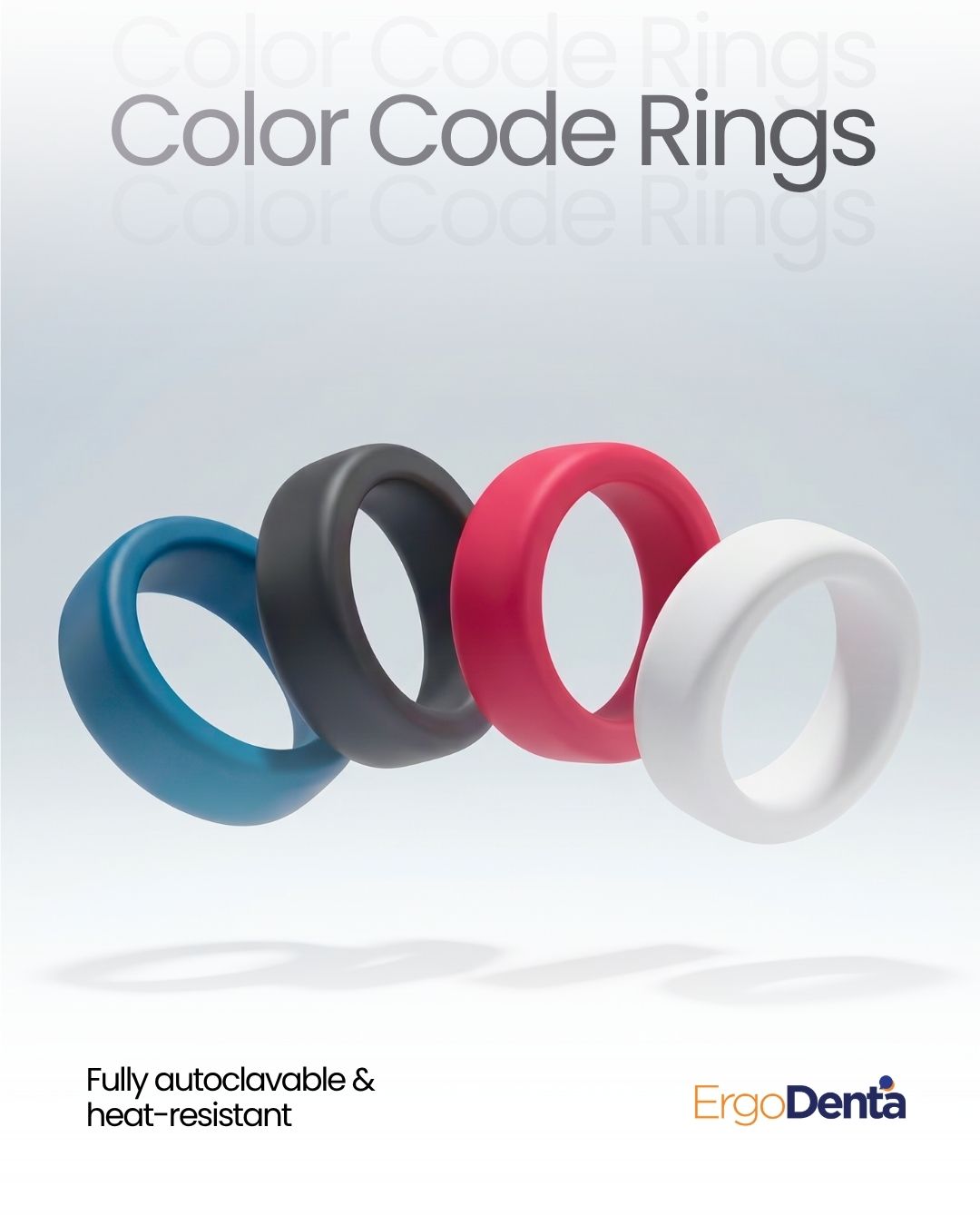
Every clinic has the same daily problem: the perio kit and the restorative kit and the surgical kit are all on the same tray, and the hygienist has to read the tip of every instrument to find the right one. Three seconds per pickup, fifty pickups per day, four staff. That is measurable lost chair time — and a measurable risk of mixing instrument families.
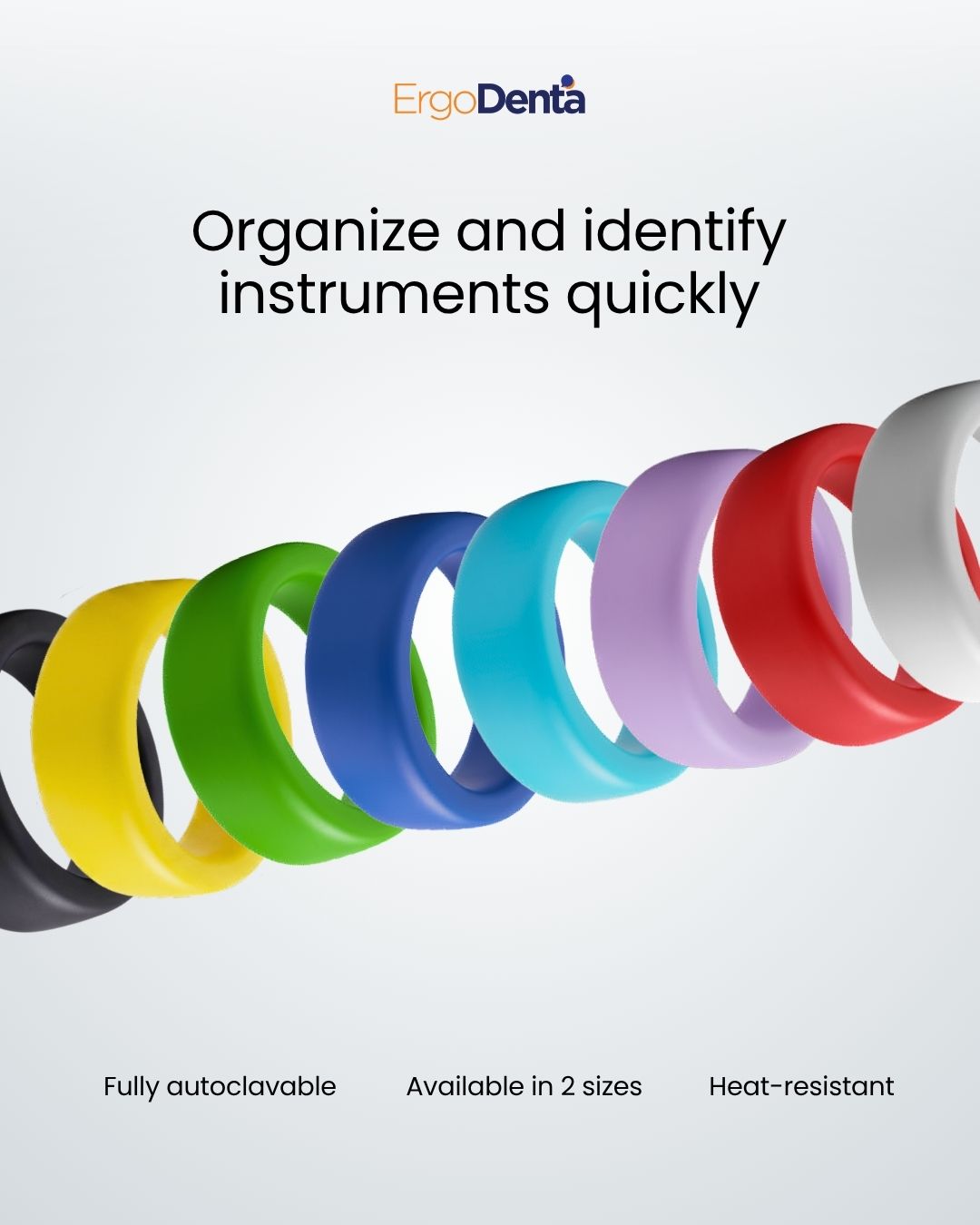
Color-code rings solve it in 30 seconds: slide one onto the handle, and the instrument now has a colour identity. Green for periodontics. Blue for restorative. Red for surgery. Yellow for endodontics. The hygienist sees the colour before they read the tip.
TL;DR
ErgoDenta Color Code Rings are autoclavable silicone rings that slide onto any dental instrument handle. 2 sizes (Small for hand instruments, Large for forceps and wide handles). 8 colours (black, yellow, green, blue, light blue, lavender, red, white). Sold per-colour in boxes of 50 (small) or 25 (large), or as mixed-colour assortment boxes. Fully autoclavable up to 134°C, heat-resistant, food-grade silicone.
How clinics use color-coding
The most common workflow is colour by procedure family:
- Green → Periodontics (scalers, curettes, probes)
- Blue → Restorative (composite instruments, plastics, condensers)
- Red → Surgery (extraction forceps, elevators, periotomes)
- Yellow → Endodontics (explorers, files, spreaders)
- White → Diagnostic (mirrors, probes)
- Black → Sterilization-tracking (rotated weekly to prove cycle)
The other common workflow is colour by clinician — Dr. Anders gets blue rings, Dr. Pia gets green, Dr. Petter gets red. Useful in multi-doctor practices where instruments accidentally end up in the wrong tray. The colour tells you whose kit it belongs to before it leaves the autoclave.
Two sizes — Small for hand instruments, Large for forceps
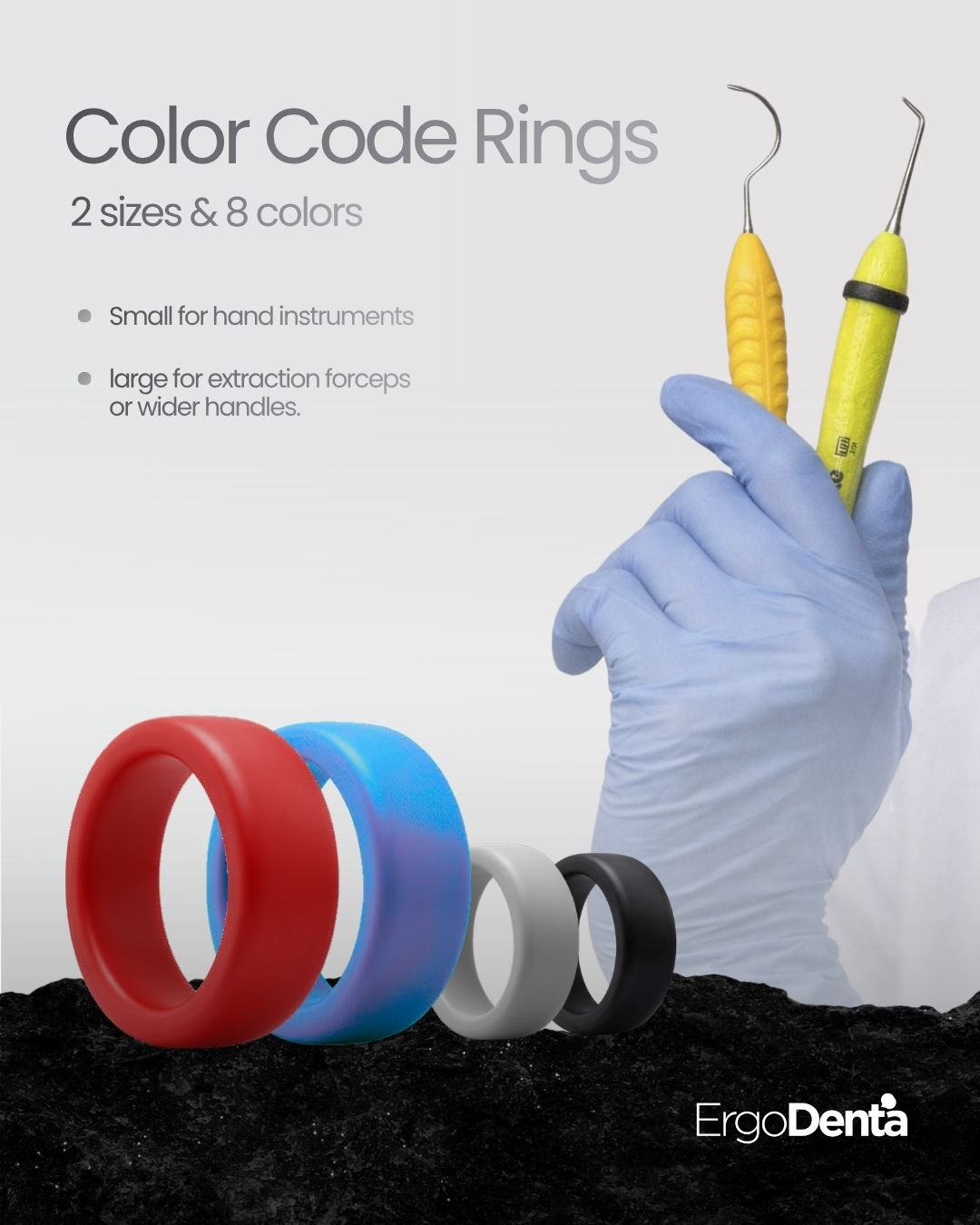
Small rings fit standard dental hand instrument handles (~6–8mm grip diameter) — scalers, curettes, probes, mirrors, composite instruments, every silicone or steel-handled instrument in the clinic. Each Small box ships with 50 pieces in one colour.
Large rings fit wider handles — extraction forceps, elevators, surgical handles, GripMaster patterns. Each Large box ships with 25 pieces in one colour (the rings are wider so fewer fit per box).
Browse — small rings (50 pcs/box per colour)
Each box contains 50 rings of one colour, packaged in a clear lid box for easy identification on the shelf.
Browse — large rings (25 pcs/box per colour)
Sized for extraction forceps and wider handles. 25 rings of one colour per box.
Available in 8 colours — pick the system that fits your clinic
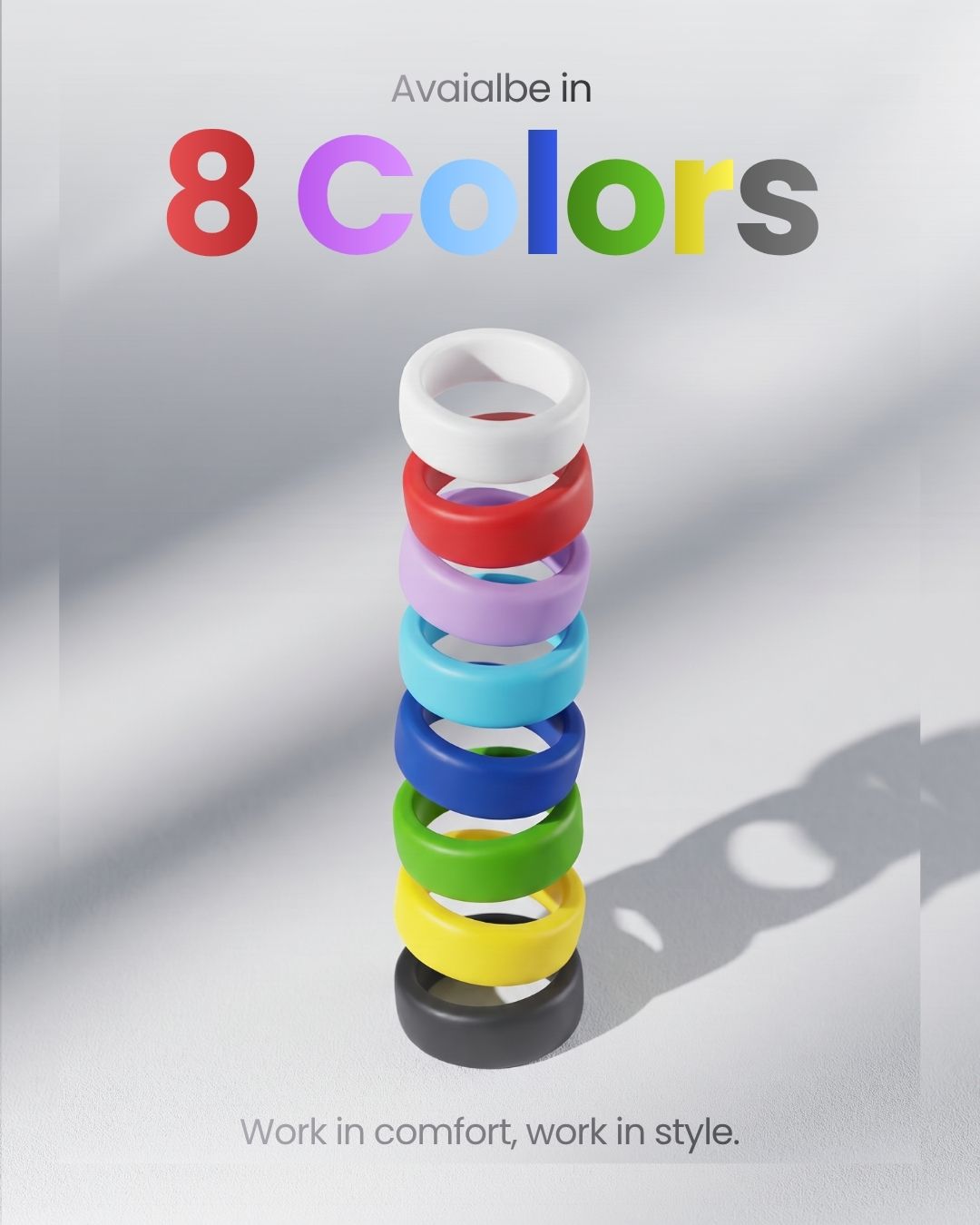
The 8-colour palette gives every clinic enough range to encode procedure family and clinician and sterilization week if needed. Most practices settle on 4–5 active colours; the remaining colours stay in reserve for new procedures or special cases.
Box options — single-colour vs. mixed assortment
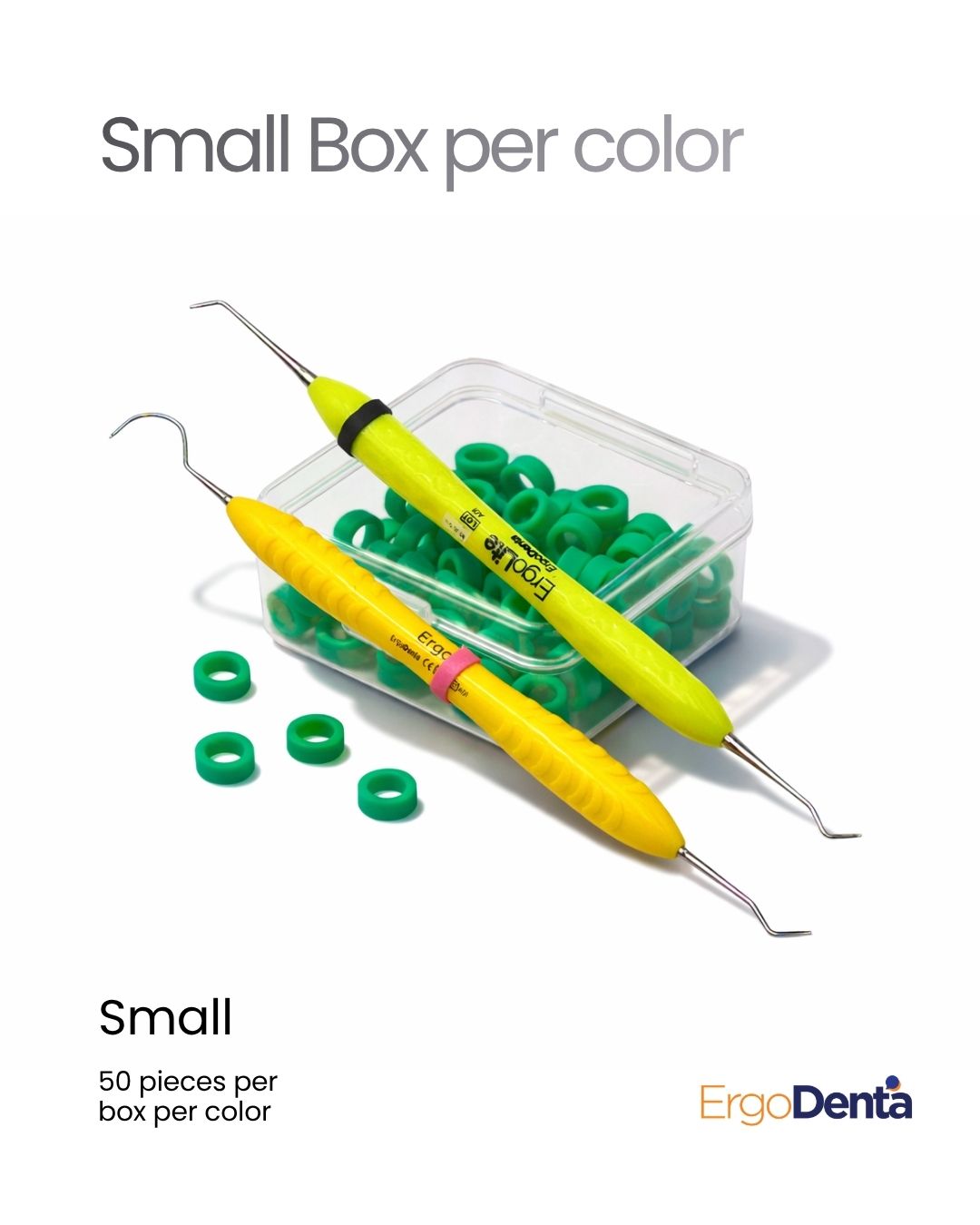
Single-colour boxes work best for clinics that have already decided their system — buy a box of green for the perio kit, refill once a year. Each Small single-colour box: 50 pieces. Each Large single-colour box: 25 pieces.
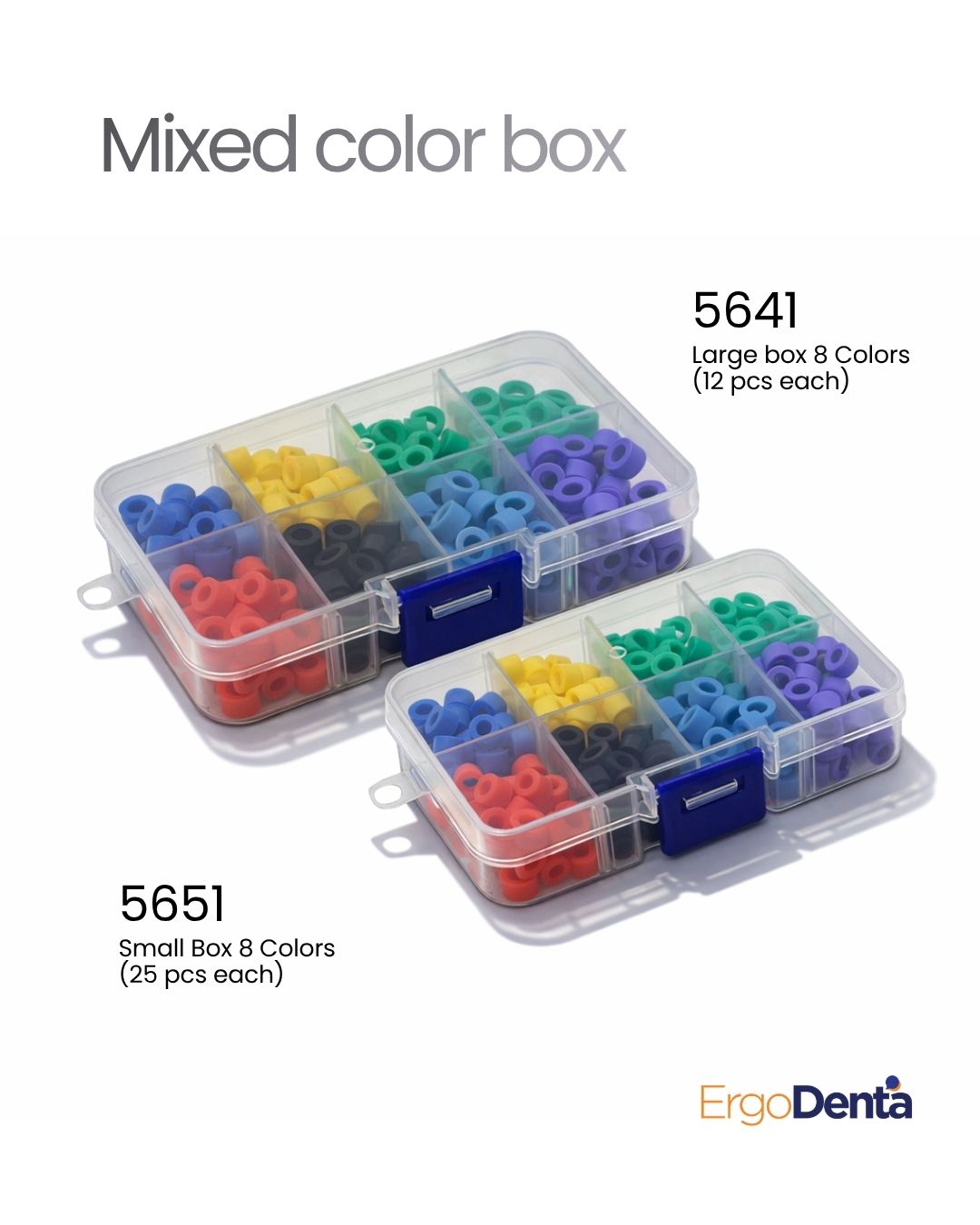
Mixed-colour assortment boxes are perfect for getting started — try every colour, decide your system, then refill the colours you actually use.
- Small Mixed Box (SKU 5651) — 8 colours × 25 pieces each = 200 small rings total
- Large Mixed Box (SKU 5641) — 8 colours × 12 pieces each = 96 large rings total
Distributors typically stock the assortment box first to demo the system to clinics, then carry single-colour refills as their network grows.
Sterilization-safe — fully autoclavable up to 134°C
The rings are made from medical-grade silicone rated for full autoclave cycles (gravity, pre-vacuum, and B-class) up to 134°C / 273°F. They tolerate routine ultrasonic cleaning and chemical disinfectants without dimensional change. The colour is integral to the silicone, not a coating — it does not fade, peel, or leach into the autoclave chamber.
Service life: typically 200–400 sterilization cycles per ring before the silicone hardens enough that you should rotate it out. Practical replacement schedule: refill ring stock every 12–18 months, depending on cycle volume.
Fitting the rings — 30 seconds per instrument
- Pick the ring colour for the instrument's family (or clinician)
- Stretch the ring over the working end (it expands easily — silicone is forgiving)
- Slide it down to the grip area, just below the working end
- Done. The ring stays put through every cycle.
For wider handles like forceps, use Large rings — the Small ones will stretch but won't seat properly on a 9mm+ grip diameter.
Why dental clinics adopt color-coding
- Less time identifying instruments — the colour is read at a glance, not by squinting at the tip.
- Fewer mix-ups between procedure trays — a green ring in the surgical kit is immediately obvious as misplaced.
- Faster setup and breakdown — a multi-procedure clinic can pre-assemble colour-coded trays in minutes.
- Sterilization tracking — rotate the colour weekly and you have a visual record of when an instrument last cycled.
- Brand differentiation — multi-doctor practices can give each clinician their own colour signature.
What to know before ordering
- Pick your size first. Small fits standard hand instruments. Large fits forceps and wider handles. Most clinics stock both.
- Decide your colour system before buying refills. The Mixed Box is the cheapest way to test.
- Buy in single-colour refills once the system is set — the per-ring volume is higher for the colours you use most.
- 50 small rings or 25 large rings per colour typically last a single-doctor clinic 6–12 months.
Frequently asked questions
Are the rings safe in autoclave cycles?
Will the rings fit any dental instrument?
How long do they last?
Can I order just one colour?
What is the most common colour-coding system?
Are the rings food-grade silicone?
Build your dental instrument range with ErgoDenta
3,300+ instruments with Danish-inspired ergonomic design. One supplier. Full documentation. Ready to ship from Denmark.