Instrument Guide · Periodontics
Sickle Scalers Explained — H6/H7, 204S, 204SD and When to Use Each
The sickle scaler is the periodontal instrument every clinician reaches for first when there's heavy supragingival calculus to remove. Pointed tip, two cutting edges, triangular cross-section — built for decisive strokes. But not every sickle is the same. Here's what the H6/H7, 204S, 204SD and M23 designs are actually for, and how to pick the right one.
What is a sickle scaler?
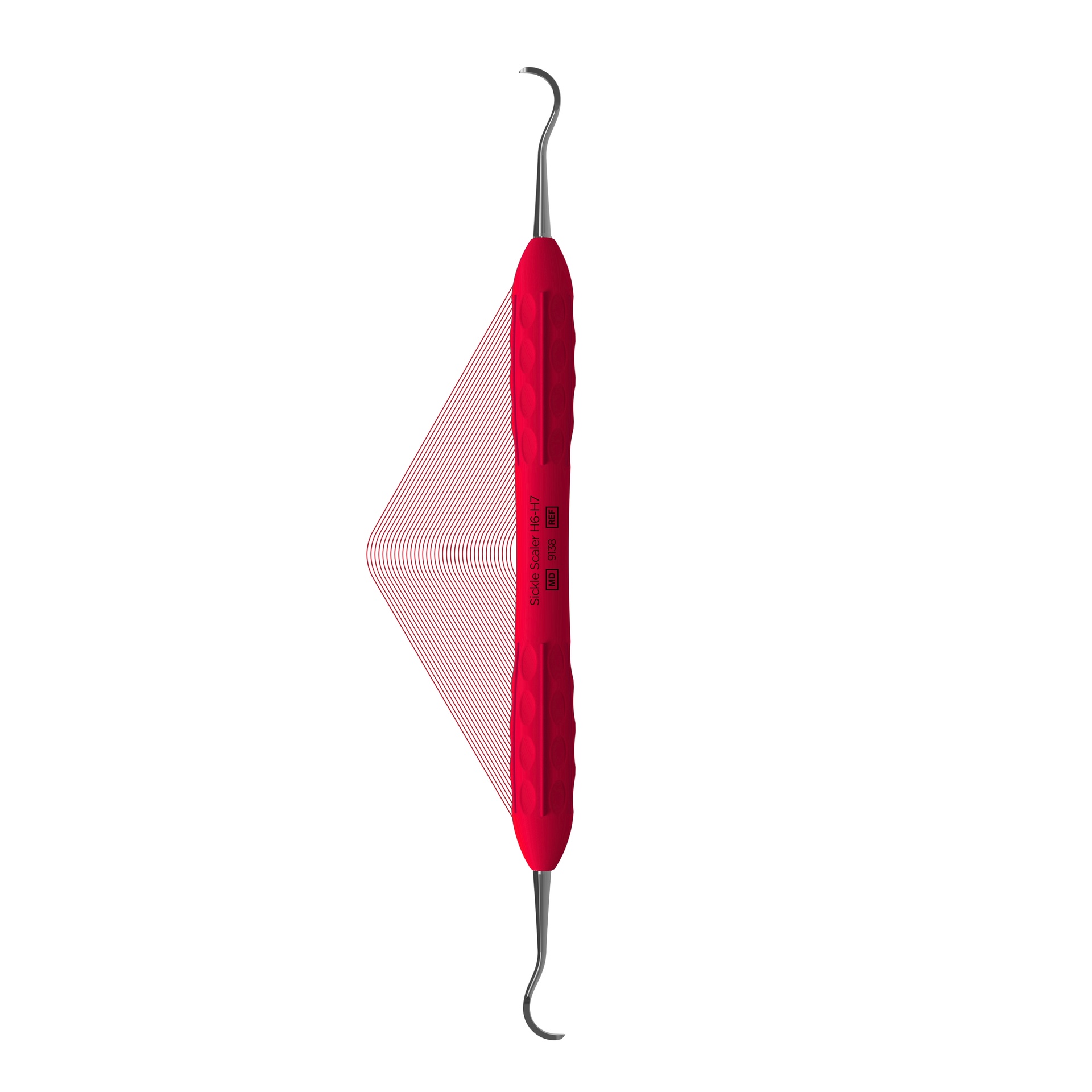
A sickle scaler is a single- or double-ended periodontal hand instrument with a pointed working tip, a triangular cross-section (giving it two cutting edges), and a face that meets the lateral surfaces at a 70–80° angle. That geometry makes it ideal for shearing calculus off enamel above the gum line — but the same sharp point and rigid blade are exactly why it should never be used sub-gingivally on root cementum.
The four classic sickle designs
| Design | Where to use | Why |
|---|---|---|
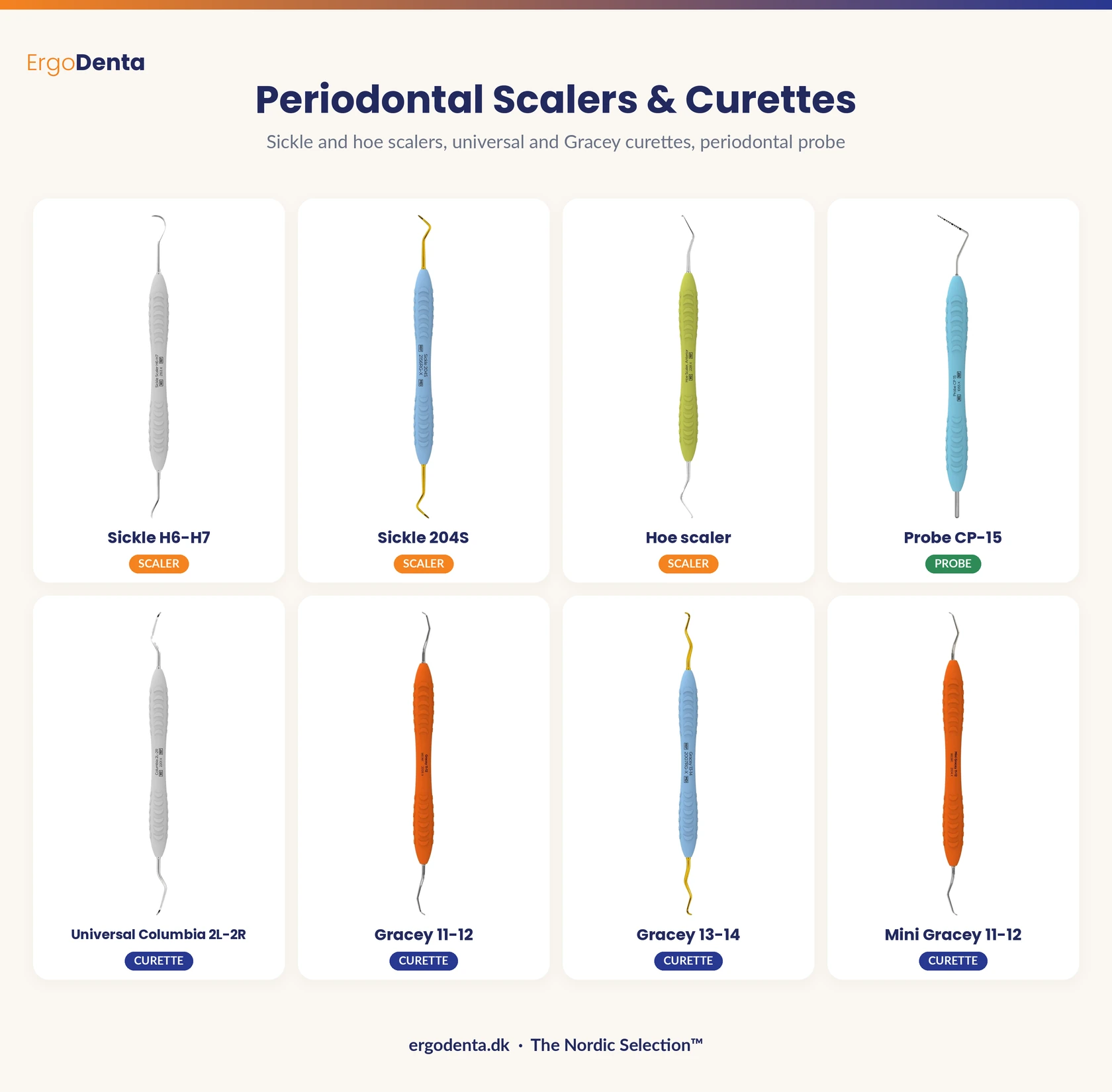
| H6/H7 | Anterior teeth (incisors, canines) | Slim straight blade ideal for the smaller anatomy and tight inter-proximals of the front of the mouth |
| 204S | Posterior, buccal & lingual | Larger contra-angled blade reaches the back of the mouth without operator wrist contortion |
| 204SD | Posterior, double-curved | Modified 204 with a steeper second curve — best for distal molar surfaces and tight access |
| M23 | Universal anterior | The classic universal anterior sickle, popular with hygienists trained in the US system |
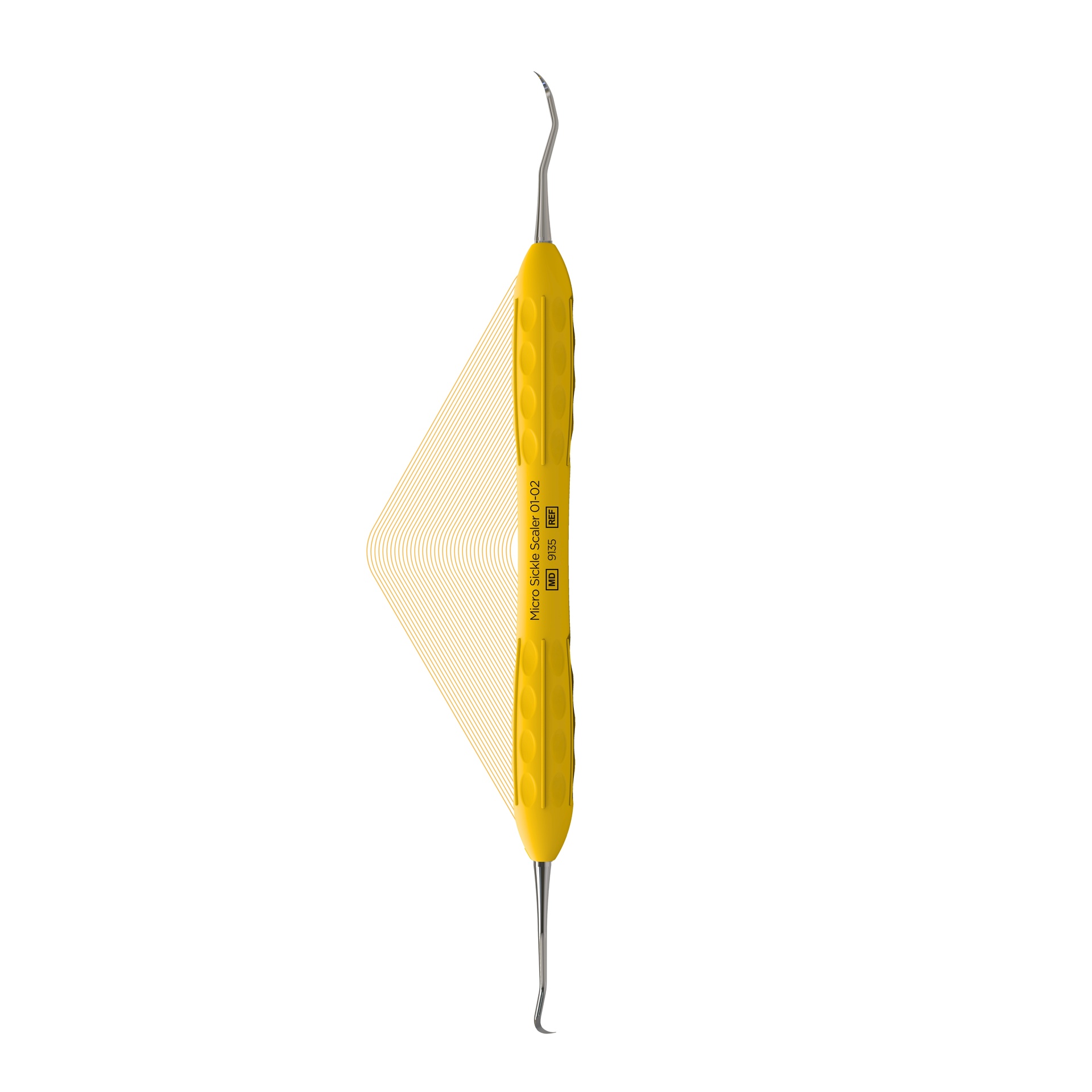
Mini Sickle & Micro Sickle (11-12 / 01-02)
Mini and micro variants have shorter, narrower blades for inter-proximal access on lower anteriors and around bridgework where the standard blade simply doesn't fit.
Sickle scaler vs hoe scaler vs curette — quick reference
| Instrument | Cutting edges | Working area |
|---|---|---|
| Hoe scaler | 1 straight | Heavy supra calculus, smooth surfaces |
| Sickle scaler | 2, pointed tip | Supra calculus, inter-proximal, mild-to-moderate |
| Gracey curette | 1 rounded toe | Sub-gingival, root planing, area-specific |
The ErgoDenta sickle scaler range
- 9138 — Sickle Scaler H6-H7 (ErgoLite X handle)
- 9139 — Sickle Scaler 204S (ErgoLite X)
- 9137 — Sickle Scaler M23 (ErgoLite X)
- 9134 — Mini Sickle Scaler 11-12
- 9135 — Micro Sickle Scaler 01-02
- 2153TB-SP — Implant-safe Titanium variant (Blue)
Care & sharpening
A dull sickle is the enemy of a calm scaling appointment — you push harder, the patient flinches, the blade skips off the calculus and gouges the enamel. Sharpen on an Arkansas or fine India stone every 4–8 patients depending on calculus load. Sterilize at 134 °C following local protocols and inspect the tip for chips before every use.
ErgoDenta sickle scaler range — H6/H7, 204S, 204SD, M23 & more
Browse the complete sickle scaler range across ErgoRazor® premium, ErgoDenta standard, and ErgoTip replaceable-tip systems. Available with titanium-coated tips for implants where standard steel can scratch the implant surface.
Frequently asked questions
When should I use a sickle scaler instead of a Gracey curette?
Use a sickle for supragingival calculus on enamel surfaces. Use a Gracey curette for sub-gingival deposits and root planing. The pointed sickle tip can damage cementum and lacerate sulcular tissue if used below the gum line.
What's the difference between H6/H7 and 204S?
H6/H7 is the anterior design — slim, straight blade for incisors and canines. 204S is the posterior design — contra-angled blade for back teeth, buccal and lingual surfaces.
What is a 204SD?
A 204SD is a modified 204S with a steeper double curve, designed for the distal surfaces of molars and tight access areas behind second/third molars.
Can I use a sickle scaler on dental implants?
Standard stainless-steel sickle scalers can scratch implant surfaces and titanium abutments. For peri-implant maintenance use a titanium-coated implant-safe variant such as the ErgoDenta 2153TB-SP.
How often should I sharpen a sickle scaler?
Sharpen every 4–8 patients depending on calculus load. A sharp sickle requires less force, less wrist effort, and produces less patient discomfort. Replace when the blade is half its original length.