Instrument Guide · Periodontics
Hoe Scaler — What It Is, When to Use It, and How to Choose One
A hoe scaler is a single-ended dental hand instrument with a chisel-like working tip used to remove heavy supragingival calculus and stained deposits from the smooth surfaces of teeth. It's a workhorse for hygienists and periodontists facing tenacious build-up that finer scalers can't remove efficiently.
What is a hoe scaler?
The hoe scaler takes its name from the gardening hoe — its blade meets the shaft at a near-right angle, with a single straight cutting edge oriented perpendicular to the tooth surface. When pulled coronally (away from the gum line), the edge "shaves" calculus off the tooth in a controlled, decisive stroke.
Hoe scalers are used only on supragingival deposits (above the gum line) and on smooth, accessible surfaces — never sub-gingivally and never around restorative margins or implants where the rigid edge could cause damage.
When to use a hoe scaler
- Heavy, tenacious supragingival calculus on buccal, lingual, and proximal surfaces of anterior or posterior teeth.
- Initial gross debridement before fine scaling and root planing.
- Accessible smooth surfaces — never deep in the sulcus or around delicate restorations.
- Stain removal on enamel, especially nicotine and chlorhexidine staining on the lingual of mandibular incisors.
The 3 main hoe scaler designs (and when to pick each)
Anterior hoe scaler
Designed for the buccal and lingual surfaces of the front teeth. The blade angle is straighter, suiting the flatter facial anatomy of incisors and canines. Use with short, controlled vertical strokes pulling toward the incisal edge.
Browse the ErgoDenta Hoe Scaler — Anterior →
Lateral hoe scaler
Curved working end shaped for the lateral (mesial and distal) surfaces of teeth. The angled blade lets the operator reach into proximal areas without a tilted hand position — particularly useful for premolars.
Browse the ErgoDenta Hoe Scaler — Lateral →
Posterior hoe scaler
Sharper blade angulation and a longer shank for back-of-mouth access — molars and premolars where leverage and reach matter most. The wider blade footprint speeds bulk calculus removal on broad buccal/lingual molar surfaces.
Browse the ErgoDenta Hoe Scaler — Posterior →
Hoe scaler vs sickle scaler vs curette — what's the difference?
| Instrument | Working tip | Use |
|---|---|---|
| Hoe scaler | Single straight blade, ~99° to shank | Heavy supragingival calculus, smooth surfaces |
| Sickle scaler | Pointed triangular blade, two cutting edges | Supragingival, interproximal access |
| Curette (Gracey) | Rounded toe, single working edge per face | Subgingival deposits, root planing |
Cross-link to related Mini Sickle Scaler 11-12 ErgoRazor® or Gracey curette range.
How to choose a hoe scaler
- Anatomy match. Pick the design (anterior / lateral / posterior) for the area you scale most.
- Steel quality. Premium surgical stainless steel holds its edge longer and resists corrosion through repeated autoclave cycles.
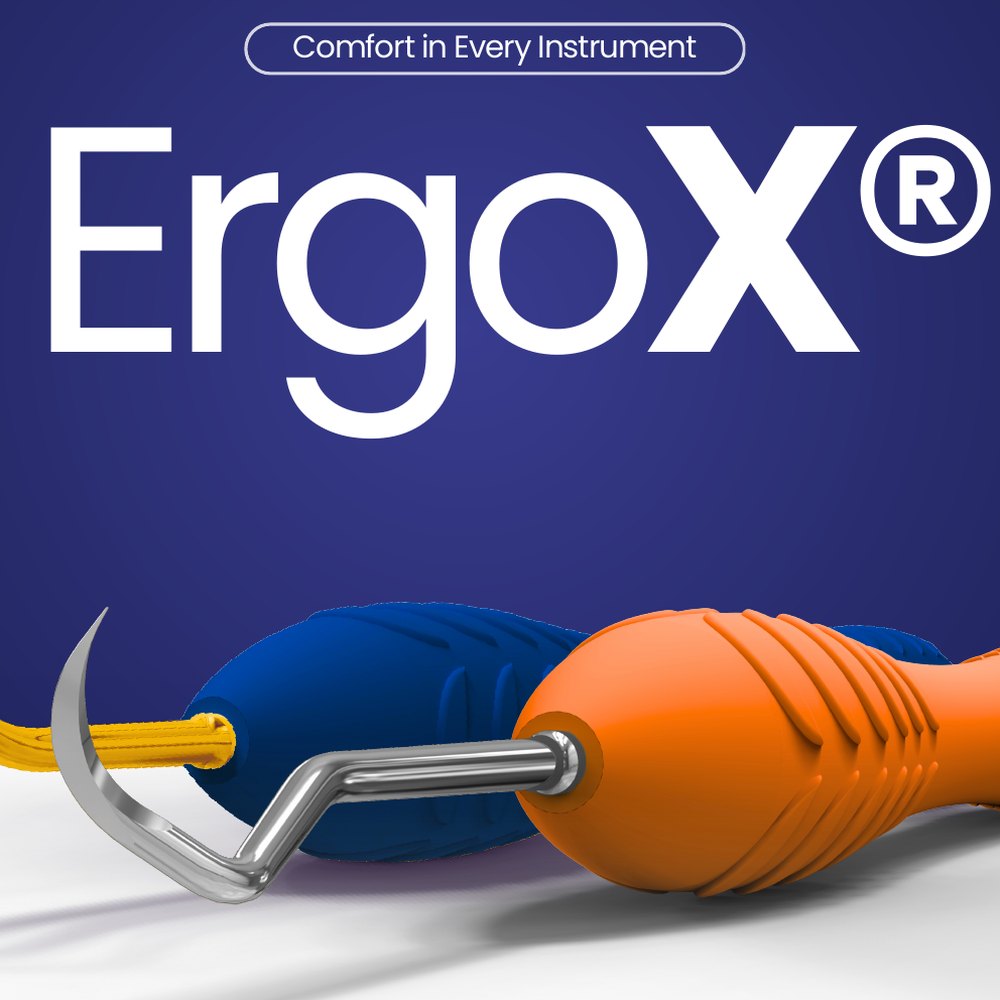
- Handle weight & grip. A lighter, knurled or silicone-padded handle reduces hand fatigue over long appointments. ErgoDenta hoe scalers ship with the ergonomic ErgoSteel handle as standard.
- Sharpenability. A re-sharpenable blade extends the instrument's working life and protects your investment.
Care & maintenance
- Rinse immediately after use to prevent debris drying onto the blade.
- Ultrasonic clean, then autoclave at 134 °C following local sterilisation protocols.
- Sharpen on a fine Arkansas or India stone whenever the edge dulls — typically every 4–8 patients depending on calculus load.
- Inspect the blade tip for chips and discard any instrument with a damaged edge to avoid lacerating gingiva.
The ErgoDenta Hoe Scaler range
All three ErgoDenta hoe scaler designs are made from premium surgical stainless steel, fitted with the ergonomic ErgoSteel hand-friendly handle, and validated for full autoclave cycles. CE-marked (EU MDR 2017/745), UKCA, and ISO 13485 certified.
The three hoe patterns
Hoes come in surface-specific sets — the shank angulation changes so the blade can sit flat against the tooth:



- Anterior — straight shank; facial and lingual surfaces of incisors and canines. The classic instrument for the lower-anterior lingual ledge.
- Lateral — angled for mesial/distal surfaces where access allows a pull stroke.
- Posterior — double-bend shank to reach buccal and lingual of premolars and molars.
Technique — the two-point rule
- Establish a firm finger rest close to the working tooth.
- Set the full blade width against the tooth below the calculus ledge, keeping two-point contact (blade edge + shank against the tooth) to stabilise the stroke.
- Pull coronally with firm, short strokes — the ledge should fracture off in pieces.
- Overlap strokes and finish with a curette; a hoe leaves a rippled surface that must be planed.
Common pitfalls
- Pushing subgingivally — the 99° blade is too bulky; you will detach the junctional epithelium.
- One-point contact — without the shank braced on the tooth the blade skips and gouges.
- Dull blades — a hoe that slides instead of biting needs sharpening across its single flat face; maintain the original 45° bevel.
Frequently asked questions
Are these instruments compliant with EU-MDR?
Yes. ErgoDenta hand instruments are CE-marked under EU-MDR 2017/745, FDA-registered, UKCA-marked, and produced under ISO 13485.
Where can I buy ErgoDenta instruments?
Through our distributor network in 25+ countries — find your nearest partner on our distributors page. Direct enquiries: info@ergodenta.dk.
How can I see the full ErgoDenta range?
Browse our 2026 catalogue 'The Nordic Selection' on the catalogue page, or visit our shop.