Clinical Topic · Implants
Implant-Safe Titanium Instruments — Peri-Implant Maintenance Guide
Peri-implantitis affects 22% of all placed implants by year 10 (Derks & Tomasi, 2015). The single biggest preventable cause: clinicians using stainless-steel instruments around titanium abutments and exposed implant threads — scratching the surface, creating biofilm-trapping micro-grooves, accelerating the disease they are supposed to be treating.
Why stainless steel scratches titanium
Surgical stainless steel has a Vickers hardness of ~200 HV. Titanium implant surfaces have a hardness of ~150 HV. When a steel scaler edge moves across exposed implant threads, it cuts micro-grooves into the titanium oxide passivation layer. Those grooves:
- Trap bacterial biofilm that is impossible to remove without further scaling
- Disrupt the titanium oxide layer that gives implants their corrosion resistance
- Create initiation sites for crevice corrosion under the gingival margin
Titanium instruments — how the coating works
Implant-safe instruments are stainless-steel base bodies with a titanium nitride (TiN) or titanium aluminium nitride (TiAlN) coating bonded to the working tip. The coating:
- Matches titanium hardness — will not scratch the implant surface even if the tip slips
- Distinctive blue color — instantly identifiable on the tray
- Holds an edge through repeated autoclave cycles
- Compatible with both implants and natural dentition
The implant maintenance instrument set
| Instrument | Use |
|---|---|
| Sickle Scaler H6/H7 (titanium) | Supragingival calculus on the implant abutment surface |
| Sickle Scaler 204S/204SD (titanium) | Posterior implant maintenance, larger working area |
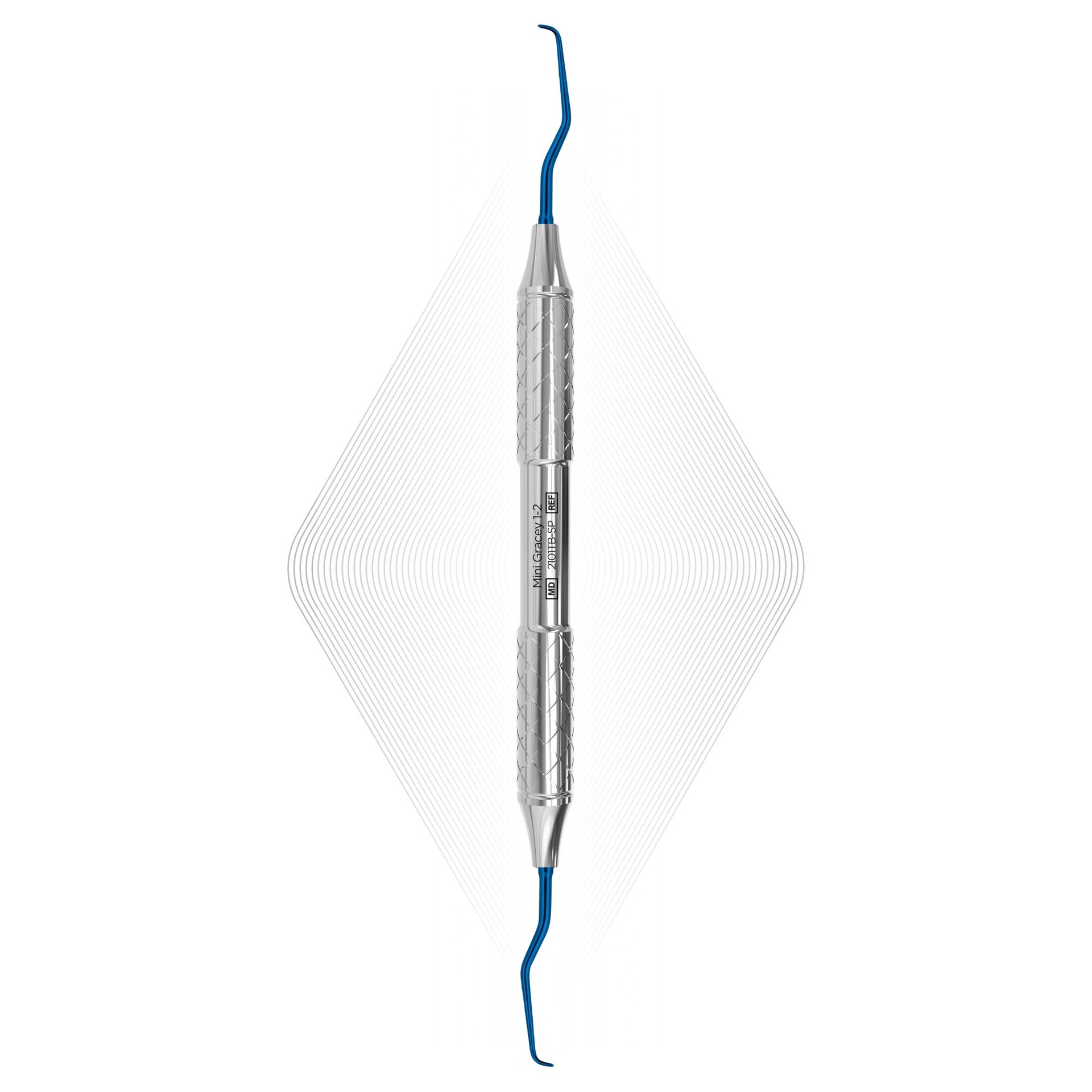
| Mini Gracey 1-2 (titanium) | Anterior implant subgingival maintenance |
| Mini Gracey 5-6 (titanium) | Premolar implant subgingival |
| Mini Gracey 7-8 (titanium) | Posterior buccal/lingual implant maintenance |
| Mini Gracey 11-12 / 13-14 (titanium) | Posterior mesial / distal implant maintenance |
The ErgoDenta blue-titanium implant range
- 2153TB-SP — Sickle Scaler H6-H7 Titanium
- 2156TB-SP — Sickle Scaler 204S Titanium
- 2157TB-SP — Sickle Scaler 204 SD Titanium
- 2101TB-SP — Mini Gracey 1-2 Titanium
- 2102TB-SP — Mini Gracey 5-6 Titanium
- 2103TB-SP — Mini Gracey 7-8 Titanium
Frequently asked questions
Why can I not use stainless steel instruments around dental implants?
Stainless steel is harder than titanium. Steel scaler edges scratch the implant surface, creating micro-grooves that trap bacterial biofilm and disrupt the titanium oxide passivation layer. This accelerates peri-implantitis. Use only titanium-coated implant-safe instruments around exposed implant surfaces.
What is the blue color on implant-safe scalers?
The blue color is from the titanium nitride (TiN) or titanium aluminium nitride (TiAlN) coating bonded to the working tip. It is visually distinctive so the assistant cannot accidentally hand the operator a steel scaler when titanium is needed. The coating matches implant hardness so it will not scratch the surface.
Are titanium instruments only for implants, or can I use them on natural teeth too?
Titanium-coated instruments work on both implants and natural dentition without damage. The trade-off: they are more expensive than steel and the coating eventually wears with sharpening. Many practices reserve titanium scalers exclusively for implant-patient appointments.
How often do I need to replace titanium implant scalers?
Replace when the working tip color changes from gold-blue to silver — that means the TiN coating has worn through and the steel base is exposed. With proper light-touch sharpening on a fine ceramic stone, a quality titanium scaler lasts 12-24 months in a busy implant maintenance program.
Can I use ultrasonic scalers around implants?
Standard steel ultrasonic tips will scratch implant surfaces just like hand instruments do. Use only PEEK (polyetheretherketone) coated ultrasonic tips, polymer tips, or titanium-coated ultrasonic tips around exposed implant surfaces.