Instrument Guide · Endodontics
Endodontic Hand Instruments — Pluggers, Spreaders & Combination Tips
Obturation is where the endodontic case is made or unmade — and the hand instruments you use to compact gutta percha into the canal directly influence apical seal quality. Here is the difference between pluggers, spreaders, and the combination tips that do both.
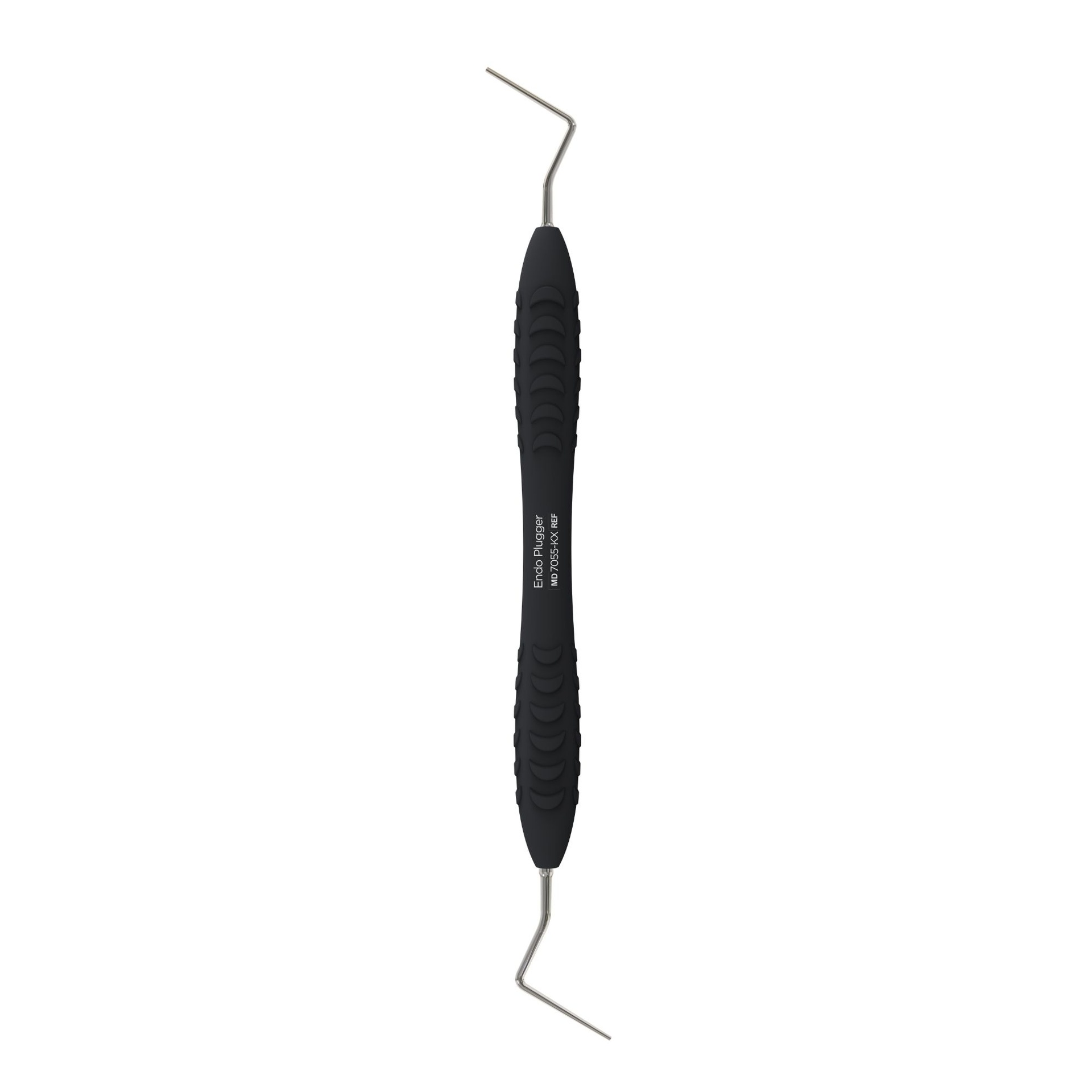
Pluggers vs spreaders
| Instrument | Tip | Force | Technique |
|---|---|---|---|
| Plugger | Flat, blunt | Vertical (apical-coronal) | Vertical condensation, warm GP |
| Spreader | Pointed, tapered | Lateral | Lateral condensation |
| Combination | Spreader + plugger | Both | Hybrid technique |
Lateral vs vertical condensation
- Lateral condensation — uses spreaders to push the master cone against the canal wall, creating space for accessory cones. Cold technique, simple, predictable.
- Vertical condensation (warm) — heated gutta percha is plugged apically with pluggers, condensed in waves down the canal. Better fill of canal irregularities.
- Hybrid — most modern endodontists use a combination of both, requiring both spreader and plugger tips on the tray.
The ErgoDenta endodontic obturation range
- Endo Pluggers — multiple sizes
- Endo Spreaders — multiple tip sizes
- 7056-KX — Endo Spreader 0.4 mm + Plugger 0.4 mm (combination)
- 7058-KX — Endo Spreader 0.6 mm + Plugger 0.8 mm
- 7059-KX — Endo Spreader 0.6 mm + Plugger 1.0 mm
Side by side
| Endo Spreader | Endo Plugger | |
|---|---|---|
| Tip | Pointed, tapered | Flat or slightly domed end |
| Motion | Apical + lateral, rotated on withdrawal | Straight vertical packing strokes |
| Technique | Cold lateral condensation | Warm vertical condensation, backfill packing |
| Goal | Space for the next accessory cone | Dense, void-free apical and coronal fill |
| Risk when misused | Wedging forces → vertical root fracture | Poor length control → extrusion |
Lateral condensation in four strokes
- Seat the master cone with tug-back at working length.
- Insert the spreader to 1–2 mm short of working length beside the cone with gentle apical pressure — finger pressure only.
- Rotate the spreader through 180° and withdraw; immediately place an accessory cone in the space.
- Repeat until the spreader penetrates no more than 2–3 mm. Sear off and pack the coronal mass with a plugger.
Frequently asked questions
What is the difference between a plugger and a spreader in endodontics?
A plugger has a flat blunt tip and applies vertical (apical) force — used to push gutta percha down the canal during vertical condensation. A spreader has a pointed tapered tip and applies lateral (sideways) force — used to push the master cone against the canal wall to create space for accessory cones during lateral condensation.
Why are spreader/plugger combination instruments useful?
Combination instruments have a spreader on one end and a matched plugger on the other, so a single double-ended tool covers both lateral and vertical condensation steps. This reduces tray size, instrument count, and switching time.
What size plugger should I use?
Match the plugger diameter to the prepared canal: 0.4-0.6 mm for the apical third in narrow canals, 0.6-0.8 mm for mid-canal work, 0.8-1.0 mm for the coronal third. Have at least 3 sizes on the tray and progress coronally as obturation builds up.
Are hand pluggers still used with modern obturation systems?
Yes — even with thermo-mechanical systems, hand pluggers are essential for the apical wave of condensation, for back-fill compaction, and for verification of obturation depth.
Can I autoclave endodontic pluggers and spreaders?
Yes — all ErgoDenta endo hand instruments are designed for full autoclave cycles at 134 °C. Inspect the tips for bending or fracture before each use; pluggers/spreaders that have been used to apply heavy lateral force can fatigue and fracture.