
Instrument Guide · Diagnostics & Surgery
Dental Tweezers Compared — College, Adson, Meriam, DeBakey, Micro Surgical
Tweezers sounds like one instrument — but a working dental tray needs at least three or four different designs. The grip, the serration, and the tip geometry determine whether you are holding cotton wool, a suture knot, or a 0.4 mm membrane fragment.
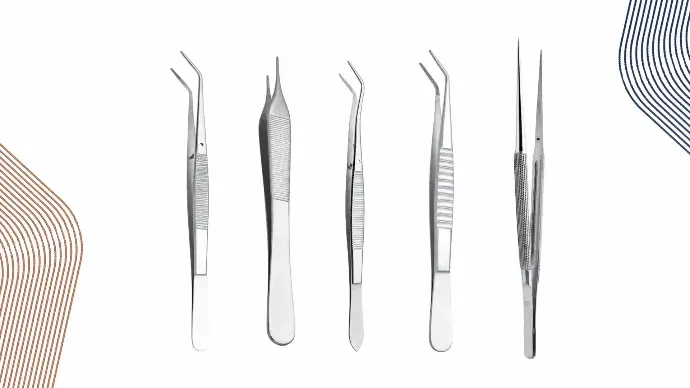
The five tweezer families
| Tweezer | Length | Tip | Use |
|---|---|---|---|
| College | 15 cm | Angled tip, serrated | Carrying cotton pellets, swabs, paper points |
| Adson | 12 cm | Wide flat tip, 1-2 teeth or serrated | Soft tissue handling during suturing |
| Meriam | 16 cm | Long, serrated Fig 1 | Deep field tissue grip, posterior access |
| DeBakey | 16 cm | Atraumatic ridged tip | Vessel and delicate tissue handling, no crushing |
| Micro Surgical | 15 cm | Ultra-fine, 1-2 or smooth | Microsurgery — implants, GBR, suture under loupes |
1x2 teeth vs serrated vs smooth
- 1x2 teeth — interlocking sharp teeth, grips tissue without slipping. Use for: skin/soft tissue handling during suturing.
- Serrated — fine cross-hatching on tip face, grips paper/cotton/cloth securely. Use for: cotton pellets, paper points, swabs.
- Smooth/ridged (DeBakey) — atraumatic, no perforation of tissue. Use for: vessels, friable tissue, microsurgery.
The ErgoDenta tweezer range
Frequently asked questions
What is the difference between Adson and DeBakey tweezers?
Adson tweezers have either 1x2 interlocking teeth or fine serrations and are designed to securely grip soft tissue during suturing. DeBakey tweezers are atraumatic with longitudinal ridges only, designed to hold delicate tissue (vessels, mucosa) without piercing or crushing.
Why are College tweezers angled?
The angled tip of a College tweezer keeps the operator hand out of the line of sight when picking up cotton pellets, paper points, or swabs. The angle also gives more posterior reach without rotating the wrist.
What does 1-2 mean on a tweezer?
1-2 refers to the tooth pattern at the tip: one tooth on one tine, two teeth on the opposing tine, interlocking when the tweezer closes. This pattern grips tissue securely without crushing — standard for surgical Adson and microsurgical tweezers.
Can I use the same tweezer for surgery and routine exam work?
Best practice is to keep them separate. Surgical tweezers (1-2 or fine teeth) get blunted faster on cotton fibres and dust during exam use. A dedicated College or Meriam tweezer for cotton/paper work, plus a separate Adson or micro-surgical for sterile soft-tissue handling, extends both instruments working life.
How do I check if my tweezer tips are still aligned?
Hold the closed tweezer up to a light. The tip surfaces should meet in a single straight line with no gap and no overshoot. Drop a sheet of paper between the tips and gently close — the tweezer should grip evenly along the full tip length. Misalignment of even 0.1 mm makes microsurgical work impossible.