Extraction · instrument guide
Elevators do most of the work in a good extraction – the forceps only finish it. But "elevator" covers several very different instruments. This guide explains the types of dental elevators by name, what each one is for, how an elevator differs from a luxating elevator, and how to build a sensible set.
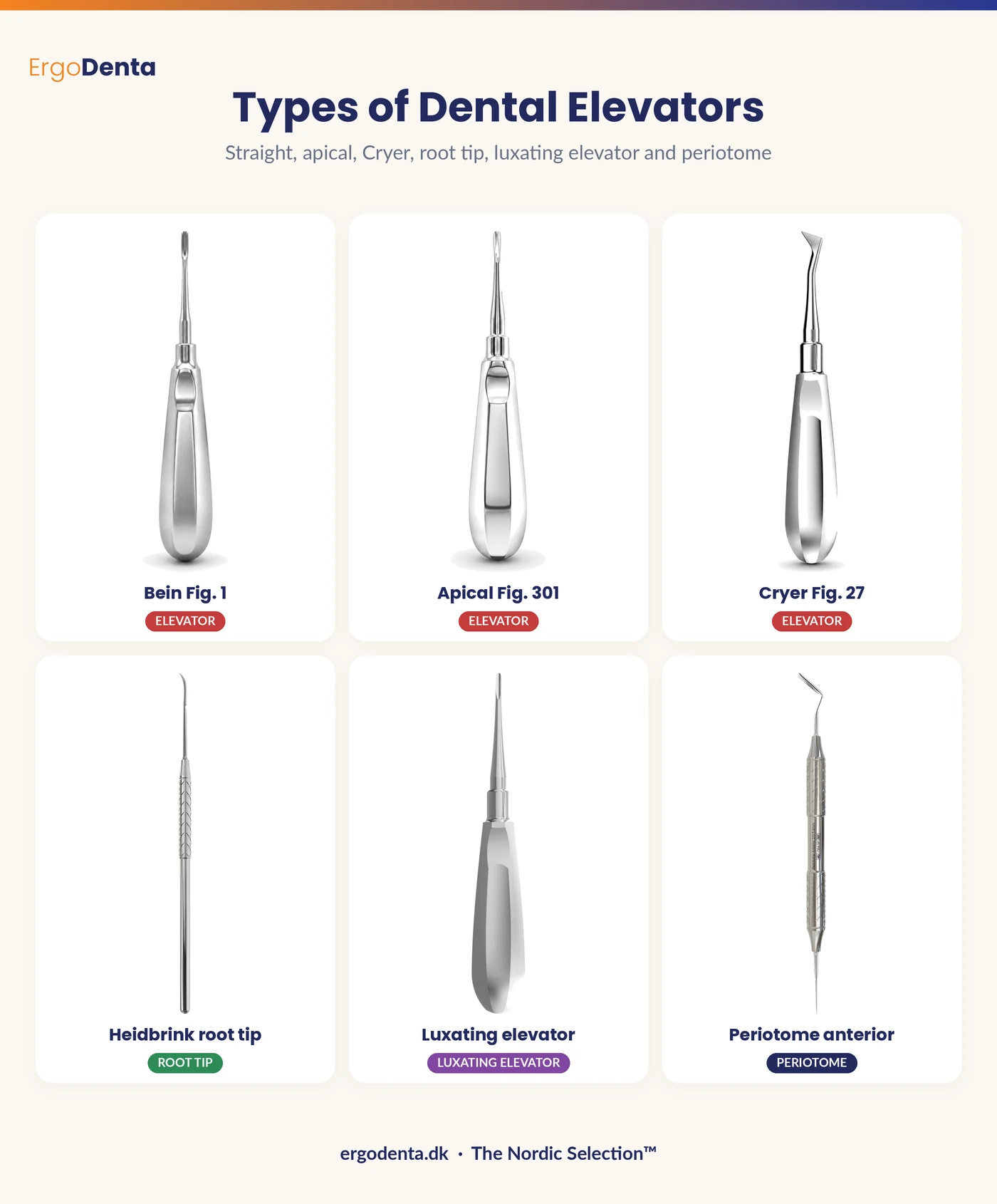
A dental elevator is a hand instrument used to loosen a tooth or root from its socket before, or instead of, forceps. The main types are straight elevators (Bein, Apical Fig. 301), angled apical elevators (Fig. 302/303), Cryer elevators (Fig. 27/28), root tip elevators (Heidbrink), luxating elevators and periotomes. Elevators work by wedging, rotation and leverage; luxating elevators have a thin, sharp blade that cuts the periodontal ligament and should not be used as a lever.
What is a dental elevator?
An elevator is placed between the root and the surrounding bone. It expands the socket, breaks the periodontal ligament (PDL) attachment and moves the tooth or root out. Used well, it reduces the force needed with the forceps – and with it the risk of fracturing the root, the crown or the buccal plate.
Every elevator has three parts:
- Handle – where force and control come from. A larger, balanced handle lets you work with a controlled palm grip instead of squeezing.
- Shank – straight, angled or contra-angled to reach different areas of the mouth.
- Blade (working end) – the part that enters the PDL space. Its width, curvature and sharpness decide what the elevator is good at.
How elevators work: three principles
| Principle | What happens | Typical instrument |
|---|---|---|
| Wedge | The blade is pushed into the PDL space parallel to the root, expanding the bone and displacing the root | Straight elevators, luxating elevators |
| Wheel and axle | The blade is rotated around its long axis to lift a root out of its socket | Cryer (triangular) elevators |
| Lever | The elevator pivots on a fulcrum to lift the root – the fulcrum must be bone, never a tooth that is staying | Straight and apical elevators |
Types & names
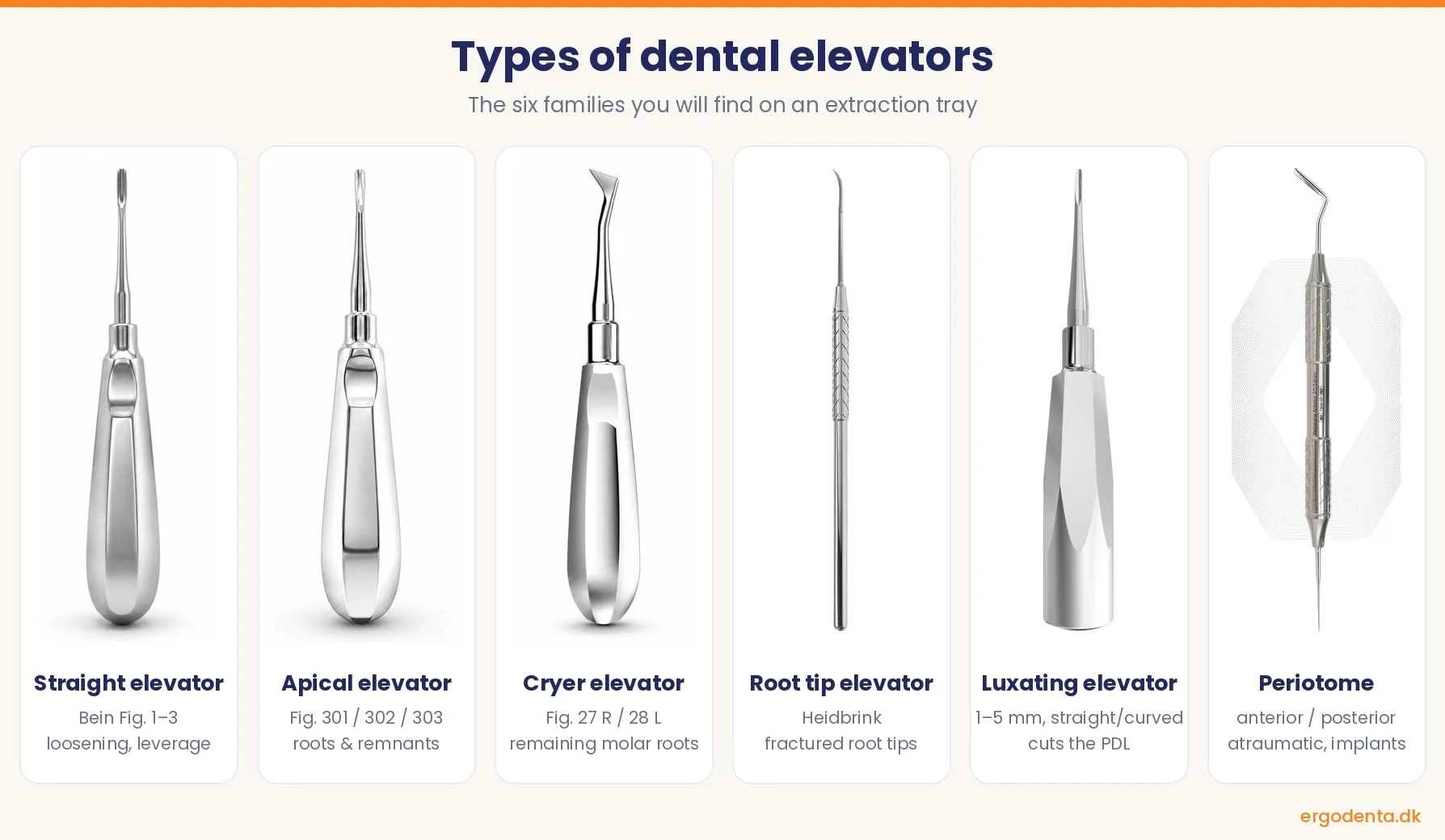
Types of dental elevators and their uses
| Type | Names / figures | Blade | Main use |
|---|---|---|---|
| Straight elevator | Bein Fig. 1–3, Apical Fig. 301, Bernard, Berten | Concave, straight | First instrument for loosening; single-rooted teeth and roots |
| Angled apical elevator | Apical Fig. 302 / 303, angled Bernard and Berten | Angled shank | Reaching posterior roots and root remnants |
| Cryer (triangular) | Cryer Fig. 27 (right) / 28 (left), Winter | Triangular, pointed | The remaining root of a multi-rooted tooth, working from the empty neighbouring socket |
| Root tip elevator | Heidbrink straight / right / left, 1.5 mm | Very fine | Lifting fractured root tips – not for heavy force |
| Luxating elevator | Straight and curved, 1–5 mm | Thin, flat, sharp | Cutting the PDL with gentle apical pressure – atraumatic extraction and socket preservation |
| Periotome & specialty | Periotome anterior / posterior, Appexo, Williger | Very thin | Separating PDL fibres with minimal force, e.g. anterior teeth and before immediate implants |
Swipe the table sideways →
 Bein Fig. 1Straight elevatorClassic first elevator.View instrument →
 Apical Fig. 301Straight apicalRoots and remnants.View instrument →
 Cryer Fig. 27RightRemaining molar roots.View instrument →
 HeidbrinkRoot tip, 1.5 mmFractured root tips.View instrument →
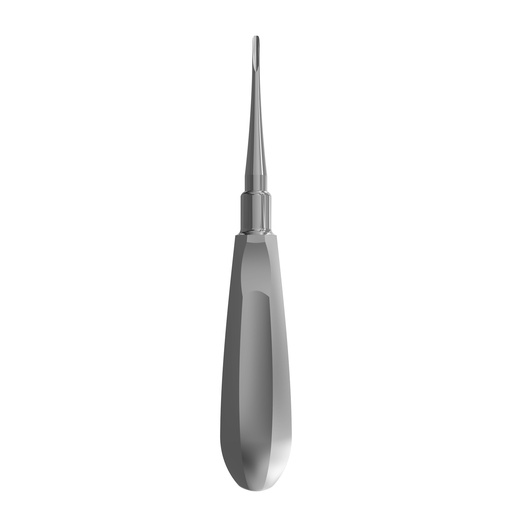 Luxating elevator 2.5 mmStraightCuts the PDL.View instrument →
 PeriotomeAnteriorAtraumatic separation.View instrument →
Shop by type: Root Elevators · Root Tip Elevators · Luxating Elevators · Periotomes & Specialty Elevators
Dental elevator vs luxating elevator: what is the difference?
They look alike, but they are used differently:
| Elevator | Luxating elevator | |
|---|---|---|
| Blade | Thicker, stronger, more blunt | Thin, flat and sharp |
| Action | Wedging, rotation and leverage | Cuts the PDL with gentle apical pressure and small side-to-side movements |
| Force | Takes controlled leverage | Must not be used as a lever – the fine tip can bend or chip |
| Best for | Lifting roots, root remnants, multi-rooted teeth | Atraumatic loosening that protects the socket walls and bone |
Many clinicians combine them: a luxating elevator first to cut the PDL around the tooth, then an elevator or forceps to deliver it. Using a luxating elevator as a lever is the most common reason tips get damaged. For the full atraumatic workflow, see our atraumatic extraction toolkit.
How to use a dental elevator safely
- Support the jaw and feel the movement – keep a finger of the other hand on the alveolar ridge. It tells you when the tooth moves and protects the tissues if the instrument slips.
- Seat the blade correctly – into the PDL space, with the concave side towards the root.
- Use bone, not teeth, as the fulcrum.
- Small, controlled movements – patience over power. If nothing moves, go back to luxation or reassess (sectioning, flap).
- Narrow first, then wider – start with a 1–2 mm blade and step up to 3–5 mm as the space opens.
- Check the tip – a dull or damaged luxating elevator tears instead of cutting. Inspect it before each use.
How to choose your elevators
A practical set for most general clinics:
- Straight luxating elevators in 2–3 mm and 5 mm – narrow to enter, wide to follow
- A curved luxating elevator of 3 mm for posterior teeth and difficult access
- A straight elevator – Bein or Apical Fig. 301
- A Cryer pair – Fig. 27 and 28
- Root tip elevators – Heidbrink straight, right and left
- A periotome if you do immediate implants or many anterior extractions
Colour coding saves time
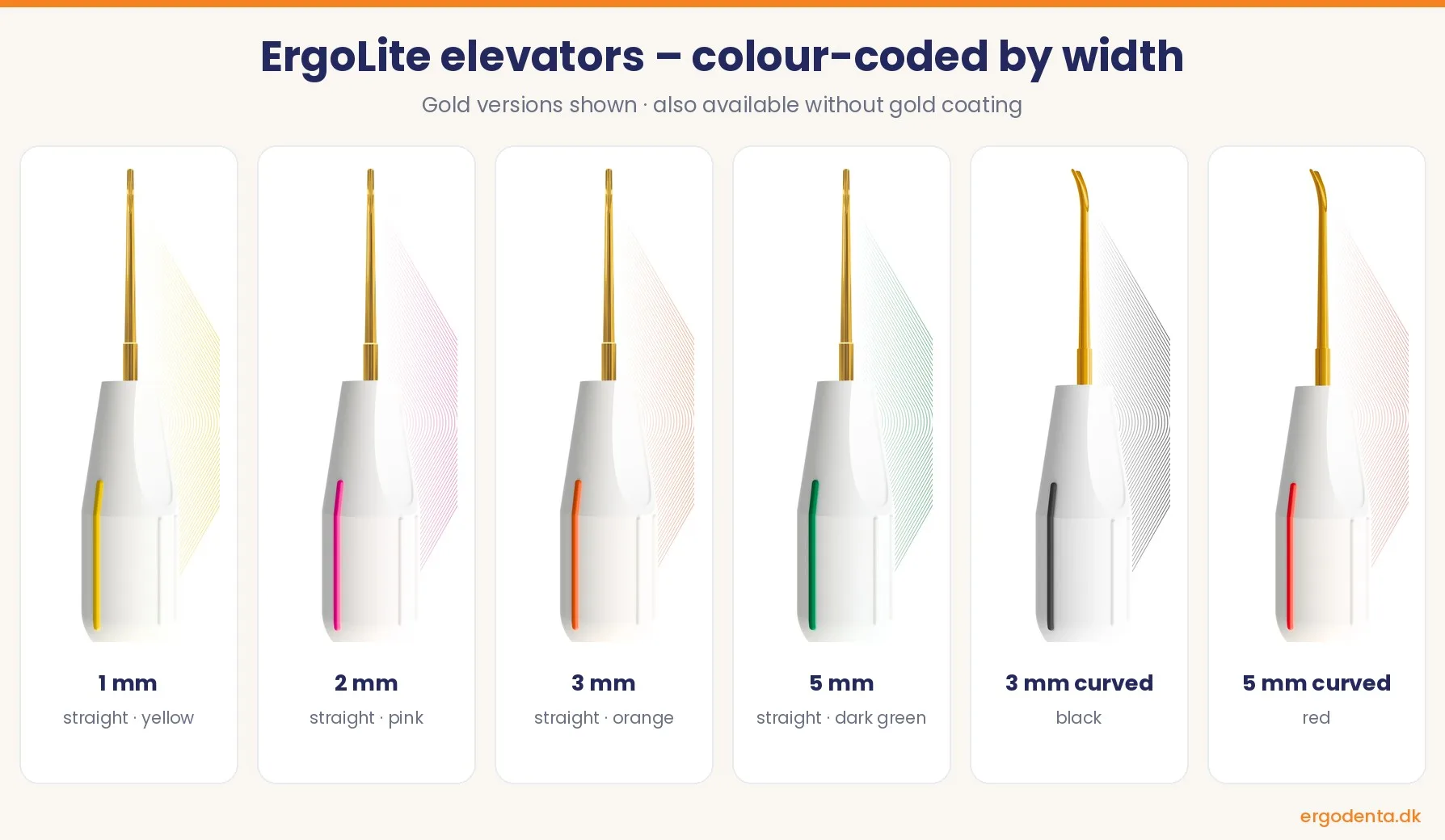
In the ErgoLite elevator range each width and blade form has its own handle colour, so the assistant can hand over the right one without reading the label. The lightweight, balanced ErgoLite handle is designed for controlled force. The range comes in straight, curved, inner-curved, contra-curved and dual-edge (3–1.5 mm, 5–3 mm) blades, with or without gold coating.



Care and sterilisation
Clean elevators straight after use, inspect the tip under good light and sterilise according to the instructions for use – see our reprocessing guide. Store luxating elevators so the tips do not touch other instruments; an ErgoTray or a cassette helps.
Questions
Frequently asked questions
What are the types of dental elevators?
Straight elevators (Bein, Apical Fig. 301), angled apical elevators (Fig. 302/303), Cryer elevators (Fig. 27/28), root tip elevators (Heidbrink), luxating elevators and periotomes.
What is the most commonly used dental elevator?
The straight elevator, such as the Bein or Apical Fig. 301, is the usual first instrument. Cryer elevators are the classic choice for remaining roots of molars.
Can I use a luxating elevator like an elevator?
No. A luxating elevator is designed to cut the periodontal ligament. Levering with it can bend or break the thin tip.
Which luxating elevator size should I start with?
Start with a narrow blade (1–3 mm) to enter the PDL space, then move to wider blades as the socket opens.
What is the difference between a dental elevator and a periosteal elevator?
A dental elevator loosens teeth and roots. A periosteal elevator, such as the Molt 9, lifts the gum and periosteum off the bone when a flap is raised – see bone curettes & periosteal elevators.
This guide gives general information about dental instruments for dental professionals. It does not replace clinical training or the instructions for use.